TL;DR: The best Namely alternatives depend on who you want to own compliance. Warp suits companies that want state registrations, filings, and tax notices handled for them. Gusto fits the simplest small-team payroll. Justworks suits companies that want a PEO provider.
Why companies are looking for Namely alternatives
Four reasons come up most when teams start comparing Namely competitors:
- State filing errors and slow fixes. Teams tell us filings arrive late or on the wrong schedule, such as quarterly when the state expects monthly, and the penalty notices that follow can take weeks or months to clear.
- Multi-state growth. Every new state means new tax accounts, registrations, and filing schedules, and many teams are unsure they are compliant in all of them.
- Support that runs on tickets. A common pattern is downloading the tax notice, opening a case, and waiting two to three weeks for a first reply. An account manager can escalate, but escalating is not the same as resolving.
- Manual workarounds. Teams still build commission and overtime calculations by hand in spreadsheets, including regular rate of pay in states like California.
If these pain points sound familiar, the next step is choosing the right platform for your needs.
How to choose a Namely payroll alternative
Most comparison pages rank tools by feature count. For payroll, a better filter is who does the work and who carries the risk. The alternatives below fall into four models:
- Fully automated, with compliance owned. The vendor registers state accounts, files forms, and answers tax notices for you. You keep your own EIN and stay the employer of record.
- Self-serve platforms. You get software and automation, and your team still handles setup, filings you need to approve, and agency mail.
- PEOs. The provider becomes your co-employer, files under its own tax IDs, and bundles benefits and workers' comp. PEOs often charge an administrative fee of roughly 3% to 15% of payroll costs, and you give up some control.
- Enterprise suites. Deep configuration and global reach, usually with longer implementations and quote-only pricing.
Ask each vendor these questions before you shortlist them: Who registers my new state accounts? Who responds when an agency sends a notice, and how fast? If a filing is wrong and I am fined, who pays? Can I keep my current benefits broker and the file feeds to my carriers? How are commissions and overtime handled, including regular rate of pay in states like California? Get the answers, and an implementation timeline, in writing.
The best Namely alternatives
1. Warp: best for companies that want compliance handled for them
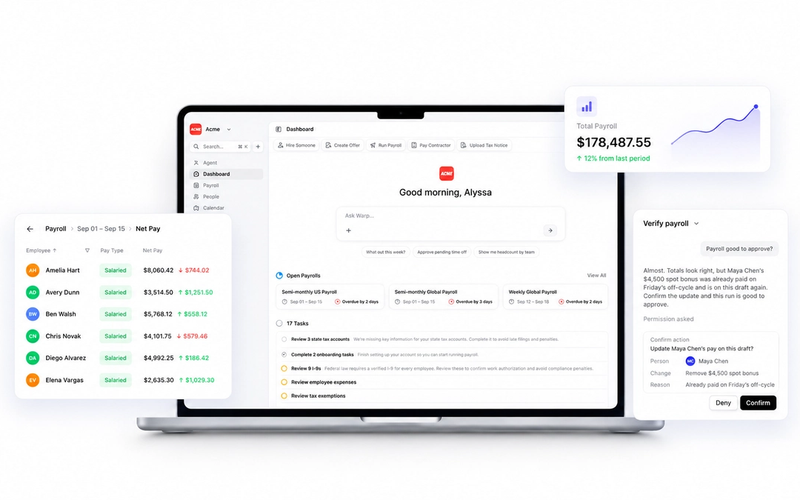
Warp is the HR & Payroll platform that runs on autopilot, built for ambitious companies. Instead of clicking through clunky dashboards or .gov websites for taxes, Warp's AI agents open every state tax account, file every payroll form, and resolve every tax notice - automatically.
With Warp, you'll never visit a government website, negotiate with tax agencies, or pay accountants $150 per filing.
Thousands of fast-growing companies trust Warp to stay compliant while they scale.
What this means in practice for a team leaving Namely:
- Compliance ownership. Warp takes on liability for its filings, responds to state agencies for you, and pays fines if a mistake traces back to its work.
- Automatic state setup. Add an employee in a new state, and the registration happens without a ticket from you.
- Low-disruption migration. Warp's white-glove migration pulls employee records, past payroll, and benefits data from Namely, so your team can validate instead of rekeying. You can keep your current benefits broker, or make Warp your broker of record so plans live in one place. See the switch guide for the full process.
Best for: teams that want compliance handled, with hands-on human support.
2. Gusto: best for simple, small-team payroll
Gusto is the default choice for many first-time business owners, and for good reason. Gusto's own comparison highlights multi-state payroll, a long integration list, and native compliance tools as the main differences from Namely. Setup is approachable and the product is easy to learn.
The tradeoff shows up with growth. In conversations with companies that moved off Gusto, the recurring theme is that compliance work still lands on the team: someone needs to read and respond to registrations, rate changes, and agency letters. Gusto also offers limited global payroll coverage, per its own guide. If you are weighing it against other tools, our breakdown of the top Gusto alternatives for scaling startups covers where teams hit that ceiling.
Best for: teams under roughly 25 people hiring in one or two states.
3. Rippling: best for companies with a dedicated HR team
Rippling pairs payroll with IT, device, and spend management in one modular platform. If you have an HR generalist or a People team that wants to configure approvals, permissions, and workflows, it is a strong tool.
The cost of that power is complexity. Many companies tell us there are too many modules, too many settings, and a self-service model that leaves configuration and compliance tasks with your team. We cover the unbundling question in 3 Rippling alternatives.
Best for: Companies that need in-depth customization.
4. HiBob: best for people-first HRIS buyers
HiBob is a modern mid-market HRIS with strong culture, engagement, and performance tools. It appeals to teams that care most about the employee experience layer. Because many HRIS-first platforms deliver payroll through add-ons or partners, ask exactly how payroll works in each state where you employ people, and who files when something goes wrong.
Best for: distributed teams that prioritize people analytics and engagement.
5. Justworks: best for teams that want a PEO
Justworks is a PEO, which means it becomes your co-employer, files taxes under its own IDs, and bundles benefits and workers' comp. For small teams with no HR function, that can remove a lot of admin. The tradeoff is control: you operate inside the PEO's systems and policies, and leaving later takes real planning. If you are weighing this path, read whether startups really need a PEO or EOR for payroll first.
Best for: very small teams that want bundled benefits and minimal admin.
Which Namely payroll alternative should you pick?
If you are a company hiring in more than one state and you do not want to carry compliance work, start with Warp. If you run a tiny team in one state and need the simplest tool, Gusto is a reasonable default. If you want someone else to be the employer for benefits and risk, a PEO like Justworks is the model to evaluate.
Whichever you choose, get the compliance answers in writing before you sign: who registers new states, who answers notices, and who pays if a filing is wrong.