A Head of People at a fast-growing 350-person company is launching a performance review cycle on Monday. On Friday afternoon, 4 new offers are signed, two in California and two in Colorado, and the company has never employed anyone in either state.
Before either hire can be paid, she has to register the company with two state revenue departments, open unemployment accounts, enroll in each state's paid leave programs, determine the local taxes for each address, and configure deductions, all before the first payroll. If she misses a step, a mail notice arrives about eight weeks later with a hefty penalty. The review cycle waits.
Introducing Warp Agent.
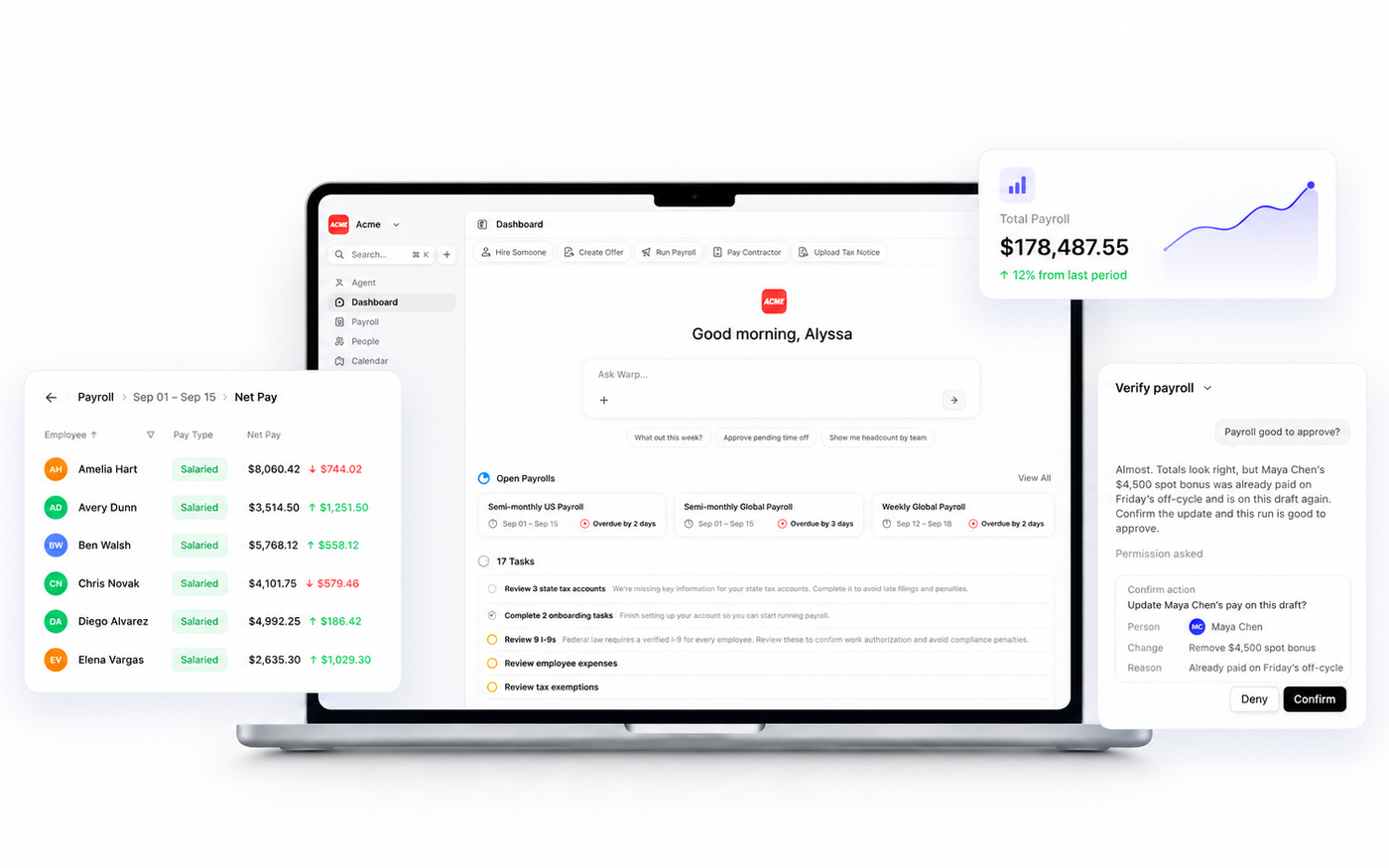
Warp Agent runs people ops for your company. It onboards new hires, handles tax compliance, enrolls people in benefits, sets up and enforces your company policies, and answers your team’s questions about pay and policy, all without waiting to be asked. It knows every employee's role, location, compensation, and benefits, and it works within the same permissions as the person it acts for. When a task requires a human, it brings in your company’s employees or a Warp specialist to finish it.
The Second Job
People and HR teams are asked to do two jobs. The first is the one they were hired for: build the culture, set talent strategy, run performance, make compensation fair, and keep the company compliant and financially sound. The second is the one that fills their calendar: dealing with tax agencies, tracking withholding and filing returns, enrolling benefits and reconciling carrier invoices, provisioning laptops and revoking accounts, and answering the same PTO question forty times a year. At a large company, the second job is a department. At a small one, it belongs to the founders at night.
The second job is why these teams are so often treated as cost centers. They absorb the operational burden of employing people, and the work that would make them strategic never gets the hours.
We think no person should do the second job. It is procedural, repetitive, and high-volume, and it consumes the time of the very people who are supposed to be building the human side of the company. At Warp, our goal is to make HR human again: remove the operational work entirely so people teams spend their time on people.
This is the reason Warp exists. Most employee management software was built to help a person do the second job faster. Warp was built to eliminate it. We started in 2023 with a focus on automating payroll tax compliance, the hardest version of the problem, because removing it from a human's plate completely would prove the path for everything else.
Since then, Warp has grown 7X year over year, saved customers $200M+ in tax penalties, and is on track to process $2 billion+ in payroll volume this year. We are proud to serve some of the world’s fastest growing AI-native companies like Serval, Greptile, Bland, Corgi, Numeral, Rillet, Campfire, who are running sophisticated people ops with just 1 or 2 full-time People ops hires.
Speeding up the wrong job
Most AI in business software is a chat interface on top of a dashboard. You ask a question and get an answer. You ask for a change, and it drafts the change for you to approve. This makes a person somewhat faster at work they still have to do. In our experience, the gain is around 20%, and the second job is still theirs to own.
An agent that can actually own the work removes this entirely. This requires four things: full context on the business and the people in it, the trust & authority to complete the task, the ability to run without being prompted, and a clear audit record of what it did.
A chatbot helps you do the work. An agent does the work, owns the outcome, and reports back.
Warp 2.0: an agent that finishes the job
Today, we’re launching Warp Agent – a powerful, always-on agent that can take entire end-to-end workflows off your plate, and our biggest platform leap yet.
Warp Agent comes with a powerful new feature:
Routines, jobs it owns and runs when something happens in your company or on a schedule. Most Routines are automatically enabled. When an offer is signed, the agent registers you in the new state, sets up payroll, enrolls benefits and 401k, orders the laptop, creates the Google and Slack accounts, and sends the first-day message. When a tax notice arrives, it resolves it. Before every payroll, it checks for variances. You can also write your own Routines in plain language: send every new hire a 30-day check-in and summarize it for their manager, or put headcount and payroll cost by state in the CFO's inbox every Monday. Each Routine has its own autonomy setting and a log of every run, so you can see what the agent did and why.
The agent uses the same permissions model that governs people in Warp, and it cannot see or do anything the person it acts for cannot. It has full context on each employee: role, location, compensation, tax profile, benefits, manager, device, and change history. This is what lets it act across systems without being told which systems are involved.
It knows who is asking. An exec, a Head of People, and a sales rep get different scopes and defaults.
It learns from your decisions. Approvals and overrides change how it handles the next case at your company.
When it reaches something only a person can do, a person does it. For example, some tax portals still require a human with Power of Attorney to make a phone call. In those cases, the agent brings in a Warp tax specialist, who makes the call and closes the case.
Trust, security, and governance – built in from day one
An agent running employee operations touches the most sensitive things a company has. It moves payroll. It holds compensation, Social Security numbers, home addresses, and health plan elections. It grants and revokes access to company systems. It changes employment records that carry legal weight. Mistakes in any of these are expensive, and some are hard to reverse, so the agent operates under the same controls we would demand of a person with that level of access, and a few that a person could never offer.
Every action the agent takes has an identity, a scope, a written rationale, and a rollback. It works only within the permissions of the person it is acting for. Money movement has hard limits the agent cannot change. Each company sets, per workflow, whether the agent recommends, acts after approval, or acts on its own. Most customers start with approval and expand autonomy as they review the log.
We designed these controls before we wrote the first agent, and we have run them on the highest-stakes workflow in the category for three years. That is why we are comfortable extending the agent to everything else.
What will you do with all the time back?
Think about last week. How many hours went to enforcing policies, benefits enrollment forms, laptop orders, payroll corrections, tax notices, and questions about PTO balances? For most people teams at a 100 to 1000 person company, that is most of the week. For most founders below that size, it is the part of the week that happens after dinner.
Now imagine that time is yours again. You run the amazing performance review cycle you have been postponing for two quarters. You spend a full day with a struggling manager instead of a full day with a state tax portal. You build the compensation bands, fix the onboarding experience, close the books on time, and answer the strategic question your CEO asked you in March.
That is what Warp is for. The Head of People can launch her review cycle on Monday. Her two hires are registered, enrolled, equipped, and paid, and she found out because the agent told her it was done.
What’s next
For decades, software platforms have been built for humans to click through. That is changing. Within a year, we expect the majority of actions on Warp to be taken by agents, both ours and our customers' own. We built the API, permissions model, and audit layer for this from the beginning.
The incumbents did not. Workday, ADP, and newer but still last-gen companies like Rippling were all built for an era where every workflow assumed a person at the keyboard. An AI assistant added on top inherits every limitation of the system underneath it.
Building for agents from the ground up compounds differently. Model improvements help, but the bigger gain comes from the work itself. Every workflow Warp Agent takes on gives it more context about how your company operates and more of the employee lifecycle under its control, so the next workflow is easier to automate than the last. An assistant on a dashboard never gets that.
Warp 2.0 is rolling out today. Admins with questions about setup can book time with their account manager, and anyone not yet on Warp can request a demo.