
This guide breaks down how startup founders should pay themselves in 2026 using real salary data, investor expectations, and runway math. It explains what “reasonable” founder compensation looks like by stage, role, and context, and why both extremes can hurt credibility and focus. The piece also offers a simple framework to set pay confidently without risking burnout, investor trust, or compliance issues.
We'll cover:
- Founder salary benchmarks by funding stage
- How investors interpret founder pay decisions
- Factors that influence compensation (role, location, company stage)
- Common founder pay mistakes that impact runway or trust
- Legal and compliance considerations around “reasonable compensation”
- A practical framework for setting and justifying founder salary
Nobody warns you about this part.
You've spent months fundraising, pitched dozens of investors, and finally closed your round. The wire hits. And then someone asks the question you've been avoiding: "So, what are you paying yourself?"
If you're like most founders, you have no idea. You've heard horror stories about founders who took too much and burned investor trust. You've also heard about founders who took nothing and burned out. The "right" answer feels like a moving target.
Here's the thing: founder compensation isn't actually that complicated once you have data. The problem is that nobody talks about it openly, so most founders are flying blind.
This guide breaks down what the numbers actually say, what investors think (not what they tell you in pitch meetings), and how to set a salary that keeps you focused on building without torching your runway.
The State of Founder Salaries in 2026
Whether you search for 'founder salary' or 'startup CEO salary,' you're asking the same question, since the founder holds the CEO title at nearly every venture-backed company. The benchmarks below apply either way.
Let's start with the benchmarks. Kruze Consulting's 2026 Startup CEO Salary Report analyzed payroll data from over 450 venture-backed startups. Unlike survey-based reports where founders might exaggerate or lowball, this is actual payroll data.
Average founder salary by funding stage:
| Funding Stage | Average Salary (2025) |
|---|---|
| Seed | $153,000 |
| Series A | $203,000 |
| Series B | $216,000 |
The overall salary average hit $165,000 in 2026, up from $161,000 in 2025 and $141,000 in 2024. Median sits at $159,000. That's a significant jump after two years of decline, and it tracks with the broader fundraising recovery. PitchBook's 2026 US Venture Capital Outlook projects U.S. venture fundraising to reach $100-130 billion this year, continuing the rebound from $71 billion in 2024.
What Investors Actually Think About Founder Pay
Here's what VCs won't say in your pitch meeting but absolutely discuss in partner meetings: your salary is a signal.
Too high, and you look like you're treating venture capital as a lifestyle subsidy. Too low (or zero), and you look like a burnout risk who might be driving for Lyft on weekends to make rent.
The sweet spot? A seed-stage founder taking $140,000-$160,000 from a $3M raise barely registers. That's table stakes. Taking $250,000+ from the same raise? That's a conversation. Taking $0? That's also a conversation, just a different one.
Experienced investors know that monetary stress kills focus. Founders experiencing financial stress are going to be distracted. VCs would rather you take a reasonable salary and stay locked in than take nothing and flame out in 18 months.
The red flags investors actually watch for:
Taking too much too early. If your salary consumes 8-10% of the raise, you're going to get questions. At seed, total founder comp (all founders combined) should probably stay under 5-8% of annual burn.
Dramatic increases without milestones. Doubling your salary right after closing a round looks opportunistic. Phasing in increases tied to hiring goals or revenue milestones looks like good judgment.
Zero salary as a flex. Some founders think taking no salary signals commitment. Most investors read it as poor planning or a sign you'll need to consult on the side. Neither is good.
Location Still Matters (But Less Than It Used To)
San Francisco and New York founders historically commanded 10-20% premiums over the national average. That gap is narrowing.
According to Pilot's research, remote work fundamentally changed the equation. Founders now set pay based on company finances and stage, not zip code. A seed-stage founder in Austin isn't automatically taking less than one in SF anymore. The benchmark is the benchmark.
That said, if you're hiring a local team in a high-cost market, you might justify a higher salary based on personal cost of living. Just be prepared to explain the logic if asked.
The AI Founder Premium
One pattern worth noting: AI founders are paying themselves more than the median.
Pilot's 2025 data shows AI founders (now 40% of their survey respondents, up from 14% last year) taking a median salary of $90,000. That's higher than the overall median despite AI startups often being earlier stage.
Why? A few reasons. AI startups tend to raise larger rounds earlier due to infrastructure costs. Investors remain enthusiastic about the category and are less price-sensitive on founder comp. And the talent market for AI founders is brutally competitive. Companies that want to keep their founders focused (rather than fielding recruiter calls) are willing to pay for it.
IRS Reasonable Compensation: The S-Corp Trap
If your startup is structured as an S-Corp (or an LLC taxed as an S-Corp), you need to know about "reasonable compensation."
The short version: the IRS requires S-Corp shareholder-employees to pay themselves a fair market salary before taking distributions. Distributions skip payroll taxes (that 15.3% for Social Security and Medicare). Salary doesn't. So there's an obvious temptation to minimize salary and maximize distributions.
The IRS knows this game and audits for it. If they determine your salary was unreasonably low, they can reclassify distributions as wages and hit you with back taxes, penalties, and interest.
What counts as "reasonable"? The IRS looks at your role, experience, time commitment, company revenue, and what comparable businesses pay for similar work. The "60/40 rule" (60% salary, 40% distributions) that floats around online? The IRS has never endorsed it. Your comp needs to reflect market rates, not an arbitrary split.
The good news: if your company genuinely can't afford to pay market rate, that's defensible. Document your reasoning. As revenue grows, your salary should grow too.
The Gender Pay Gap Is Real (But Shrinking)
This one's uncomfortable but important. Kruze's 2025 data shows female startup CEOs earn about $11,000 less than male CEOs on average.
The encouraging news: the gap is shrinking. It peaked at $45,000 in 2020 and has declined every year since. Female CEO salaries increased 17.8% year-over-year in 2025 versus 13.9% for male CEOs.
Transparency helps. The more founders talk openly about compensation (and the more data gets published), the harder it becomes to justify disparities. If you're a female founder, benchmark aggressively and don't undersell yourself. If you're an investor, pay attention to whether the founders you back are compensated equitably.
Common Mistakes to Avoid
Mistake #1: Not paying yourself at all pre-profitability. Once you've raised institutional capital, pay yourself. Period. The martyrdom play backfires.
Mistake #2: Benchmarking against big tech. Your friend at Google makes $400K. You're not at Google. Startup comp includes equity upside that big tech salaries don't. Compare apples to apples.
Mistake #3: Ignoring the co-founder conversation. If you and your co-founder have different expectations about comp, surface it now. Not after the round closes. Not after resentment builds.
Mistake #4: Spiking salary right after funding. Phase it in. Tie increases to milestones. Don't give your investors a reason to question your judgment in the first board meeting.
Mistake #5: Forgetting about runway math. Your salary isn't just about you. It's about how long your company can operate. Do the math backward: if you need 24 months of runway, what does that mean for total burn, and what's your share of it?
How to Set Your Salary: A Simple Framework
Here's the framework we recommend:
Step 1: Start with the benchmark for your funding stage ($147K for seed, $203K for Series A, $214K for Series B).
Step 2: Adjust for your role. If you're CTO, not CEO, knock off 10-15%.
Step 3: Adjust for location if you're in a high-cost market with a local team.
Step 4: Sanity-check against runway. Does your total founder comp (all founders) stay under 5-8% of annual burn at seed? Under 10% at Series A?
Step 5: Document your logic. If you're an S-Corp, this matters for IRS purposes. Even if you're not, having a clear rationale helps when board members ask.
Frequently Asked Questions
What's the average startup CEO salary in 2026?
Same number as founder salary, since at most startups the founder holds the CEO title. Kruze Consulting's 2026 benchmarks put the average at $153,000 for seed-stage CEOs, $203,000 at Series A, and $216,000 at Series B, with an overall average of $165,000 across stages.
Is "founder salary" the same as "CEO salary"?
For nearly every venture-backed startup, yes. The founder is the CEO, so "founder salary" and "startup CEO salary" describe the same paycheck. The benchmarks in this guide apply either way.
How much do startup CEOs pay themselves at seed stage?
Most seed-stage CEOs pay themselves between $130,000 and $170,000 a year, averaging $153,000 in 2026. The right number depends on your burn rate: keep total founder compensation under 5-8% of annual burn.
What's a typical Series A or Series B CEO salary?
Series A CEOs average $203,000, and Series B CEOs average $216,000, per Kruze's 2026 benchmarks. Boards start asking harder questions once total compensation climbs past 8-10% of the round raised, so treat these as a ceiling to justify, not a floor to hit.
How does a tech or AI startup CEO's pay compare?
Tech and AI-focused founders trend at or above the broader average, mostly because they raise larger early rounds. Pilot's research found AI founders taking a median salary of $90,000, higher than most non-AI seed-stage peers, driven by bigger check sizes and investor appetite for the category.
Does the IRS treat CEO salary differently than founder salary?
No. If your company is structured as an S-corp, the IRS requires "reasonable compensation" for any shareholder-employee performing services, CEO title or not. Document your reasoning (role, time commitment, comparable market pay) regardless of which term is on your business card.
The Bottom Line
Founder compensation isn't a mystery. It's a math problem with known inputs: your funding stage, your role, your location, and your runway.
The founders who get this right aren't the ones who take the most or the least. They're the ones who set compensation thoughtfully, document their reasoning, and adjust as the company grows.
Pay yourself enough to stay focused but not so much that you're burning trust or runway. And please stop guessing. The data is out there. Use it!
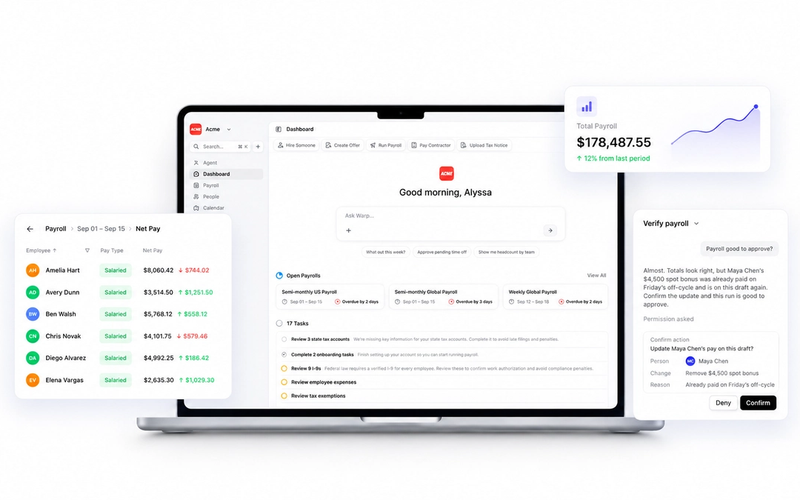
Warp is built for ambitious, fast-growing companies. AI agents handle payroll, compliance, and benefits so your team doesn't have to. Get started in 10 minutes.