
Originally Published June 2024. Last Updated July 2026.
If they want their startup to succeed, founders must take advantage of every opportunity they get. However, many first-time founders don't realize that how you structure your startup can sometimes give you a meaningful advantage. Especially when it comes to raising venture capital, issuing equity to employees, and qualifying for tax benefits like Qualified Small Business Stock (QSBS).
Limited liability companies (also known as LLCs) and C corporations (commonly referred to as just corporations) are two of the most popular ways to structure a new startup in the United States. However, their features and characteristics make each one ideal in certain scenarios.
As a startup founder, it's crucial to understand the differences between these two entity types. Your chosen structure impacts your business operations, tax responsibilities, and even your growth potential. So, if you're thinking about establishing your startup in the state of Delaware, this guide will walk you through which business entity type you should choose. We'll cover:
- Why Delaware is the top choice for startups
- What Delaware C corporations and LLCs have in common
- Four important differences between Delaware LLCs and C corporations
- A quick comparison table
- Which structure is right for your startup
- What about S corporations?
Why should you establish your startup in Delaware?
In addition to the benefits your startup receives by structuring it as an LLC or corporation, forming it in Delaware offers some unique advantages.
In addition to the state's low corporate taxes, startups established in Delaware have access to favorable business tax and regulatory laws as well as a dedicated court system for businesses known as the Court of Chancery. This is why many business owners and startup founders (plus 68.2% of Fortune 500 companies) choose to establish their headquarters in the Diamond State.
However, determining whether a Delaware LLC or C corporation is the best choice for your startup depends on several factors. In the next few sections, we'll compare the defining characteristics of each business entity type to help you choose the one that best fits your startup's needs.
What do Delaware C corporations and Delaware LLCs have in common?
Liability protection for owners and shareholders
One of the biggest draws for these two entity types is the protection they grant their owners and investors from the company's debts and other financial obligations. If your startup owes lenders money, they can't go after your personal assets to settle the debt. They can only go after the assets your business owns.
Perpetual existence
Both types of businesses will exist indefinitely once they're established unless the startup's operating agreement or articles of incorporation state otherwise. Even if the original owners or members of the organization leave or retire, companies structured as LLCs or corporations will continue to exist until they're dissolved.
However, to maintain their existence, both entity types must pay franchise taxes to the state each year.
Ownership requirements
Both entity types offer unrestricted ownership, meaning they allow for multiple owners or shareholders. Although there are instances where an LLC or corporation may be owned and operated by one person, there is no limit to the number of people (or entities) that can own a business structured as one of these entity types in the state.
There are also no citizenship or residency requirements for the owners of LLCs or C corporations. Anyone can form one of these business entities in the state of Delaware --- even if they are a resident or citizen of another country.
Quick and easy business formation
Finally, LLCs and C corporations are highly sought after partly because they're easy and affordable to set up --- especially compared to the formation process required by some other states.
Filing to form an LLC or corporation in Delaware can take about three to five business days, although it's also possible to establish your startup there in less than an hour with the state's same-day filings.
Filing fees are relatively affordable too. It costs $110 to file for an LLC, while the filing fee for corporations starts at $109.
LLC vs. C Corp: Quick Comparison
| Delaware LLC | Delaware C Corp | |
|---|---|---|
| Liability Protection | Yes | Yes |
| Formation Cost | $110 | From $109 |
| Annual franchise tax | $300 flat | $175+ (based on shares) |
| Taxation | Pass-through (default) | Double taxation |
| VC fundraising | Limited | Yes - required by most VCs |
| Stock options / equity comp | No | Yes |
| QSBS Eligibility | No | Yes |
| IPO-eligible | No | Yes |
| Board of directors required | No | Yes |
| Annual report required | No | Yes |
| Conversion to C corp | Possible | N/A |
Four important differences between Delaware LLCs and C corporations
Company structure and governance
One of the most significant differences between Delaware LLCs and their C corporation counterparts is how these entities are structured and governed.
Corporations follow a three-tiered structure that includes shareholders, directors, and officers. Each tier of governance has its own duties and responsibilities. Shareholders own a portion of the company by purchasing stock --- this grants them the ability to vote on certain business decisions, including who sits on the board of directors. Shareholder voting power is determined by the number of shares each shareholder owns.
The board of directors, in turn, chooses the officers who manage the corporation on a day-to-day basis. Directors make most of the company's decisions, although some changes --- including changing the business's name or increasing the amount of authorized stock --- can only be made by amending the company's certificate of incorporation.
However, as we'll see later, a corporation's statutes dictate much of its operations. They can't be changed by the company's shareholders, directors, or officers.
LLCs, on the other hand, are structured more simply. Each one is operated by one or more members of the company, or the members can hire a third-party manager to run the business for them.
All LLCs are required to have an operating agreement, a contract that outlines how the company is structured and run. This document can be as complex or as simple as the LLC owners want, giving the members much more freedom and flexibility than they would if they had incorporated their startup as a C corporation. The operating agreement establishes the voting rights of the LLC members, and the agreement itself can be directly changed if needed.
Business taxes
Corporations are treated as separate entities from their shareholders. Startups structured as this entity type are taxed at the corporate income rate on all income they receive, while shareholder distributions are taxed at the individual's personal income tax rate. This is known as double taxation.
Some workarounds exist for the double taxation issue, such as structuring your startup as an S corporation instead of a C corporation. If you're interested in learning more, visit the Delaware Division of Corporations website for details on how to set up an S corporation in the state.
Although LLCs can be taxed as a C corporation or S corporation, they also allow single-member LLCs to pay taxes through their owner's personal tax returns. Any profits made by these LLCs are taxed at the owner's individual income tax rate, and the LLC itself doesn't pay any income taxes. This is called pass-through taxation.
Delaware corporations and LLCs are also subject to annual franchise taxes, which certain business types must pay to operate within the state. The amount you pay depends on how you structure your business.
Delaware LLCs pay a flat fee tax of $300. The amount corporations are liable for depends in part on the number of shares they have issued. Generally, though, the minimum amount corporations pay in franchise taxes is $175.
Ability to raise capital
As mentioned earlier, corporations sell stock to shareholders to raise capital for their operations. In exchange, they grant shareholders partial ownership of the company and a portion of its profits in the form of dividends. Corporate shareholders also have the power to issue and sell more stocks to raise additional capital for the company.
Corporations can conduct these transactions privately or sell stock publicly on a stock exchange. So, if you plan on taking your startup public, you'll need to structure it as a corporation first.
Unlike corporations, Delaware LLCs are not allowed to issue shares of ownership in the company. As a result, they can't sell stocks on a public stock exchange either.
Compliance requirements
Corporations formed in Delaware have fewer compliance requirements than those in other states. For instance, Delaware corporations allow one person to act as officer, director, and shareholder simultaneously --- a privilege not available to corporations in other states.
However, they are still subject to certain requirements, including filing an annual report each year and holding meetings with shareholders at least once every 13 months.
LLCs formed in Delaware have fewer organizational requirements than C corporations. Since they don't have a board of directors, there is no need for board meetings, records of meeting minutes, or annual reports. This gives LLC owners much more flexibility in operating their startups.
Delaware corporations also follow stricter guidelines than LLCs when it comes to the confidentiality of their owners' personal information. For instance, corporations in the state must disclose the names and addresses of their directors and at least one officer --- which means this information becomes available in the public record.
LLCs aren't required to follow this rule, however. The only information these entities must disclose is their registered agent's name and address.
Should you structure your startup as a Delaware LLC or C corporation?
Many new business owners start out with an LLC, since there are fewer requirements and processes to follow compared to corporations. Corporations are also more expensive to run than their LLC counterparts, which is another reason first-time founders first structure their company as an LLC.
C corporations are best for startups that are experiencing high growth and can take full advantage of all the benefits this type of business entity can offer, such as selling stock to raise capital. After all, corporations come with more compliance requirements and administrative responsibilities, ones that smaller organizations may not feel ready to take on just yet.
Also note that many angel investors and venture capitalists require the companies they invest in to be structured as corporations. So, if you plan on selling stock right out of the gate, a corporation may serve you better than an LLC.
But keep in mind that you're not confined to the same business structure you start with. It's simple to change your startup from an LLC to a corporation. And while going from a corporation to an LLC may require more paperwork, it's certainly possible to do so too.
Many startups first structure their business as an LLC to take advantage of the flexibility and short-term financial savings this type of business entity offers. These benefits can often be the difference between failure and success for many early-stage startups.
Then, once you have the appropriate infrastructure in place, turn your startup into a corporation to benefit from the long-term savings and fundraising opportunities this entity type offers.
One important caveat on converting later: While converting from an LLC to a C corp is straightforward on paper, it can trigger unexpected tax events and restart the QSBS five-year holding clock. If you think you'll want QSBS eligibility down the road, starting as a C corp from day one is often the cleaner path. Talk to a startup attorney before assuming you can defer the decision.
What about S corporations? Some founders ask whether an S corp is a middle ground between LLC and C corp. For most venture-backed or growth-oriented startups, it's not. S corps cannot have more than 100 shareholders, cannot issue preferred stock (which VCs require), and cannot have foreign shareholders: limitations that make them a poor fit for most startups raising outside capital. S corps can make sense for profitable small businesses where pass-through taxation is the priority and VC funding is off the table.
Frequently Asked Questions
Is a Delaware C corp or LLC better for raising venture capital?
A Delaware C corp is required by virtually all venture capital firms and institutional investors. VCs need preferred stock (which only C corps can issue) and don't want pass-through tax liability. If you plan to raise a seed round or beyond, structure as a C corp from the start.
Can I convert my Delaware LLC to a C corp later?
Yes, and many founders do. However, conversion is not always tax-neutral. It can trigger capital gains, restart the QSBS five-year holding clock, and add legal fees. If you think a C corp is in your future, starting there is often simpler than converting later.
What is QSBS, and does it apply to my startup?
Qualified Small Business Stock (QSBS) is a federal tax benefit under Section 1202 that lets founders, employees, and investors in qualifying C corps exclude up to $10 million in capital gains on a stock sale. To qualify, the company must be a C corp, have gross assets under $50 million at the time of issuance, and shareholders must hold the stock for at least five years. LLCs are not eligible.
Do Delaware LLCs pay less in franchise tax than C corps?
Generally, yes. Delaware LLCs pay a flat $300 annual franchise tax due June 1. C corporations pay a minimum of $175 in franchise taxes, but the amount can scale significantly based on the number of authorized shares. Startups that authorize large share counts (common for option pools) often pay more. The annual report filing fee for C corps is an additional $50.
Does the state I operate in matter if I incorporate in Delaware?
Delaware is the state of incorporation, but you'll still need to register as a foreign entity and pay taxes in any state where you operate or have employees. Most startups incorporate in Delaware for the legal framework and investor familiarity, then register in their home state separately. If you're managing payroll across multiple states, multi-state payroll compliance becomes an important operational consideration as you grow.
Put your startup's admin work on autopilot with Warp
When you establish a business, you'll have to take on certain responsibilities to maintain your startup's good standing, no matter what business entity type you choose. However, you can significantly reduce the amount of work you do by automating tasks like running payroll and filing payroll taxes.
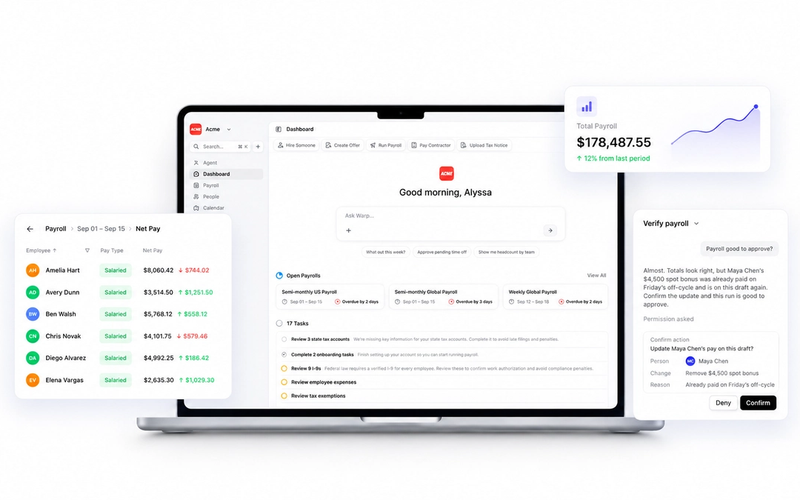
With Warp, you can manage payroll, employee benefits, independent contractor payments, and tax compliance all on one easy-to-use platform. Request a demo today to see how Warp can simplify how you run your startup.