
If you feel your admin workload is heavier than it used to be, you may not be imagining it.
According to Gartner's July 2024 survey, 75% of HR leaders report their managers are overwhelmed by the expansion of their responsibilities. Today's software easily captures and analyzes business data, meaning there are more opportunities for optimization and improvement. And because your startup is still in its early stages, you can expect your responsibilities to grow along with the business.
To meet these demands, startup founders must choose payroll software that can support their current and future needs. Keep reading this blog post to learn:
- Why choosing the right payroll software matters so much for startups
- What to look out for in your ideal payroll platform
- Five questions to ask when choosing a payroll platform for your startup
- The payroll platform created with startup founders in mind
Why choosing the right payroll software matters so much for startups
As the most significant expense for most companies, payroll is essential to get right. Your payroll software doesn't just impact your HR or finance operations. The effectiveness of this platform can affect your entire organization.
Accurate and timely payroll helps maintain employee confidence in your business. It results in error-free financial reporting, enabling you to make better decisions for your startup.
Your payroll software also catches any mistakes your team might make when inputting information into the system, so you can avoid corrupting your financial data and paying fines to the IRS.
Of course, the right payroll software also significantly reduces the time, money, and effort required to run a successful business. Here's how.
Consistent and accurate payroll runs
One of the quickest ways to lose your team's trust is by making careless mistakes with their paychecks. When they spend day after day helping you build your startup from the ground up, it's your responsibility to keep them financially stable in return.
This is especially true given PayrollOrg's 2024 Getting Paid in America survey findings. The report reveals that 77% of workers would find it "very difficult" or "somewhat difficult" to meet their financial obligations if their next paycheck were delayed for a week, with 49% saying it would be "very difficult."
Not prioritizing accurate and timely payroll can result in lower employee morale or workers leaving your startup for more consistent paychecks elsewhere.
Easier compliance with payroll tax regulations
As your startup grows, your payroll tax obligations and the regulations you'll need to follow will change along with it. You may also find yourself hiring different kinds of workers, each with varying pay structures, tax calculations, and benefits.
In 2025, compliance has become dramatically more complex. If you're hiring remotely across multiple states, you're dealing with varying state income tax rates, different State Unemployment Insurance (SUI) regulations, local taxes, and expanding Paid Family and Medical Leave (PFML) programs. Currently, 13 states plus D.C. have enacted mandatory PFML laws, with 9 states plus D.C. actively paying benefits and Delaware, Maine, and Minnesota launching programs in 2026.
Pay transparency laws have also expanded rapidly. Illinois, Minnesota, New Jersey, Vermont, and Massachusetts all implemented or strengthened requirements in 2025. If you have remote workers in these states, you need to comply even if your company is based elsewhere.
But with so many things on your plate (and without a huge HR team to assist you), you want to ensure these obligations are met, no matter what. After all, startups don't have the luxury of paying fines for easily fixable mistakes.
Keep your funds available for more important initiatives by investing in a platform that simplifies how you manage payroll. The best payroll software ensures you comply with the regulations your startup is expected to meet. If you fall out of compliance, some platforms will even resolve these issues on your behalf.
When you choose a platform that automatically maintains your payroll tax requirements in every state you operate in, you can rest knowing your organization is covered.
Time and cost savings through payroll automation
As a startup founder, payroll is just one of the many things needed to keep your business operational. Software that runs payroll automatically while making deductions and withholdings on your behalf can take this task off your to-do list.
According to Slack's June 2024 Workforce Index, 81% of desk workers using AI tools report improved productivity. Once software has taken over your team's routine payroll tasks, your core HR staff can focus their efforts on initiatives like recruitment or retention instead.
What to look out for in your ideal payroll platform
Not all payroll software is created equal. Because all startups are unique, some platforms will be a better fit for you than others. Although the exact criteria you'll seek out will depend on your company's needs, here are the key things you should prioritize in your search for the right payroll platform.
Features
First and foremost, make sure your chosen payroll platform has all of the features you absolutely cannot go without. If you employ HR or finance staff, ask them what features they'd want to see in your payroll software too.
In 2025, the baseline expectations have evolved significantly. Must-have features now include:
- Automated payroll processing with federal, state, and local tax calculation and filing
- Multi-state compliance automation (critical with roughly 22% of the US workforce working remotely or hybrid)
- Support for both W-2 employees and 1099 contractors
- Employee self-service portal for pay stubs and tax documents
- Next-day or same-day direct deposit
- Fast setup (under 30 minutes is now expected)
- Integrations with QuickBooks or other accounting software
Depending on your startup's needs, you may also want premium features like compliance monitoring, earned wage access, global contractor payments, advanced benefits administration (401k, health insurance), and dedicated support or HR advisor access.
Scalability
You probably don't intend for your startup to remain small forever. So, when you choose your payroll provider, it's important to pick the one you can take with you as you grow.
Most SaaS providers offer multiple service tiers, with upgraded or additional features in each successive tier. Look for companies that provide the features you need now, with options to upgrade to higher plans that deliver the features and services you'll require as your startup grows.
For example, opening new locations may be part of your startup's five-year plan. If so, you should look for software that supports the features you need to run payroll seamlessly for each office, and one that automatically handles the tax registrations and compliance requirements across potentially thousands of local tax jurisdictions.
Ease of use
The most powerful payroll platform with all the bells and whistles will not be helpful for your company if it's too complicated to use. Imagine how much time you'd lose each month if employees didn't know how to check their pay stubs or update their tax withholding information.
By choosing an intuitive and easy-to-use platform, your employees are much more likely to adopt the new system and benefit from its features. Look for platforms that can get you up and running in 15 minutes or less.
Integrations
Integrations are an essential feature every founder should look for in their payroll software, especially if you already have a robust tech ecosystem. By choosing payroll software that integrates with your back office tech stack, you can streamline your operations, reduce errors, and stop manually entering data into different systems.
But if the software doesn't integrate with some of the tools you use, don't write it off just yet. Check to see if you can use a tool like Zapier to connect the two.
Customer support
When researching different payroll platforms, check what kind of support each company offers. If you have a preferred support method, confirm that it's available as well.
If you're the type of person who expects direct access to a support representative, you may want to choose a platform with phone support or a dedicated representative during business hours. If you prefer DIY solutions, you may want to see your provider offering a robust knowledge base.
You'll also want to check how responsive the support team is. If you have any questions, reach out to them for assistance. Then, see how long it takes for them to respond to your query and assess whether you're satisfied with the response you receive.
Data security measures
Running payroll requires you to keep each employee's sensitive personal information on file. This is why it's crucial to choose software with the security features you need to keep your payroll data safe and secure.
According to IBM's 2025 Cost of Data Breach Report, the global average cost of a data breach is $4.44 million, with U.S. organizations facing even higher costs at $10.22 million. You can't afford to compromise on security.
In particular, look for tools that offer measures like:
- AES 256-bit encryption for data at rest
- TLS 1.3 for data in transit
- Multi-factor authentication (MFA)
- Role-based user access controls
- 24/7/365 security monitoring
- Regular penetration testing and vulnerability scans
If your industry requires software to meet additional standards like GDPR or CCPA compliance, check for those in your payroll platform of choice as well. California employees now have the same privacy rights as consumers for their payroll data under CCPA/CPRA, and 19 US states have passed comprehensive data privacy laws.
Five questions to ask when choosing a payroll platform for your startup
In addition to the considerations outlined above, here are five other questions you should consider before deciding on your startup's payroll platform.
1. Does the software meet your startup's needs?
Does your payroll provider give you everything you need to meet your payroll and tax obligations? Does it make your life easier?
Suppose you know you don't have the expertise or capacity to file payroll taxes every month. In that case, you may ask providers whether they automatically calculate, withhold, and pay payroll taxes on your behalf. Not only will this save time and effort on your end, it will help ensure you don't miss any deadlines or make costly mistakes.
In 2026, also ask about multi-state compliance automation if you have or plan to have remote employees across different states. Ask how the platform handles registrations across potentially 10,000+ tax jurisdictions. The best platforms automate this entirely, while others leave it to you.
Then, check to see if the software can grow with you as you scale your startup. Can it handle more complex payroll requirements, such as changes in your organizational structure or workforce size? If freelancers will make up a significant part of your workforce in the future, does the software have features to make managing a freelance team easier?
Ultimately, you don't want to switch providers in just a few years because your software doesn't have the features to support your growing business.
2. How often does the payroll provider update their tax compliance guidelines?
This is important to ensure your company's compliance with federal and state regulations, regardless of how often they change.
Ideally, your provider should update the guidelines every time a new law is passed in the relevant states. This will ensure that you stay compliant with the latest guidelines with minimal to no effort and that you won't be on the hook for any late fees or penalties.
Depending on the features the software offers, you may also find it helpful to ask how often the company updates its tax tables, whether it notifies you if you're out of compliance or fixes certain compliance issues automatically, and whether it flags potential issues for you to review.
3. Does the company have a good reputation?
You also want to ensure you're putting your startup's money in good hands. So, to that end, do some research on the company behind your chosen payroll software. Read reviews on sites like G2 and Capterra, and ask people in your network if they have experience using that payroll solution.
Don't forget to check on the longevity of the company too. The newest startup on the block may have all the latest features, but do your due diligence to ensure it'll still be around to cover your payroll needs in a few years. Look for companies that have raised institutional funding and have a track record of serving growing startups.
4. What is the total expected cost for this software?
Many payroll software providers charge on a monthly basis, and most companies advertise that rate upfront. Still, there may be additional costs you may need to factor in for your total investment. This may change the total amount you pay for the software, so confirm that all the fees are accounted for before making your final decision.
Some extra costs to look out for include:
- Implementation or setup fees
- Employee training expenses
- Upkeep or ongoing support fees
- Fees per user (or seat)
- Fees for additional features or services
In 2026, transparency in pricing has become a major differentiator. Look for providers that clearly outline all costs upfront with no hidden fees or confusing upsells.
5. Is there a free trial you can sign up for?
Many software providers offer prospective customers a free trial or demo to test things out for themselves before signing a contract. If your chosen provider offers one of these options, set aside some time to sign up and try the tool out for yourself.
Aim to use as many features as possible during your free trial, and if possible, ask a few of your employees to put it through its paces as well. Set up any dashboards you might need to see how useful they are, test out the mobile app if they offer one, and explore the compliance features.
Confirm that the software meets your needs and is easy to use and navigate for your employees, too. Pay special attention to how the platform handles multi-state compliance, as this is where you'll see the biggest operational differences between providers.
The payroll platform created with startup founders in mind
If you're a startup founder experiencing startup-specific payroll issues, why wouldn't you turn to a solution designed specifically for people like you?
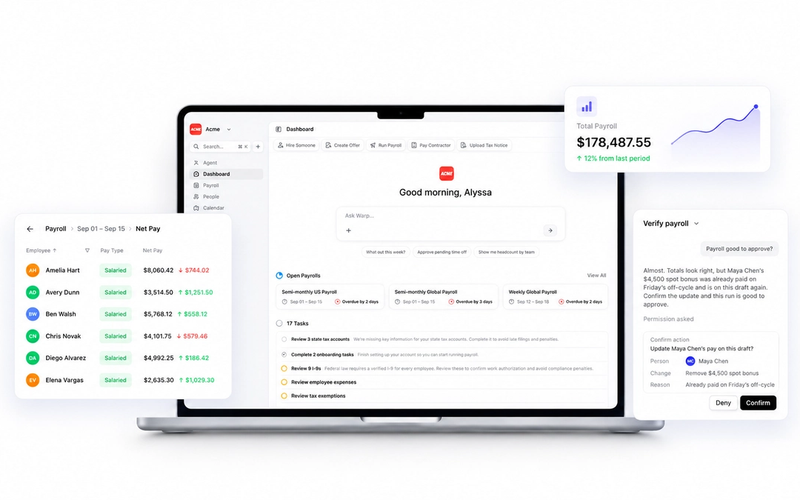
Warp is the payroll and HR platform built for the distributed startup era. Our software rolls payroll, tax compliance, and employee benefits into one automated platform, so all your HR tasks are managed in one place. We handle your tax registrations and compliance across all 10,000+ tax jurisdictions automatically, so you can focus on what you do best: building your business.
With Warp, you can:
- Get payroll set up in under 15 minutes (95% of our customers onboard in under 15 minutes)
- Automate multi-state compliance without manual registrations or filings
- Pay US employees and global contractors in 150+ countries
- Get transparent pricing with no hidden fees or lock-ins
- Receive US-based support with a 5-minute median response time
Trusted by hundreds of startups and backed by Y Combinator, Sound Ventures, and the founders of Dropbox, Warp is the modern payroll solution that scales with you from pre-seed to Series A and beyond.
See for yourself why startups choose Warp by requesting a demo today.