
TL;DR
Off-cycle payroll is any payroll run that happens outside your regular schedule. You need it for bonuses, corrections, terminations, new hire timing gaps, and contractor one-offs. The mechanics are simple. The traps are in the taxes, the state compliance rules, and the hidden per-run fees that most payroll providers bury in the fine print.
What Is Off-Cycle Payroll?
Off-cycle payroll is a payroll run processed outside your normal pay schedule. If your company pays employees every other Friday and you need to issue a bonus check on a Tuesday, that is off-cycle payroll.
The mechanics are the same as a regular payroll run: you enter the payment amount, the system calculates withholdings, and funds are debited and deposited. The difference is timing. Off-cycle runs are not tied to a fixed pay date, which means they can happen any time a payment needs to go out that cannot wait for the next scheduled cycle.
Some payroll providers refer to them as unscheduled payrolls, manual payrolls, or out-of-cycle runs. The terminology varies, but the concept is the same.
When Do You Actually Need to Run an Off-Cycle Payroll?
Most off-cycle runs fall into one of five categories.
Bonuses and commissions. You closed a big deal, hit a quarterly target, or want to reward a team member before the next pay period. Off-cycle payroll lets you pay it out immediately rather than making the employee wait two weeks.
Payroll corrections. Someone's hours were entered incorrectly, a new hire's salary was wrong, or a deduction was applied that should not have been. Corrections almost always require an off-cycle run rather than waiting for the next scheduled payroll to issue the adjustment.
Terminations. This is where off-cycle payroll becomes a compliance requirement, not just a convenience. Several states require that terminated employees receive their final paycheck on the same day they are let go. If your next scheduled payday is in ten days, you cannot wait. The states with same-day termination pay requirements include California, Colorado, Hawaii, and a handful of others. Getting this wrong exposes you to penalties and, in some cases, litigation.
New hire timing gaps. An employee starts on the 20th. Your next payroll runs on the 1st. If your system does not automatically prorate, you either run an off-cycle to cover those eleven days or make the employee wait an extra two weeks to see their first paycheck (not a great onboarding experience).
Contractor one-offs and expense reimbursements. Contractors working on a milestone basis or employees submitting large expense reports often cannot be practically rolled into the next scheduled payroll cycle without a long delay. Off-cycle runs let you pay people when the work is done, not when the calendar allows.
The Tax Rules of Off-Cycle Payroll
Off-cycle payroll is where tax errors tend to happen, specifically around bonus payments.
When you pay a bonus off-cycle, the IRS requires you to use the supplemental wage withholding method. For most employees, that means a flat 22% federal income tax withholding rate on the bonus amount. If the employee's total supplemental wages for the year exceed $1 million, the rate jumps to 37% on the amount above that threshold.
This is different from how regular pay is taxed, where withholding is calculated based on the employee's W-4 elections and the periodic method. Many founders and HR teams make the mistake of applying regular withholding rates to off-cycle bonus runs. The result is either over-withholding (which creates an annoyed employee and a reconciliation headache) or under-withholding (which creates a tax liability the employee discovers at filing time).
One workaround: you can add the supplemental income to a regular payroll cycle and calculate withholding on the total combined wages. This avoids the flat rate but requires planning the timing accordingly. Whether you run it off-cycle or include it in a regular run, be intentional about which method you are using.
For state taxes, the rules vary significantly. Most states follow the federal supplemental rate approach, but some have their own flat rates for bonus income. If you are paying employees in multiple states, the compliance burden compounds quickly.
The Cost of Running Off-Cycle Payroll
A pain point that shows up constantly in conversations with businesses switching payroll providers: a lot of platforms charge extra for every off-cycle payroll run.
The fees vary by provider but typically range from $25 to $150 per off-cycle run. That sounds manageable until you realize that terminations, corrections, bonuses, and contractor payments add up fast, especially as your headcount grows. A company with 50 employees running ten off-cycle payrolls a year might end up paying $500 to $1,500 in fees they never accounted for in their original contract.
One founder described this exact dynamic when switching providers:
"I know how to run payroll off cycle, on cycle, call who I need to call to move a check date. And, you know, I force it to work. But the goal here is to not force anything to work, it should just work by itself."
The operational friction of legacy payroll systems, where running an off-cycle check requires a phone call and a fee, is a real productivity drain.
Warp does not charge per payroll run. You can run unlimited off-cycle payrolls, bonus runs, contractor payrolls, and manual payrolls at no additional cost. Whether you are running one off-cycle check a year or one a week, the pricing does not change.
State Compliance Risks with Off-Cycle Payroll
Beyond final paycheck timing, there are a few other state-specific rules that create compliance exposure when running off-cycle payrolls.
Same-day termination pay states. California, Colorado, Massachusetts, Montana, Oregon, and others require that terminated employees receive all earned wages on their last day of work. Running an off-cycle payroll in these states is not optional: it is a legal obligation. Missing it can result in waiting time penalties that accrue daily.
The table below covers the states where this comes up most often for growing companies. Laws change, so confirm your state's current rule before a termination, especially if you are expanding into a new state for the first time.
| State | Involuntary termination (fired/laid off) | Voluntary resignation |
|---|---|---|
| California | Immediately (same day) | Same day if 72+ hrs notice given; within 72 hrs if no notice |
| Colorado | Immediately (same day) | Next regular payday |
| Massachusetts | Same day | Next regular payday |
| Montana | Immediately (same day) | Next regular payday |
| Oregon | End of next business day | Next regular payday (or final day if 48+ hrs notice) |
| Hawaii | Next business day | Next regular payday |
| Alaska | Within 3 working days | Next regular payday |
| Nevada | Within 3 days | Next regular payday |
| Texas | Within 6 calendar days | Next regular payday |
| New York | Next regular payday | Next regular payday |
| Illinois | Next regular payday | Next regular payday |
| Washington | Next regular payday | Next regular payday |
| Georgia | Next regular payday | Next regular payday |
| New Jersey | Next regular payday | Next regular payday |
Alabama, Florida, Georgia, Mississippi, and South Carolina have no state-specific final paycheck law; the federal FLSA default applies, which requires payment by the next regularly scheduled payday.
Wage theft laws. Many states have wage theft statutes that include provisions about correction timelines. If an underpayment error is discovered, some states specify how quickly the correction must be issued, which may require an off-cycle run on a shorter timeline than your provider's standard processing allows.
Payroll tax deposit timing. Off-cycle runs can affect your payroll tax deposit schedule. If an off-cycle bonus payment pushes you over certain IRS threshold amounts, it can change how frequently you are required to deposit payroll taxes (from monthly to semi-weekly, for example). Most modern payroll software handles this automatically, but it is worth understanding if you are tracking it manually.
What to Look for in Payroll Software for Off-Cycle Runs
Not all payroll software handles off-cycle runs equally. When evaluating options, ask these questions.
Is there a per-run fee? As covered above, many providers charge each time you run an off-cycle payroll. If you anticipate running more than a handful per year, this cost adds up. Look for a provider with unlimited payroll runs included in the base price.
Does it support same-day payroll? If you are in a state with same-day termination pay requirements, this is not optional. Find out whether same-day processing is available and what it costs (some providers charge a premium for it).
Does it handle multi-state complexity automatically? If you have employees in multiple states and you run an off-cycle termination payroll for someone in California, does the system automatically apply the correct rules? Or do you have to know to ask? The answer to this question separates genuinely automated payroll platforms from ones that just have a lot of features.
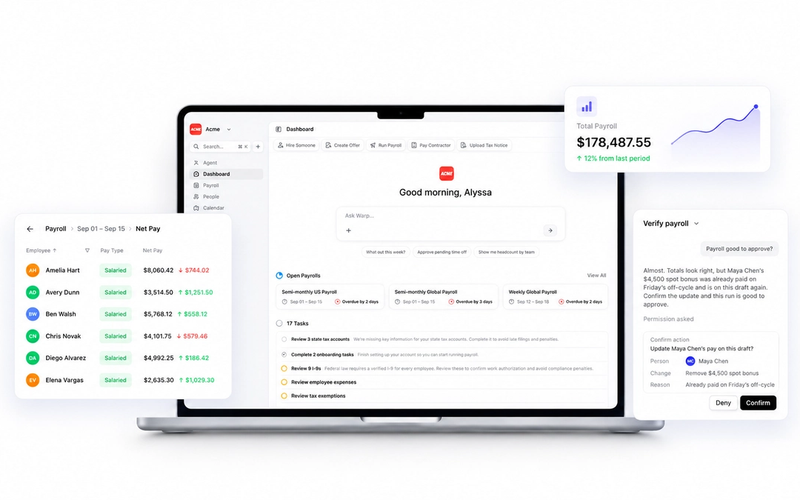
Does offboarding automatically trigger the payroll calculation? In Warp, when you offboard an employee, the system automatically creates the offboarding payroll calculation so you are not starting from scratch. The task appears in your dashboard with the numbers pre-populated. You review, approve, and send. This is a small thing that saves a meaningful amount of time and error risk when someone's last day falls in the middle of a pay period.
Frequently Asked Questions
Is off-cycle payroll the same as manual payroll?
Often used interchangeably, but technically distinct. Manual payroll usually refers to calculating and processing payroll by hand, without software. Off-cycle payroll just means a payroll run outside your regular schedule, regardless of whether it is processed manually or through software. Most people use manual payroll to mean an unscheduled one-off run.
Are off-cycle payroll runs charged extra?
It depends entirely on your payroll provider. Some platforms charge anywhere from $25 to $150 per off-cycle run. Others, including Warp, include unlimited payroll runs in the base price. If you are evaluating providers, ask this question directly before signing a contract.
How long does off-cycle payroll take?
Standard ACH direct deposit takes one to two business days. Some providers support next-day or same-day payroll for off-cycle runs, though this varies by platform and sometimes comes with an additional fee. If you need to issue a final paycheck on the day of termination due to state law, confirm your payroll provider supports same-day processing before you need it.
What taxes apply to off-cycle bonus payroll?
Federal supplemental wage withholding applies at 22% for bonuses up to $1 million per year (37% above that threshold). This is separate from the regular withholding method used in scheduled payrolls. State tax treatment varies by jurisdiction. A payroll platform with built-in compliance handling will apply the correct rates automatically.
Do I need to run an off-cycle payroll for a terminated employee?
It depends on your state. Many states allow employers to issue a final paycheck on the next regularly scheduled pay date. However, California, Colorado, Hawaii, and several others require same-day payment when you terminate an employee. Failing to comply can result in daily penalties. If you operate in multiple states, your payroll software should automatically flag the requirement for each state.
Can I run unlimited off-cycle payrolls?
There is no legal limit to how many off-cycle payroll runs you can process. The practical limit is usually your payroll provider's pricing structure. Some providers charge per run, which discourages frequent use. Providers with unlimited payroll runs allow you to pay people whenever it makes sense without worrying about cost.
Run Off-Cycle Payroll Without the Friction (or the Fees)
Off-cycle payroll is not complicated conceptually, but the details matter: the tax method you use for bonuses, the state compliance requirements for terminations, and whether your payroll platform is charging you $75 every time you need to issue an unscheduled check.
For fast-growing companies especially, the ability to run off-cycle payrolls quickly and without friction is not a nice-to-have. When you are adding headcount across multiple states, issuing performance bonuses, and occasionally making corrections, you will be running off-cycle payrolls regularly. The payroll platform you use should make that easy, not expensive.
Warp is the only AI-native HR and payroll platform built for ambitious companies. Instead of clicking through clunky dashboards or calling support to move a check date, Warp's AI agents handle state tax accounts, payroll filings, and compliance automatically. Every company gets a dedicated Account Manager included to guide them through payroll setup, multi-state expansion, and off-cycle edge cases, so you are not figuring it out alone.
With Warp, you will never pay extra for an off-cycle payroll run, never call a government agency about a termination payment deadline, and never have to "force it to work." Run your first payroll or get a demo to see how it works.
This article is for informational purposes only and is not legal or tax advice. Consult a qualified professional for guidance specific to your situation.