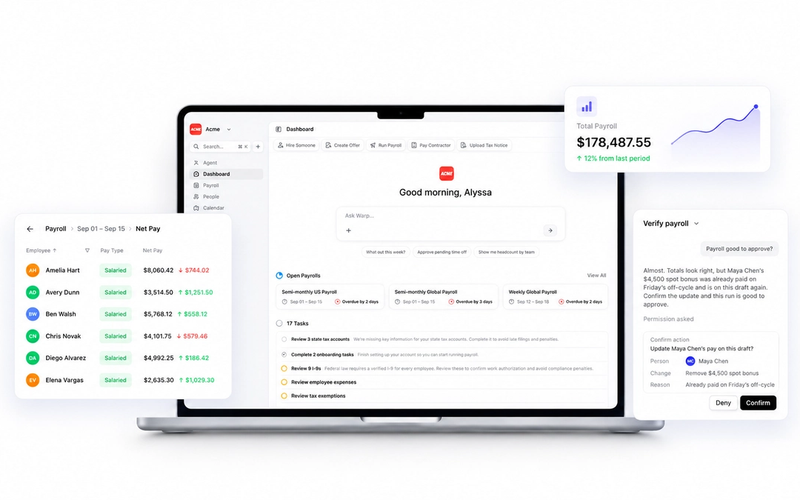

TL;DR: A unified payroll platform handles payroll, tax compliance, and benefits using a single employee record. This means that when you update information in one place, it updates everywhere else automatically. In contrast, an “all-in-one” HR suite combines modules like IT, finance, recruiting, and payroll, but they often don’t share data smoothly. When considering a unified payroll platform, go beyond the marketing and check three things: does it use one employee record for payroll, tax, and benefits; does it manage compliance automatically rather than just flagging issues; and can you reach a real person for help when something goes wrong?
If you have ever updated an employee’s address in one system but found their tax withholding still linked to the old state, you know the problem a unified payroll platform aims to fix. Most companies begin with several systems: a payroll processor, a separate HRIS for headcount and org charts, a benefits broker’s portal, and a spreadsheet to track state registrations. Each new hire means entering the same information in multiple places, and any mistake can turn into a compliance issue later.
The phrase “unified payroll platform” is now widely used by vendors to describe their solutions. However, the term is often used so loosely that it has lost some of its meaning. This article explains what truly makes a payroll platform unified, how that is different from being “all-in-one,” and what you should check before trusting a vendor’s claim.
What “Unified” Actually Means in Payroll Software
A unified payroll platform stores payroll, tax compliance, and benefits administration on one employee record, rather than syncing data between different systems. When you update an address, pay rate, or work location, the change happens once and all related processes, like tax withholding, benefits eligibility, and W-2 reporting, update right away.
This setup differs from integrated payroll, where separate tools connect through APIs or middleware. Integrated systems can work, but each connection is a spot where data might get out of sync, a sync job could fail without warning, or a field might not match correctly between systems.
This difference is more important than it seems. Payroll compliance problems usually do not come from one system failing completely, but from two systems having different information. For example, the HRIS might show an employee moved to Texas three weeks ago, but payroll is still withholding New York state tax. A unified platform prevents this by having only one record to update.
Why Companies End Up With a Fragmented Payroll and HR Stack
This isn’t a niche problem. A Forrester Consulting study of 217 HCM technology leaders found that the average business uses over six different Human Capital Management providers to manage employees. 77% said they keep employee data in several databases, and 71% said they cannot transfer data between their own platforms. Almost all (91%) said they would prefer a single-database solution.
We hear stories like this from almost every HR lead who considers switching to Warp. Recently, an HR manager told us her team used one system for payroll, another for recruiting, a third for e-signatures, and a fourth for org charts. When the company address changed, she updated it in one place and told one department, expecting the change to carry over. It did not. Other departments kept the old address until she tracked each one down and asked them to update it.
For early-stage startups, this collection of systems usually grows over time, but not by design. You start with a payroll processor when you incorporate. After a few hires, you add a benefits broker because your payroll tool does not handle insurance. When you hire someone in another state, you create a spreadsheet to track registrations. Each decision makes sense on its own, but by the time you have 20 or 30 employees in several states, you are keeping the same employee data in multiple places, and any of them can become outdated.
Warp was created to solve this exact problem. All payroll for employees and contractors, state tax registrations and filings, and benefits enrollments are managed in one place. This means you do not have to manually check and match information across different systems. When you add a new hire’s work location, the platform automatically opens any required state tax accounts, so it doesn’t become another task on your list.
Unified Payroll Platform vs. All-in-One HR Suite
Many buyers get confused here: vendors often use “unified” and “all-in-one” as if they mean the same thing, but they are different.
An all-in-one HR suite bundles as many business functions as possible into one login: payroll, HR, IT device management, expense management, sometimes even spend management or recruiting. The pitch is that you never have to buy another tool again. In practice, that breadth comes with a tradeoff. Most companies that adopt one of these suites end up using a fraction of the available modules, because the specific tools they need for finance or IT are usually built by teams that specialize in finance or IT, not payroll. You end up paying for, configuring, and onboarding modules you’ll never touch.
A unified payroll platform, on the other hand, focuses on the employee record. It handles payroll, tax compliance, HR, and benefits thoroughly, instead of covering every business function only at a basic level. This is a deliberate choice, not a limitation.
If your team genuinely needs one login for IT asset management and spend controls alongside payroll, an all-in-one suite might be worth the added complexity. But if what you actually need is payroll, tax compliance, and benefits to stop living in separate places, a platform unified around that specific scope will usually get you there faster and with less unused surface area to manage.
What to Look For in a Truly Unified Payroll Platform
Before you take a vendor’s “unified” claim at face value, check for these four things.
One employee record, not synced records.
Ask the vendor directly: when I update an employee’s work location, does that change flow automatically into tax withholding and benefits eligibility, or do I need to update it separately in each module? If the answer involves the word “sync,” it’s integrated, not unified.
Compliance handled, not just tracked.
Many platforms will tell you which state tax accounts you need to register for. Fewer will actually open those accounts on your behalf. Warp’s multi-state payroll compliance guide walks through how quickly registration obligations trigger once you hire outside your home state, and it’s a useful gut check for how much of that process you’d still be doing manually on a given platform. For the federal baseline that applies no matter which platform you choose, the IRS’s overview of hiring and paying employees is a reliable starting point.
Benefits inside the same record, not a separate broker portal.
If benefits enrollment lives in a different system than payroll, you’re back to manually reconciling deductions, which defeats the purpose of unifying in the first place.
A real person when something breaks.
Automation handles the routine cases well. It’s the exceptions—an agency notice, a registration that gets stuck, a filing that bounces—where a dedicated point of contact matters. This is a genuinely underrated part of evaluating “unified” platforms, because the marketing rarely mentions what happens when the software alone isn’t enough.
How to Evaluate a Unified Payroll Platform Before You Switch
If you run payroll on one system and use two or three others for everything else, switching is a real project, not a quick decision. Here are a few practical steps to take before you commit:
- Map your current stack. List every system that touches employee data today: payroll, HRIS, benefits broker, any spreadsheets tracking state registrations.
- Ask each vendor the direct question. Not “are you unified,” but “if I change an employee’s work location today, what updates automatically and what do I have to update manually?”
- Check what happens to your historical data during migration. Ask specifically about W-2 history, past filings, and mid-year moves. Will your existing benefits coverage carry over without a gap, or do employees have to re-enroll?
- Compare what you’re paying today across every tool against the true all-in cost of one platform. Include broker fees, the HRIS subscription, and the time your team spends manually reconciling data. It’s often larger than it looks on paper.
The Bottom Line
A unified payroll platform isn’t just a marketing label. It’s a specific technical choice: one employee record instead of several, so a change made once is true everywhere it needs to be. That’s different from an all-in-one HR suite, which optimizes for how many functions live under one login, not how tightly the underlying data is actually connected. Before you take either claim at face value, ask the direct question this article keeps coming back to: when something changes, what updates itself, and what still depends on someone remembering to fix it by hand?
Warp is the only AI-native HR and Payroll platform built for ambitious companies. Instead of clicking through clunky dashboards or .gov websites for taxes, Warp’s AI agents open every state tax account, file every payroll form, and resolve every tax notice, automatically.
Every company gets a dedicated Account Manager and Benefits Advisor included to guide them through payroll setup, multi-state expansion, and benefits selection, so you don’t have to spend hours on hold with tax agencies or worry about compliance mistakes.
With Warp, you’ll never visit a government website, negotiate with tax agencies, or pay accountants $150 per filing. Just focus on building your business while Warp handles payroll, compliance, and benefits for your team across any state or country.
Thousands of fast-growing startups trust Warp to stay compliant while they scale.
If you want to see what a genuinely unified employee record looks like in practice, see how Warp’s payroll platform works, or talk to our team about switching.