
Paying your first international contractor is easy enough. Send a wire, use a transfer service, or pay through an app.
The process gets harder when you have eight contractors across five countries, each with a different rate, currency, invoice, and payment schedule. Finance is tracking payments in a spreadsheet. Contracts live in one folder, tax forms in another, and nobody has a clear view of what the company spends on its distributed team.
That’s usually when a process that once felt simple starts creating work AND risk.
If you're a US company hiring internationally, you need to get three things right: the contractor relationship, the tax paperwork, and the payment process. Here's how to handle each, how the main payment methods compare, and when it's worth moving beyond a collection of disconnected tools.
To pay an international contractor:
- Confirm the working relationship is genuinely a contractor arrangement. The contract alone doesn't determine classification; local rules and the actual working relationship matter.
- Sign a written agreement. Define the work, rate, currency, payment schedule, confidentiality obligations, and intellectual property ownership.
- Collect the appropriate tax documentation. Foreign individuals generally provide Form W-8BEN, while foreign entities generally provide Form W-8BEN-E. US persons generally provide Form W-9.
- Choose a payment method based on total cost. Transfer fees are only part of the equation; foreign exchange (FX) markups and recipient fees matter, too.
- Keep everything in one place. Store contracts, invoices, tax forms, and payment records together.
- Revisit the process as you grow. Once you’re paying contractors across multiple countries, managing everything manually can create more work than it saves.
The goal isn't just to send money overseas. It's to make every payment accurate, traceable, and repeatable.
What changes when you pay contractors internationally?
An international contractor is generally someone who provides services to your business from outside the United States as an independent business or individual. The exact legal definition depends on the applicable rules.
Compared with paying a US-based independent contractor, three things become more complicated.
Tax documentation is different. Foreign individuals and entities generally provide the appropriate W-8 form rather than a W-9. Whether you have US reporting or withholding obligations depends on the contractor's status and where the work is performed.
Payments cross borders. You may need to manage different currencies, transfer networks, exchange rates, and intermediary bank fees. A payment that looks inexpensive on your side can still arrive short on the contractor's side.
More than one country's rules may apply. US tax requirements are only part of the picture. The contractor's country may have its own rules for worker classification, contracts, intellectual property, and other employment-related obligations.
One important distinction: hiring someone overseas doesn't automatically mean they should be a contractor. If you need someone working full-time under your direction as an integrated member of your team, an employee arrangement may be more appropriate. You might hire through a local entity or an employer of record (EOR), depending on the circumstances.
What paperwork should you collect before the first payment?
Get the basics in place before money moves. Reconstructing documentation after the fact is harder, especially if a contractor has already started work or a payment needs investigation.
1. A written contractor agreement
Your agreement should cover:
- Scope of work and deliverables
- Rate, currency, and invoicing schedule
- Payment terms and responsibility for transfer fees
- Confidentiality and data protection
- Intellectual property ownership and assignment
- Termination terms
Don't assume a contract written for US contractors will work everywhere. Local laws can affect whether specific provisions are enforceable, including intellectual property assignments. Have the agreement reviewed for the contractor's jurisdiction when appropriate.
2. The right tax form
For many US companies, this is the most confusing part of international contractor onboarding. The correct form depends on the contractor's US tax status and whether they're an individual or an entity, not simply their mailing address.
| Who you're paying | Typical form |
|---|---|
| Foreign individual who is not a US person | Form W-8BEN |
| Foreign business entity | Form W-8BEN-E |
| US citizen or other US person living abroad | Form W-9 |
These forms serve different purposes, and exceptions can apply. Confirm the appropriate documentation for your specific situation.
The payer generally retains a W-8 form rather than sending it directly to the IRS. Its validity and renewal requirements depend on the form and circumstances, so track expiration dates and changes in the contractor's status.
Consult a tax professional with questions.
3. Payment details and invoicing terms
Collect the information needed to pay the contractor correctly:
- Legal name and relevant business details
- Bank account information in the format required by their country
- Preferred payment currency
- Invoice frequency and payment schedule
- Agreed rate and process for approving changes
Agree on the details upfront. If a contractor changes their rate every month, you need a reliable way to record and approve that change before payment, not just a spreadsheet update.
Do international contractors get a 1099?
Generally, a foreign contractor who performs all their work outside the United States does not receive a Form 1099-NEC from a U.S. payer. However, it depends on the contractor's tax status, where the services are performed, and the applicable reporting rules.
A few distinctions matter:
- A US person living abroad may still be subject to the usual US contractor reporting requirements.
- Services performed physically in the United States can change the sourcing and withholding analysis.
- Missing or incorrect tax documentation can create additional obligations.
Don't use a contractor's foreign address as the only basis for deciding whether a 1099 or withholding is required. Confirm the facts and applicable IRS rules before making that determination.
How to pay international contractors: Comparing your options
The best payment method depends on how many contractors you pay, which countries they live in, and how much administrative work you want to manage yourself.
For one occasional payment, a bank transfer or money transfer service may be perfectly adequate. For a growing team, compare the full cost of paying people, not just the advertised transfer fee.
| Payment method | What to consider | Best fit |
|---|---|---|
| International bank wire | Wire fees, FX markup, intermediary fees, and manual reconciliation | Occasional payments |
| Money transfer service | Exchange rates, recipient costs, payment limits, and batch-payment support | Small teams with straightforward needs |
| Payment apps | Convenience, currency-conversion costs, and recipient fees | Simple, low-volume payments |
| Business bank transfers | Existing banking relationship, supported currencies, and transfer costs | Companies prioritizing a bank-based process |
| Contractor payment platform | Platform fees, payment coverage, and whether contracts, invoices, and tax forms are included | Companies managing contractors across countries |
| Payroll platform with global contractor payments | Integration with US payroll, supported countries, and total cost | Companies that want one system for employees and contractors |
Actual fees and delivery times vary by provider, currency, country, and payment route. Compare current pricing before choosing a method.
Don't compare transfer fees alone
The advertised fee rarely tells the whole story.
Two numbers deserve particular attention:
FX markup. This is the difference between your provider's exchange rate and the relevant mid-market rate. A provider can advertise a low transfer fee while earning revenue through currency conversion.
Recipient fees. Intermediary banks and receiving institutions may deduct fees before the money arrives. If you agreed to pay a contractor $3,000, those deductions can create an awkward conversation about why they received less.
The administrative cost. If finance spends hours each month matching bank transfers to invoices, checking exchange rates, and correcting payment records, those hours belong in your comparison.
Should you pay in USD or local currency?
Paying in local currency can make a contractor's income more predictable and reduce the work they need to do to convert their earnings.
Paying in USD shifts the conversion burden to the contractor, who may face bank fees and exchange-rate spreads.
When is an international contractor actually an employee?
A contractor agreement doesn't settle the classification question. Authorities may look at the actual relationship, and the applicable tests differ by jurisdiction.
Potential warning signs include:
- The person works exclusively for your company on an ongoing, full-time basis.
- You control their working hours, time off, or day-to-day activities.
- They function like an internal employee rather than an independent service provider.
- They occupy a continuing role within your organization rather than working toward defined deliverables.
- They manage your employees or are integrated into your normal management structure.
No single factor necessarily determines classification. Several together may warrant a review under the rules of the contractor's country.
Misclassification can lead to back taxes, social contributions, benefits, severance, or other liabilities, depending on the jurisdiction.
If the relationship is really employment, consider hiring through an employer of record (EOR) or establishing a local entity. The right approach depends on your headcount, hiring plans, cost structure, and local requirements.
How to pay an international contractor, step by step
Use this checklist for your next international hire.
- Confirm classification. Check the relationship against the applicable rules in the contractor's country.
- Sign the agreement. Document scope, rates, currency, payment terms, confidentiality, and IP ownership.
- Collect the right tax documentation. Obtain the applicable W-8 form or W-9 and track any renewal requirements.
- Verify payment details. Confirm the account information and the currency the contractor will receive.
- Choose a payment method. Compare exchange rates, transfer fees, recipient costs, delivery times, and administrative overhead.
- Approve invoices consistently. Check amounts against the agreed rate and work performed before authorizing payment.
- Pay and reconcile. Confirm the transfer and connect it to the relevant invoice, contract, and tax records.
- Review the process periodically. Reconcile payments to your books and verify that documentation remains current.
The key is consistency. Every contractor should follow a defined process, even when the payment is straightforward.
How Warp handles international contractor payments
If you're already running US payroll, managing international contractors through a separate collection of tools creates unnecessary handoffs.
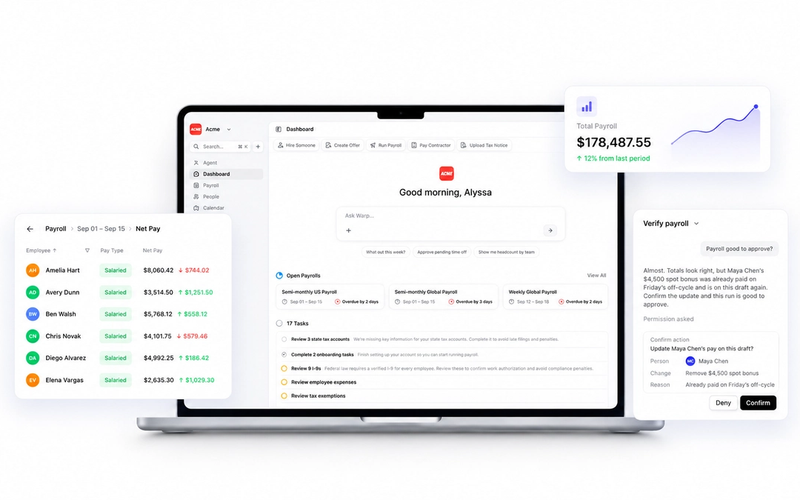
Warp brings US employees, US 1099 contractors, and international contractors into one payroll workflow. Instead of managing contractor onboarding, invoices, and payments independently, you can keep more of that process together.
With Warp's global contractor payments, you can:
- Pay contractors in local currency across 150+ countries, subject to supported-country coverage.
- Access near-mid-market FX rates with no transfer markup.
- Pay standard bank transfer costs.
- Manage global contractor payments as part of every plan, rather than as a separate add-on.
1. Contractors complete their own onboarding
You add the contractor, and they complete the onboarding process themselves.
Depending on the contractor and applicable requirements, this can include:
- Personal and business information
- International bank details
- Contract review and electronic signature
- The appropriate W-8 tax form
- Applicable country-specific compliance documents
- Background-check consent, if required by your company
International contractors don't complete US employee onboarding forms that don't apply to them, such as Form I-9 or Form W-4.
One practical detail still matters: verify that the contractor's bank details match the receiving account. Incorrect account information can delay or prevent a transfer.
2. W-8 forms are collected and tracked in one place
Warp's W-8 workflow helps collect the appropriate form for an individual or business contractor and track its status.
For businesses, the onboarding process may include additional tax classification and reporting details, depending on the entity and its circumstances.
Within Warp, the W-8 Forms area shows form status, including forms that haven't been started, have been submitted, or need renewal. You can also download forms, review submission history, or upload a form completed elsewhere.
Keeping documentation organized makes it easier to spot missing or expiring forms before they become payment or compliance issues.
3. Invoices and approvals stay connected
Contractors can submit invoices through the Contractor Portal. You review the hours, amount, currency, and description, then approve the invoice for payment.
For fixed-rate arrangements, you can enter the payment amount directly when an invoice isn't needed.
The benefit is a clearer connection between the amount requested, the approval, and the resulting payment. Contractors can also track payments and update their payment details through the portal, reducing the need for repeated status emails.
4. Run contractor payments alongside payroll
Once invoices are approved, the payment process follows a consistent workflow:
- Open the contractor payroll section in Run Payroll.
- Select the international contractors to pay.
- Confirm the payment amounts and local currencies.
- Include approved invoices or enter direct payment amounts, as appropriate.
- Review and submit the payment run.
- Track transfers through completion.
The result is a more unified view of payroll and contractor payments, rather than a separate process finance has to reconstruct at month-end.
Already managing contractors through multiple tools? Warp offers free, white-glove migration.
Frequently asked questions
Do I withhold US taxes when paying an international contractor?
Not necessarily. The answer depends on the contractor's tax status, where the services are performed, and whether the required documentation is in place. Work performed in the United States or missing documentation can change the analysis. Confirm the requirements with a qualified tax professional.
What currency should I use to pay international contractors?
Local currency is often more convenient for the contractor because it reduces the need to convert their earnings. Compare your provider's exchange rate and all applicable fees before deciding whether to pay in local currency or USD.
What's the cheapest way to pay international contractors?
For an occasional payment, a money transfer service may be cost-effective. For a growing team, compare total costs including FX markups, transfer and recipient fees, and the time spent reconciling payments. The cheapest option depends on your countries, currencies, payment volume, and provider.
Can my US payroll provider pay international contractors?
Some payroll providers support international contractor payments, while others don't or charge extra. Ask which countries and currencies are supported, what the total payment costs are, whether tax-form collection is included, and whether contractors can submit invoices through the same system.
Do international contractors need a W-9?
Foreign individuals who aren't US persons generally provide Form W-8BEN, and foreign entities generally provide Form W-8BEN-E. US persons, including qualifying US citizens living abroad, generally provide Form W-9. Confirm the correct documentation for the specific contractor.
Can I pay international contractors in USDC or other stablecoins?
Some businesses use stablecoins for contractor payments, where permitted and supported. Using a different payment method doesn't eliminate your recordkeeping or tax obligations. Consider local laws, the contractor's ability to receive and convert the funds, transaction records, and applicable tax treatment before proceeding.
Why did my international contractor payment fail?
Incorrect bank details are one possible cause, including an invalid IBAN, SWIFT/BIC, or account name. A transfer can also be delayed by intermediary banks or compliance reviews. Confirm the receiving details, check the provider's payment status, and follow the provider's instructions before resending the payment.