
Many startups turn to professional employer organizations (PEOs) and employers of record (EORs) to handle payroll and HR—often without fully understanding what these services do or whether they actually need them. The lack of transparency in this industry means founders frequently overpay for services that don't match their needs.
Understanding the differences between PEOs, EORs, and modern payroll software can save your startup thousands of dollars annually while keeping you compliant across every state where you have employees.
If you're hiring employees for the first time or evaluating your current payroll setup, keep reading to learn:
- What is a PEO?
- What is an EOR?
- What's the difference between a PEO and EOR?
- How much do PEOs and EORs cost in 2026?
- Five questions to ask when choosing a provider
- Key 2026 regulatory changes affecting PEOs and EORs
- What's the best option for startups?
- Startup payroll made easy with Warp
What is a PEO?
A professional employer organization (PEO) is a third-party HR firm that small and mid-sized businesses partner with to outsource payroll, taxes, benefits administration, and compliance tasks. Think of them as an extension of your HR team that handles the administrative burden of employment.
When you work with a PEO, you enter a co-employment arrangement—the PEO becomes the employer of record for tax and benefits purposes while you maintain day-to-day control over your employees' work. All tax filings happen under the PEO's Employer Identification Number (EIN), not yours.
Here's a practical example: Say your startup is based in California, but you want to hire employees in New York and Texas. Your team isn't familiar with the labor laws in those states, and they already have their hands full. A PEO can handle the HR responsibilities for your out-of-state employees—payroll taxes, benefits enrollment, compliance filings—while you focus on building your product.
PEO services typically include:
- Payroll processing and tax withholding
- Federal, state, and local tax filings
- Health insurance and benefits administration
- Workers' compensation insurance
- HR compliance guidance and support
- Employee onboarding and handbook creation
- Unemployment insurance administration
What is an EOR?
An employer of record (EOR) acts as the legal employer in countries or regions where you don't have a business entity. While your company remains the functional employer—you direct the work, set compensation, and manage performance—the EOR handles employment contracts, payroll, benefits, and local compliance through their established infrastructure.
EORs already have the legal entities, bank accounts, payroll systems, and insurance coverage required by local governments. This means you can hire internationally without spending months (and tens of thousands of dollars) registering a foreign subsidiary.
EOR services are primarily used for:
- Hiring full-time employees in countries where you have no legal presence
- Testing new markets before committing to foreign entity establishment
- Employing remote workers in multiple countries compliantly
- Converting contractors to employees in foreign jurisdictions
- Navigating complex local labor laws without in-house expertise
What's the difference between a PEO and EOR?
While PEOs and EORs share some overlap in services, they serve fundamentally different purposes. Here are the key distinctions:
Legal responsibility
PEO: You enter co-employment, meaning both you and the PEO share responsibility for your employees. If the PEO makes a compliance mistake, you may still be liable for the consequences. Tax filings happen under the PEO's EIN.
EOR: The EOR takes on full legal employer status in their jurisdictions. Liability and risk from the EOR's services falls on their shoulders, not yours. This is particularly important for international employment where local laws may be unfamiliar.
Geographic coverage
PEO: Most PEOs operate only within the United States, making them ideal for startups hiring across multiple states. You'll still need your own legal entity (your company registration), and the PEO handles HR under that entity.
EOR: EORs focus on international hiring. Major providers maintain legal entities in 100-180+ countries, allowing you to hire globally without establishing foreign subsidiaries. Deel operates in 150+ countries, Oyster in 180+, and Remote in 100+.
Entity requirements
PEO: You must have an existing legal entity. The PEO co-employs your workers through your company structure.
EOR: No local entity required. The EOR employs workers through their own legal entities in each country, which is why they're essential for international expansion without subsidiary setup.
Flexibility and minimums
PEO: Many PEOs enforce minimum employee counts—typically 5+ employees—and multi-year contracts. According to NAPEO (National Association of Professional Employer Organizations) data, 66% of all PEO clients have 10-49 employees, representing the sweet spot where PEOs make economic sense.
EOR: Most EORs don't enforce minimum headcounts, making them accessible to startups hiring even a single international employee. Month-to-month contracts are common, though annual commitments often unlock 15-20% discounts.
How much do PEOs and EORs cost in 2026?
The cost difference between PEOs and EORs is substantial, reflecting their different service models and compliance responsibilities.
PEO pricing
PEO pricing typically falls into two models: a flat per-employee-per-month (PEPM) fee or a percentage of payroll. According to TriNet's analysis citing NAPEO data, the average annual PEO cost is $1,395 per employee—roughly $116 per month.
Flat fee (PEPM) pricing ranges:
- Budget/basic tier: $40-75 per employee monthly
- Mid-range: $75-150 per employee monthly
- Premium: $150-250+ per employee monthly
Percentage of payroll pricing typically runs 2-12% of gross payroll, with most PEOs charging 3-6%. For a startup with $500,000 in annual payroll at 5%, that's $25,000 per year just in PEO fees—before adding health insurance or workers' comp premiums.
EOR pricing
EOR services cost significantly more than PEOs due to the complexity of international compliance. According to EOR pricing guides, the global average ranges from $400-600 per employee monthly, or approximately 10-15% of salary.
EOR regional pricing variations
EOR costs vary substantially by region based on compliance complexity:
- North America (US, Canada): $500-1,000/month
- Western Europe: €500-1,500/month ($550-$1,650)
- Eastern Europe: €199-500/month ($220-$550)
- Asia-Pacific: $300-1,500/month
- Latin America: $350-700/month
Hidden costs to watch for
Both PEOs and EORs charge additional fees beyond base pricing. Always request a complete fee breakdown before signing:
- Setup/onboarding fees: $0-500 per employee
- Termination/offboarding fees: $500-2,000+ (especially for EORs)
- Currency exchange fees: 2-10% for EOR international payments
- Security deposits: 1-3 months' salary (EOR)
- Benefits pass-through: Health insurance and workers' comp premiums
Five questions to ask when choosing a PEO or EOR provider
If you're considering a PEO or EOR, these questions will help you evaluate providers and avoid costly mistakes.
1. What are your company's actual needs?
Be honest about what you're trying to solve. Do you need help with multi-state tax compliance? Access to better health insurance rates? Support for international hiring? Many startups sign up for comprehensive PEO packages when they only need payroll processing and tax filing—paying for HR consulting, training programs, and other services they'll never use.
2. Do you need a legal entity in your target locations?
This is the fundamental PEO vs. EOR decision point. If you're hiring only in the U.S. and already have a company registered, you don't need an EOR—a PEO or standalone payroll software will work fine. If you want to hire full-time employees in countries where you have no legal presence, an EOR may be your only practical option short of spending $20,000-50,000+ to establish a foreign subsidiary.
3. What type of workers will you hire?
Consider whether you're hiring full-time employees, contractors, or a mix. PEOs work best for companies with stable, full-time W-2 staff—their minimum employee requirements and co-employment structure don't accommodate high contractor turnover well. If you rely heavily on freelancers and project-based workers, an EOR or standalone payroll platform may offer more flexibility.
4. Is the provider properly certified and licensed?
For PEOs, IRS Certified PEO (CPEO) status is critical. CPEOs assume sole federal employment tax liability—if they fail to remit collected payroll taxes, you're protected. With non-certified PEOs, you could still be held liable even after paying the PEO. Fewer than 10% of U.S. PEOs hold CPEO certification—always verify on IRS.gov before signing.
Also check for ESAC accreditation, state licensing (35 states require specific PEO licenses), and audited financial statements.
5. Does the provider own their infrastructure?
Some agencies outsource work to third parties, leaving you with markup costs and inconsistent service. Ask directly: Does the provider own the entities they operate under? What systems do they use for payroll processing? For EORs, verify whether they use owned entities or third-party partners in each country—this affects compliance risk and service quality.
What's the best option for startups that need help with payroll?
Here's the truth that PEO and EOR providers won't tell you: most early-stage startups don't need either one.
When a PEO makes sense
PEOs work best for companies that need HR infrastructure they can't build themselves. Typically businesses with 10-50 employees that want access to large-group health insurance rates, full HR outsourcing including recruiting and training, and dedicated HR support without hiring in-house staff.
According to NAPEO, companies using PEOs are 50% less likely to go out of business and experience 7-9% faster growth, but these benefits come with the cost and complexity of co-employment.
When an EOR makes sense
EORs are essential for companies hiring internationally without the time or resources to establish foreign entities. They're the right choice when hiring full-time employees in countries where you have no legal presence, testing new markets before committing to subsidiary setup, or converting international contractors to employees for compliance reasons.
When you don't need a PEO or EOR
If your workforce is primarily U.S.-based, you don't need to give up control of your payroll (and pay a hefty premium) to stay compliant. Modern payroll software can handle everything a PEO does for compliance—multi-state tax registration, automatic withholdings, tax filings, year-end W-2s—without the co-employment arrangement or the costs.
This is especially true for early-stage startups that have fewer than 10 employees, hire primarily in the United States, work with a mix of W-2 employees and 1099 contractors, and want to maintain full control over their payroll and HR data.
For a direct comparison of standalone options, see our Gusto alternatives guide
FAQ
Do startups need an EOR?
Only if you're hiring a full-time employee in a country where you have no legal entity. If every hire is inside the US, an EOR is the wrong tool entirely, even though it's the one most comparison articles lead with. Most early-stage startups only need one once they make their first international hire.
Do startups need a PEO?
Usually not before 10 employees. Below that, a PEO's minimums and multi-year contracts cost more than the HR support is worth. PEOs earn their cost once a startup needs large-group health insurance access or dedicated HR support at scale, typically in the 10-50 employee range.
Is an EOR the same as a PEO?
No. A PEO co-employs your existing staff under a shared U.S. entity, splitting compliance responsibility with you. An EOR becomes the sole legal employer in a country where you have no entity of your own, taking on full liability for payroll, benefits, and labor law compliance in that jurisdiction.
What is the downside of a PEO?
Most PEOs require a minimum headcount (typically 5+ employees) and lock you into multi-year contracts. Pricing runs 3-6% of payroll or a flat per-employee fee that stacks on top of your actual payroll costs, and switching providers mid-year can mean re-enrolling every employee in new benefits and payroll systems.
What are the three types of PEO?
PEOs fall into three tiers based on certification: IRS-Certified PEOs (CPEOs), which meet the strictest federal bonding and reporting standards; ESAC-accredited PEOs, independently audited for financial stability; and state-licensed PEOs that meet only their state's minimum requirements. Fewer than 10% of PEOs hold CPEO status, so it's worth checking before you sign.
Does Warp replace a PEO or an EOR?
Warp replaces the payroll and compliance work most startups actually need a PEO for (multi-state tax filings, W-2/1099 handling, benefits) without the co-employment structure or minimums. It doesn't replace an EOR for hiring full-time employees in a country where you have no legal entity.
Startup payroll made easy with Warp
Before Warp, startups faced an uncomfortable tradeoff: handle payroll themselves (time-consuming and error-prone) or outsource to a PEO (expensive and limiting). Warp offers a third option: payroll software built specifically for startups that delivers PEO-level compliance without the co-employment strings attached.
Key benefits of running payroll with Warp:
- Own your payroll: You remain the sole employer of record. No third party becomes your co-employer, no shared liability, and no vendor lock-in.
- Startup-friendly pricing: Warp costs $20 per employee per month—a fraction of PEO costs ($100-150+) or EOR fees ($400-600). For a 10-person startup, that's $2,400/year with Warp versus $12,000-18,000+ with a typical PEO.
- W-2 and 1099 in one platform: Unlike PEOs that focus primarily on W-2 employees, Warp handles your entire workforce—full-time staff, part-time employees, and contractors—in a single system.
- Automated multi-state compliance: Automatic tax registration, withholdings, filings, and year-end documents across all 50 states.
- No minimums or long-term contracts: Start with your first hire and scale without artificial constraints.
- Workers' compensation integration: Warp integrates with NEXT Insurance for pay-as-you-go workers' comp with automatic premium calculations.
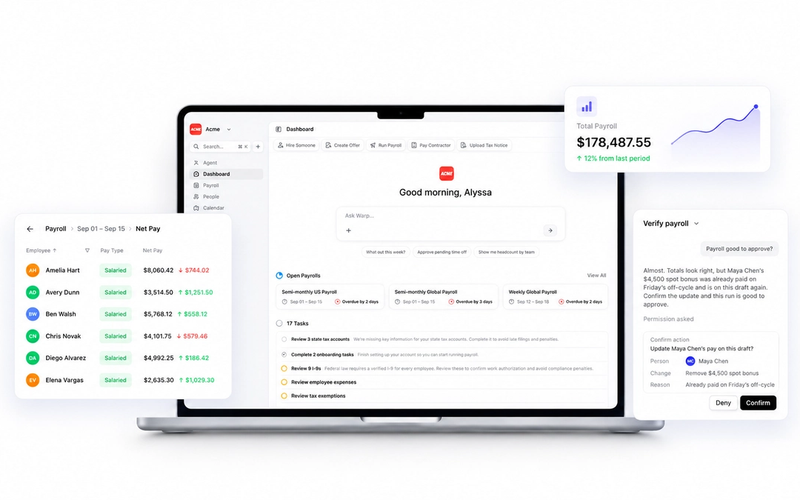
- One-click payroll: Run payroll in minutes, not hours. Need an off-cycle bonus payment? Do it yourself instantly instead of submitting a request to your PEO.
If you’re considering switching off of your PEO or EOR to a new payroll provider, check out our full migration guide.
If you're a small team of just founders/cofounders running payroll, you may not need a PEO at all. Modern payroll software like Warp can handle everything you need—multi-state compliance, tax filings, benefits administration—at a fraction of the cost.
The key question is whether you need the full HR outsourcing and large-group benefits access that PEOs provide, or just reliable payroll processing with built-in compliance.
Discover how Warp can help your startup run more efficiently by requesting a demo today.