
There's a version of HR digital transformation that most companies are running. They buy a new HRIS. They add a recruitment module and a performance dashboard. Three years and several subscription fees later, the HR team is managing more software than before and still sitting on hold with state tax agencies.
That's not transformation. That's accumulation dressed up as progress.
HR digital transformation, done right, is measurably different. It reduces the number of things HR has to touch, not just the interfaces they use to touch them. And in 2026, with AI agents capable of opening state tax accounts, filing payroll forms, and automatically resolving compliance notices, the gap between companies that have actually transformed and those that have merely upgraded is widening fast.
This article explores what HR digital transformation actually means, where most organizations stall, and what a practical roadmap looks like now that agentic AI has entered the picture.
What the Search Data Says About Where HR Leaders Are Right Now
Before getting into what transformation actually requires, look at what HR leaders and founders are searching for, because the pattern reveals something the conventional "digital transformation" narrative misses.
The data below compares US Google search trends for AI and HR-related year-over-year. The source is Google Trends, analyzed by Warp in July 2026.
| Keyword | Year-Over-Year Change |
|---|---|
| HR Digital Transformation | +1,750% |
| Agentic AI in HR | +1,000% |
| AI Automation in HR | +650% |
| AI in HR | +450% |
A few things stand out.
"HR Digital Transformation" search interest is up 1,750% year-over-year, the sharpest rise of the four terms. HR leaders aren't casually curious about transformation; they're actively researching it, and interest is accelerating faster than any adjacent term.
"Agentic AI in HR" is up 1,000%, and “AI Automation in HR” is up 650%. That's a fast-moving search cluster around a concept most HR software vendors haven't caught up to yet. It signals that a meaningful segment of the market is already looking for AI that acts, not just AI that advises.
Even the broadest term in the set, "AI in HR," is up 450%. None of these are incremental increases. HR leaders aren't asking whether to automate. They're asking how. Their HR platforms either have an answer, or they don't.
What Is HR Digital Transformation?
HR digital transformation is the process of fundamentally redesigning how HR operates. Not just digitizing existing processes, but rethinking what HR should and shouldn't be doing at all. It spans technology, workflows, data infrastructure, and organizational design.
The distinction that matters: digitization means converting a paper process to a digital one. Transformation means questioning whether that process should continue to exist in its current form.
In practice, HR digital transformation typically covers:
- Automating administrative and compliance tasks (payroll processing, tax filings, benefits enrollment)
- Moving from system-of-record HR to system-of-intelligence HR, where data informs decisions rather than just stores them
- Embedding AI into talent acquisition, workforce planning, performance management, and skills development
- Replacing manual government agency interactions with automated compliance infrastructure
The urgency is real. Gartner's CHRO Report found that 72% of HR leaders already recognize that reinventing HR workflows is essential to unlocking AI-driven productivity. SHRM's State of AI in HR 2026 found that 87% of CHROs forecast greater AI adoption within HR processes this year, up from 83% in 2025. The market is moving. The question is whether your HR function is moving with it or watching it happen.
Why Most HR Digital Transformation Efforts Stall
Most HR transformation programs underdeliver for a predictable reason: they use AI and technology to accelerate existing workflows rather than eliminate them.
A Deloitte study found that 59% of organizations take a technology-first approach to AI implementation, and those organizations are 1.6 times more likely to fail to extract expected value than those that take a human-centric approach. Technology is a multiplier. Applied to a broken workflow, it just scales the dysfunction.
These specific failure modes show up repeatedly in HR transformation efforts:
Adding tools without removing work. The average HR team today runs payroll software, a separate HRIS, a benefits platform, a compliance tool, and often a third-party accountant for state tax filings. Each system requires someone to input data, verify outputs, and manage exceptions. The tools didn't reduce HR's operational burden; they redistributed it.
Treating compliance as a service, not a system. Payroll compliance covers state tax registrations, quarterly filings, unemployment insurance accounts, and tax notice resolution. It remains largely manual across most organizations. Even companies using “modern” HR software still regularly navigate .gov sites, call state agencies, and pay accountants $150 or more per filing.
Confusing reporting for intelligence. Adding analytics dashboards gives HR leaders visibility into what happened. It doesn't improve what happens next. Real digital transformation in HR means using workforce data to make proactive decisions, not retrospective ones.
Underestimating the people side. McKinsey found that while nearly 8 in 10 organizations have deployed AI in at least one business function, only 1 in 5 have actually rebuilt their work processes around it. The transformation programs that generate returns pair AI deployment with workflow redesign and change management. They don't just provision access to tools and declare victory.
The Four Pillars Driving HR Digital Transformation Success
Regardless of where an organization sits on the transformation curve, four pillars determine whether the HR transformation effort succeeds.
1. Unified data infrastructure. HR transformation fails when employee data is fragmented across systems that don't communicate. A single source of truth that connects payroll data, benefits enrollment, compliance records, and performance data is the prerequisite for everything that follows. Without it, every automation effort runs into the same wall: the data isn't where the system expects it to be.
2. Process automation with human oversight. Automation handles the volume work. Human judgment handles exceptions, edge cases, and high-stakes decisions. The design principle: automate anything that has a deterministic right answer, and preserve human review for anything that doesn't. In practice, this means payroll processing that runs without manual intervention, with human review surfaced only when an exception falls outside normal parameters. With Warp, companies typically recover 10 to 20 hours per month in payroll operations alone.
3. Compliance as infrastructure, not a service. The most time-consuming HR work in most organizations involves state and federal compliance: tax registrations, quarterly payroll filings, notice resolution, and annual reporting. At traditional providers, multi-state compliance is a manual or third-party cost center. Companies expanding into new states routinely pay $200 or more per state registration to third-party vendors, often chalked up to the administrative cost of telling a government agency that your company exists. Treating compliance as infrastructure means that work is automated at the moment of hire, not billed separately per state and manually coordinated. That is the difference between compliance-as-a-service and compliance-as-infrastructure.
4. Change management and visible leadership. Oftentimes, the gap in leading a successful digital transformation isn't a technology problem; it's a people problem. Prosci's research found that 63% of organizations cite human factors as the primary challenge in AI implementation. The same study found that 43% attributed AI adoption failure specifically to insufficient executive sponsorship, and 38% to inadequate user training. Technology readiness is not the constraint; visible leadership is.
HR Digital Transformation Roadmap: Where to Start
The most common mistake in building an HR digital transformation roadmap is trying to do everything at once. The programs that succeed start narrow and move fast.
Months 1 to 3: Audit operational drag. Identify where HR time is actually going. Manual payroll corrections, compliance filings, government agency calls, spreadsheet reconciliations. These are the processes your HR digital transformation strategy should target first because they carry the highest time cost and the clearest path to automation.
Months 3 to 6: Consolidate and automate core operations. Move to a unified payroll and HRIS platform. Automate compliance filings and state tax account management. Eliminate manual touchpoints that only exist because the previous system required them.
Months 6 to 12: Layer in analytics and workforce intelligence. With operational data centralized and processes automated, the infrastructure for predictive HR is in place. Workforce planning, attrition modeling, and skills gap analysis become possible when you have clean, real-time data.
Year 2 and beyond: Continuous iteration. HR transformation is not a project with an end date. The organizations that sustain competitive advantage treat their HR function as a product: continuously tested, measured, and improved.
One benchmark worth keeping in mind: ADP's 2026 HR trends report found that 48% of large businesses have already adopted agentic technologies, and CHROs project 327% growth in agent adoption by 2027. Your HR digital transformation roadmap should account for this trajectory, not react to it after the fact.
What Agentic AI in HR Actually Looks Like in 2026
Most AI in HR discussions center on individual features: an AI-powered job description generator, a chatbot for employee questions, an automated resume screener. These are incremental improvements. The more significant shift is happening at the infrastructure layer.
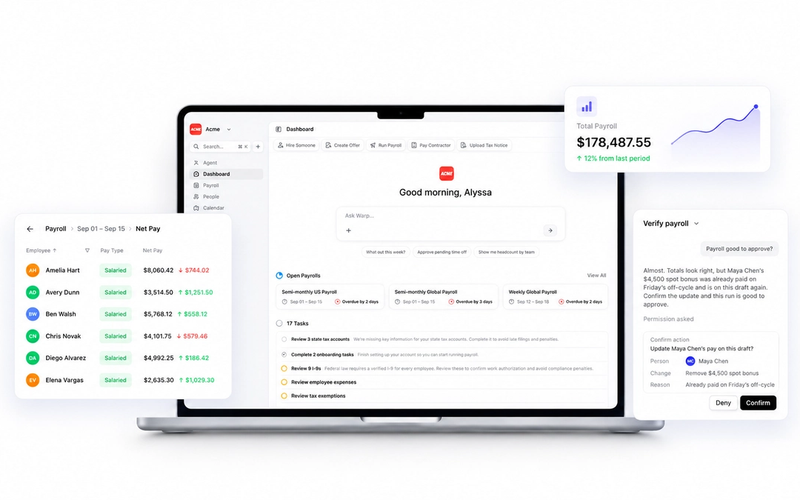
The organizing principle behind that shift is what Warp calls the Subtraction Economy. The last generation of HR software was built around addition: more dashboards, more integrations, more tools that HR teams still had to hand-crank manually. The next generation is being built around subtraction: how much work can be removed from the HR team's plate entirely, not managed differently, but removed.
Agentic AI, meaning systems that take multi-step actions autonomously rather than just responding to single prompts, is beginning to restructure how compliance-intensive work like payroll actually operates. Gartner forecasts that 40% of enterprise applications will embed task-specific AI agents by the end of 2026, up from less than 5% in 2024. The search data confirms the market is catching up: Google Trends shows US search interest in "Agentic AI in HR" up 1,000% year-over-year, and "AI Automation in HR" up 650% in the same period.
The practical implication: an HR team at a company scaling from 20 to 200 employees should not have to scale in proportion. If the operational layer is automated, including compliance filings, state tax account registrations, and benefits enrollment, the HR function stays lean while headcount grows. The work disappears. That is the benchmark for actual transformation.