
Last Updated: July 2026
The complete guide to leaving your Professional Employer Organization. Whether you've outgrown co-employment, want full control of your payroll and tax accounts, or are ready to switch to large-group health insurance, this page gives you everything you need: the reasons most companies leave, the exact checklist for leaving a PEO, and how to do it without disrupting a single paycheck.
Signs It's Time to Leave Your PEO
PEOs serve an important purpose for very early-stage companies. When you have 5-10 employees and don't have HR infrastructure in place, outsourcing payroll, taxes, and benefits to a co-employer can make sense. But as companies grow, the cracks become visible.
Here are 4 signs it’s time to leave your PEO:
- Costs are spiraling. PEOs charge 3-15% of your total payroll. For a 20-employee startup with $100K average salaries, that's $60K-$300K per year in PEO fees alone. As your team and salaries grow, the percentage-of-payroll model compounds against you.
- Loss of control. PEOs co-employ your team. They technically own your employee relationships, control your benefits data, and make decisions that affect your culture without your input. Tax filings happen under their EIN, not yours.
- Inflexibility. Want to offer an ICHRA instead of the PEO's group plan? Can't do it. Want to switch 401(k) providers? Not allowed. PEOs bundle everything because it benefits them, not you.
- Hidden fees everywhere. That “all-inclusive” pricing includes massive markups on benefits premiums, administrative fees that scale with headcount, and surprise charges for services you assumed were included.
If any of these sound familiar, you're not alone. The question isn't whether to leave; it's what to do next.
When to Leave a PEO
A PEO may still make sense if: you have fewer than 15 employees, no dedicated HR person, and the PEO's large-group benefits rates are meaningfully cheaper than what you could get independently. At this size, the convenience of bundled services can outweigh the downsides.
It's time to leave if:
- You have 25+ employees and a dedicated HR person who wants control over payroll and benefits
- You're approaching 50 employees and becoming eligible for large-group insurance
- Your percentage-of-payroll fees are growing faster than your team
- You want benefits flexibility including ICHRA, custom carriers, or plan designs the PEO doesn't support
- You need full visibility into your compliance filings and tax accounts
Leaving a PEO Mid-Year: What You Need to Know
Most companies prefer to exit at year-end (December 31), and for good reason. Leaving at year-end means:
- Employees receive a single consolidated W-2 from the PEO (covering January through December under their EIN)
- You begin the new year with a clean slate under your own EIN
- Social Security and Medicare wage bases reset naturally with the calendar year
- ACA compliance reporting covers a single, clean plan year
Leaving mid-year is possible, but carries specific consequences you need to plan for:
- Dual W-2s. Employees will receive two W-2s for the year: one from the PEO for the months they were co-employed, and one from your company for the months after the exit. This is confusing for employees and requires clear communication upfront.
- Payroll tax wage base reset. FICA taxes (Social Security, Medicare) and state unemployment insurance (SUI) have annual wage bases. When you leave a PEO mid-year, those wage bases can reset under your EIN, meaning higher-earning employees may have FICA taxes temporarily withheld again until the new wage base is reached. This reduces take-home pay temporarily.
- Benefits plan year interruption. If your PEO's benefits run on a calendar plan year and you leave in September, employees may lose coverage mid-plan-year. Transitioning to ICHRA or a new group plan mid-year triggers a 60-day special enrollment period, but employees need to actively re-enroll.
If you're locked into a contract with a mid-year renewal, the practical answer is to plan 60–90 days ahead and communicate clearly with your team.
Tax Implications of Leaving a PEO
Leaving a PEO triggers a specific set of tax account requirements that most companies underestimate until they're in the middle of the transition.
What you need to establish under your own EIN:
- Federal employer accounts (EIN registration is already yours, but federal deposit schedules, FUTA accounts, and 941 filing responsibilities transfer to you)
- State income tax withholding accounts in every state where you have employees
- State unemployment insurance (SUI) accounts in every state
- State-specific accounts: California SDI, New York DBL/PFL, New Jersey TDI, Washington Cares Fund, and others depending on where your team works
- Local tax accounts in cities with local income taxes (Philadelphia, New York City, Pittsburgh, and others)
Two W-2s at year-end & FICA wage base reset: When you transition off a PEO, you are set up as a new company under your own EIN. This means employees will receive two W-2s at year-end: one from the PEO covering the months under co-employment, and one from Warp covering the remainder of the year. It also means the Social Security and SUI wage bases reset from zero. For higher-earning employees, this means FICA taxes may be temporarily withheld again until they reach the annual cap under your EIN. This is standard for PEO exits and should be communicated clearly to employees upfront.
The good news: Warp's AI compliance engine opens every required account automatically. You don't fill out a single government form. Warp handles state registrations, deposit schedules, and ongoing filings all under your EIN, with full transparency.
Your Benefits Options After Leaving a PEO
When you leave a PEO, you lose access to their group health plan. This is often the biggest concern, but you have better options than you think.
Option 1: ICHRA (Individual Coverage HRA)
You set a monthly allowance and employees buy their own insurance from the individual marketplace. You reimburse them tax-free up to your set amount. Complete budget control, no surprise renewals, no risk pooling, no premium spikes. Common ranges: $300-800/month per employee. This is the option most startups leaving PEOs choose.
Option 2: Traditional Group Insurance
You become the plan sponsor and work with a broker to select carriers (Aetna, Blue Cross, United). Familiar for employees, but expensive at small scale. One high-cost claim can trigger 15-30% premium increases at renewal. Best for teams of 15-25 with predominantly young, healthy employees.
Option 3: Level-Funded Plans
This option is state by state, carrier by carrier specific and we have seen cost savings of up to 63% from a PEO plan. A level-funded plan provides you with detailed claims data and a ceiling of how much exposure your team has towards insurance costs. If your claims data is lower than anticipated, you can receive credits towards your premium at renewal which can be up to 2 months off!
Warp is a nationally licensed insurance brokerage (NPN: 22074328) that supports all of these models: ICHRA, small group, large-group, and level-funded. We'll run the numbers for your specific team demographics and show you what each option actually costs. No pressure, no commission games, just transparent pricing and honest advice.
The Complete Leaving-a-PEO Checklist
Use this checklist to manage your PEO exit. The timeline assumes a year-end exit starting in October, but it applies to any exit date with adjusted lead times.
8–12 Weeks Before Your PEO Exit Date
- Review your PEO contract. Confirm your notice period (typically 30–90 days), termination terms, and whether you can exit mid-year or are locked to a renewal date.
- Decide your exit date. Year-end (December 31) is simplest. If mid-year, see the mid-year considerations above.
- Choose your payroll platform. This is the most important decision. Your new platform handles all tax filings, registrations, and payroll runs going forward. Evaluate based on multi-state compliance capability, dedicated support, and migration experience.
- Determine your benefits strategy. ICHRA, small group, or large-group insurance? Work with a benefits advisor (or Warp's included Benefits Advisor) to compare costs for your specific team demographics.
- Notify your PEO in writing. Follow your contract's notice requirements. Document everything. Request a clear offboarding timeline from the PEO.
- Request all payroll and employee data. This includes: employee records, pay history, YTD payroll figures (for your own records and to accurately communicate wage base and W-2 implications to employees), PTO balances, tax account numbers, and copies of all filings made under their EIN.
- Identify which compliance obligations are currently handled by the PEO. State registrations, ACA reporting, workers' comp. Understand what you'll be taking over so nothing falls through the cracks.
4–6 Weeks Before Your PEO Exit Date
- Begin new state tax account registrations. Your new payroll provider should handle this. If doing it yourself, allow 4–6 weeks for some states (California, New York) to process registrations.
- Complete benefits planning. For group insurance: get carrier quotes, select a plan, and open enrollment. For ICHRA: finalize your monthly allowance and set up the HRA administration.
- Secure standalone workers' compensation coverage. Your PEO's workers' comp coverage ends when you leave. Get a standalone policy in place before your exit date.
- Set up your 401(k) if the PEO was administering it. Evaluate whether to stay with the same plan provider or switch. Ensure a seamless rollover for employee contributions.
- Communicate the transition to your employees. Your team needs to understand: what's changing, why, what they need to do, and what stays the same. Frame it as an upgrade, not a disruption. Warp provides templated employee communications for this.
- Prepare a benefits FAQ for employees. Especially for ICHRA transitions, employees need education on shopping for individual coverage on the marketplace.
2–4 Weeks Before Your PEO Exit Date
- Open employee enrollment for new benefits. Employees need time to make elections. For ICHRA, loss of PEO coverage triggers a 60-day special enrollment period on the marketplace.
- Verify your new payroll platform is configured. Pay schedules, direct deposit information, tax configurations, and state registrations should all be confirmed before the first payroll run.
- Prepare employees for two W-2s. Because Warp sets you up as a new company under your own EIN, employees will receive one W-2 from the PEO and one from Warp for the year. Let them know this in advance so it doesn't cause confusion at tax time.
- Confirm benefit effective dates. New coverage must start the day old coverage ends. Zero gaps.
- Brief your HR team on new processes. Who runs payroll, who fields employee questions, who manages benefits administration? Document the new operating model before the transition goes live.
On Your PEO Exit Date
- Confirm first payroll run under your own EIN. It should process normally, on schedule.
- Confirm new benefits are active. Check that ID cards are issued and coverage is confirmed with carriers.
- Notify employees that the transition is complete. Same pay dates, same direct deposits — just a better platform.
30 Days After Your PEO Exit
- Reconcile first carrier invoices. First-month billing errors are common. Review line by line.
- Confirm all state tax accounts are active and receiving deposits.
- Request copies of the final W-2s/1099s the PEO will issue for the portion of the year they administered payroll. For year-end exits, this should be one clean set covering the full year.
- Set a renewal cadence with your benefits advisor. Don't let next year's benefits decision become a fire drill.
The PEO Exit Timeline at a Glance
How to Talk to Your Team About Leaving the PEO
Employee communication is where most PEO exits succeed or fail. Your team needs to understand what's changing, why it's changing, and what they need to do. The good news: most employees notice things got better, not worse.
What NOT to do:
- Don't surprise anyone. Announce the transition at least 4 weeks before go-live.
- Don't underestimate the benefits change. Health insurance is personal. Give employees a dedicated channel to ask questions.
- Don't make it sound scary. The PEO wasn't their employer; you were. The platform is just changing.
Warp provides templated employee communications and your dedicated Account Manager helps coordinate the messaging timeline at no additional cost.
Case Study: How Push Digital Group Saved Tens of Thousands Leaving Their PEO
13% cost savings vs. PEO renewal | 70+ employees transitioned | 0 disruptions during transition
When two firms merged to form Push Digital Group, the result was a lean, 70-person digital political marketing agency operating across 18 states. Chief People Officer Timothy Nurnberger was dealing with a system built for a much smaller company.
"It worked when we were smaller. But with almost 70 employees, a dedicated HR function, and more complex needs, the PEO quickly became a bottleneck."
The cracks were visible everywhere: employees confused by simple updates, customer support meaning a 1-800 number and a wait, benefits options that rarely aligned with employees' needs, and costs that kept climbing.
After transitioning off their PEO, Push Digital Group avoided a 23% cost increase that their former provider had projected. Instead, they landed a 10% increase, effectively saving 13% and adding up to tens of thousands of dollars for both the company and employees.
"Now we actually know the value of what we're paying for. It's not some black box of bundled services where everything is opaque."
The shift didn't just save money. It gave HR its time back. Timothy stopped being the middleman between employees and the PEO. Employees got direct access to expert support, easy-to-use benefits tools, and faster resolution.
"Before, the tactical work took up huge portions of my day. Now I'm able to plan, build, and move the business forward."
For companies at a similar inflection point of 25–100 employees, outgrowing their PEO, wanting control and visibility, the pattern is consistent: exit the PEO, own your payroll, and use the savings to invest in your people.
How Warp Makes PEO Exits Simple
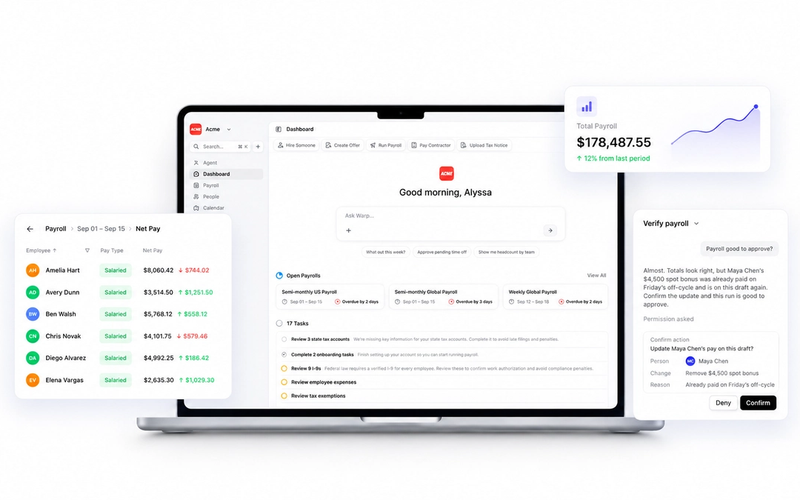
Warp is the only AI employee management platform built for companies graduating from PEOs. Instead of fighting for attention from an overloaded PEO rep, Warp's AI agents open every state tax account, file every payroll form, and resolve every tax notice automatically.
AI compliance engine replaces PEO manual processes. State registrations, tax filings, and notice resolution, all automated under your EIN. NY DBL/PFL, CA SDI, SF PPLO handled automatically with full transparency.
Licensed brokerage for benefits. We work with 30+ carriers including Oscar, Guardian, Aetna, United Healthcare, and Blue Cross Blue Shield. ICHRA, small group, or large-group insurance (50+ employees), your choice. Everything syncs with payroll automatically.
Dedicated Account Manager and Benefits Advisor. Every company gets personalized support that scales with you. Not a rotating cast of PEO reps, but a dedicated team that knows your business.
Simple setup, live in days. We handle employee data, tax account setup, benefits coordination, and onboarding. Most companies go live in under a week.
The result: companies run payroll, HR, and compliance with a fraction of the overhead. $35/employee/month flat, no percentage-of-payroll fees, no co-employment, no lock-in. Your tax accounts stay in your name. Your benefits are your choice. And you can leave anytime.
Learn more about Warp vs PEO here.
Frequently Asked Questions About Leaving a PEO
Can I leave a PEO mid-year?
Yes. Leaving a PEO mid-year is possible but requires more planning than a year-end exit. The main consequences are: employees receive two W-2s for the year (one from the PEO, one from your company), payroll tax wage bases may reset under your EIN for some employees, and benefits transitions trigger a 60-day special enrollment period. With proper planning and the right platform, none of these create lasting disruption.
What happens to my benefits when I leave a PEO?
Your PEO's group health plan coverage ends on your exit date. Loss of PEO coverage qualifies as a qualifying life event, giving employees a 60-day special enrollment period to select new coverage. You have three main options to replace the benefits: ICHRA (you set a monthly tax-free allowance; employees buy individual marketplace plans), traditional small-group insurance (you become the plan sponsor), or large-group insurance if you have 50+ employees.
Do I need to re-establish tax accounts when leaving a PEO?
Yes. Because your PEO filed payroll taxes under their EIN, all state and local tax accounts need to be established under your company's EIN. This includes state income tax withholding accounts, state unemployment insurance (SUI) accounts, and state-specific accounts like California SDI, New York DBL/PFL, New Jersey TDI, and others. Warp's AI compliance engine opens every required account automatically. You never fill out a government form.
What are the tax implications of leaving a PEO mid-year?
The main tax implication of a mid-year PEO exit is the potential FICA wage base reset. Social Security taxes apply up to an annual wage cap ($184,500 in 2026). Under a PEO, your employees' wages accumulate toward that cap under the PEO's EIN. When you leave mid-year, the cap restarts under your EIN — meaning higher-earning employees may have Social Security taxes withheld again until they reach the cap under your EIN. This is temporary but will reduce take-home pay for some employees for a period. The best way to mitigate this is to exit at year-end or, for mid-year exits, communicate clearly with affected employees in advance.
How long does it take to leave a PEO?
A well-planned PEO exit takes 8–12 weeks from decision to go-live. The main timeline drivers are: your PEO's notice period (typically 30–90 days), state tax account registration times (2–6 weeks depending on the state), and benefits enrollment timelines. Warp handles the tax registration and benefits setup in parallel, which is why most companies go live in under a week from the time we're engaged, even when the overall transition timeline spans 8–12 weeks.
I'm locked into a PEO contract. Can I still switch?
Review your contract carefully. Most PEO contracts have specific termination windows (often tied to renewal dates) and notice requirements. Some allow termination at any time with 30–90 days' notice; others lock you to annual renewal dates. If you're mid-contract, you may owe a termination fee or be required to fulfill the contract term.