
Last updated: June 2026
Warp operates a licensed insurance brokerage with active licenses in all 50 states.
Open enrollment is the annual window when employees can enroll in, change, or drop their employer's health and benefits plans for the coming plan year. Outside this window, employees generally cannot change their elections unless they have a qualifying life event. For employers, it is the one period each year when you set your plan lineup, communicate it, and lock in everyone's coverage.
Most guides on this topic are written for individuals shopping the public marketplace. This one is for the employer side: what open enrollment is, when it happens, and how to run it for a startup team without it becoming a fire drill.
What is open enrollment?
Open enrollment is a set period, chosen by the employer, during which employees can make benefits elections that take effect for the next plan year. During this window an employee can pick a medical plan, add or drop dental and vision, set their FSA contribution, adjust life or disability coverage, and add or remove dependents.
There are two versions of the term, and they get confused constantly:
The employer open enrollment is the one your team goes through. You decide the plans, set the window, and elections apply to your group health coverage.
The public marketplace open enrollment is the federal window for individuals buying coverage on their own, which runs from November 1 to January 15 in most states. This does not apply to employees who get coverage through your company.
If you offer group health insurance, your team is in the first category. The marketplace dates are irrelevant to them unless they leave the company or you stop offering coverage.
When does open enrollment happen?
There is no legally required date. As the employer, you set the window so that elections are finalized before your plan year begins. Most companies run open enrollment for two to four weeks, ending a couple of weeks before the new plan year starts.
Many startups align their plan year to the calendar year, which puts open enrollment in the late fall. But your plan year is whatever your carrier contract says it is. If your coverage renews in March, your open enrollment happens in winter, not fall. The trigger is your renewal date, not the calendar.
The practical deadline that matters is your carrier's submission cutoff. Every election has to be collected, confirmed, and sent to the carrier before that date, which is why a rushed two-day window almost always causes problems.
What is the difference between open enrollment and a special enrollment period?
Open enrollment is the scheduled annual window. A special enrollment period is an exception that opens when an employee has a qualifying life event, such as marriage, divorce, the birth or adoption of a child, or the loss of other coverage.
When a qualifying life event happens, the employee typically has 30 days to make a change that reflects it, like adding a new spouse or child. This matters because of how benefits are paid for. Most employer health premiums and FSA contributions run through a Section 125 cafeteria plan, which means they come out of pay pre-tax and are locked for the plan year. The qualifying life event is what legally allows a mid-year change to those pre-tax elections.
One common point of confusion: an HSA is different. Employees can change HSA contributions during the year without a qualifying life event, unlike an FSA, which is set at enrollment. The IRS sets out the rules for both in Publication 969.
What can employees change during open enrollment?
Open enrollment usually covers more than just the medical plan. A typical window lets employees:
- Choose or switch their medical plan, including moving between tiers
- Add, change, or drop dental and vision coverage
- Set or change their FSA election for the year
- Adjust employer-sponsored life, short-term disability, and long-term disability coverage
- Add or remove dependents such as a spouse or children
- Opt out of coverage if they have insurance elsewhere
Two things often sit outside the health open enrollment window. HSA contributions can usually be changed any time during the year. And 401(k) enrollment and contribution changes are typically allowed on an ongoing basis under most plans, not just once a year. It is worth telling employees which decisions are locked for the year and which are not, so they treat the medical and FSA choices with the attention they need.
What does an employer need to do to run open enrollment?
This is where most of the work lives. A clean open enrollment for a startup team follows roughly this sequence:
- Confirm your renewal. Get your renewal rates and any plan or network changes from your broker well before the window opens. This is the input that drives everything else.
- Decide your plan lineup. Choose which plans to offer, how much the company will contribute, and whether you are changing carriers or how your plan is funded. Lock this before you communicate anything.
- Set the window and the deadline. Pick a two to four week period that ends before your carrier's submission cutoff. Put both dates in writing.
- Communicate clearly, more than once. Send a plain-language summary of what is changing, what each plan costs the employee per paycheck, and exactly what they need to do. Plan on at least one reminder, because people wait until the last day.
- Decide active or passive enrollment. In passive enrollment, current elections roll over automatically if an employee does nothing, except the FSA, which almost always requires a fresh election each year. In active enrollment, employees must re-elect or they lose coverage. Active enrollment produces cleaner data but needs more follow-up.
- Collect and confirm elections. Track who has enrolled and chase the people who have not. Confirm each election back to the employee so there are no surprises in January.
- Submit to the carrier and update payroll. Send final elections to the carrier before the cutoff, then update payroll deductions so the new pre-tax amounts hit the first paycheck of the plan year. A mismatch here is one of the most common and most annoying errors.
What are the most common open enrollment mistakes?
The failure modes are predictable, which means they are avoidable:
- A window that is too short, so non-responders miss the deadline
- Communicating plan changes without showing the per-paycheck cost, which generates a wave of questions
- Forgetting that FSA elections do not roll over and must be re-entered every year
- Missing the carrier's submission deadline, which can delay or jeopardize coverage
- Updating the carrier but not updating payroll deductions, so the first paychecks of the year are wrong
- Treating a qualifying life event mid-year as if it has to wait for the next open enrollment
Most of these come down to two things: communication and reconciliation. The companies that run open enrollment smoothly are the ones that over-communicate up front and reconcile elections against payroll before the plan year starts.
How Warp handles open enrollment
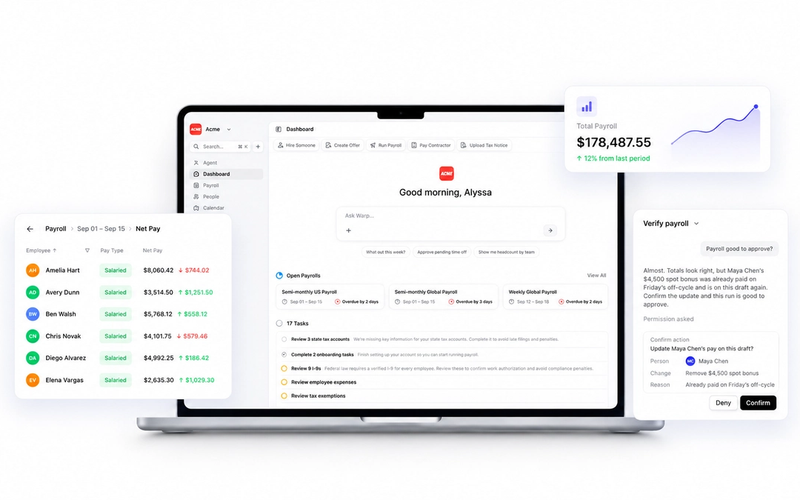
Warp is an AI-native HR and payroll platform built for ambitious companies, and benefits run natively inside it rather than through a disconnected portal. Warp operates as a licensed insurance brokerage with direct relationships across more than 30 carriers and no markup on premiums, so the plans your team sees during open enrollment are real market options, not a marked-up marketplace.
Every company gets a dedicated Account Manager and Benefits Advisor included. They help you confirm your renewal, shape your plan lineup, and run the enrollment window, so the sequence above does not land entirely on your operations lead. Because brokerage, benefits administration, and payroll live in one system, elections flow straight into payroll deductions without a manual reconciliation step, and Warp's AI agents handle qualifying life events and the downstream updates as they come up during the year.
The goal is simple. You decide what to offer your team, and the administrative weight of open enrollment is something you mostly do not have to carry. To see how benefits work inside the platform, visit Warp's benefits page, or compare funding approaches in our guide to employer-sponsored health insurance.
Frequently Asked Questions
Is open enrollment mandatory for employers? There is no law requiring a specific open enrollment date, but if you offer group health insurance, your carrier contract defines a plan year and an enrollment window tied to it. In practice you have to run one to renew coverage and collect elections for the new plan year.
What happens if an employee misses open enrollment? If you run passive enrollment, their current elections usually roll over, though they will need to re-elect an FSA. If you run active enrollment, they can lose coverage until the next window unless they have a qualifying life event. This is why reminders and a clear deadline matter.
How long should an open enrollment period be? Two to four weeks is typical. The window needs to be long enough for employees to review options and ask questions, but it must close with enough buffer to confirm elections and submit them before your carrier's deadline.
What is the difference between active and passive enrollment? In passive enrollment, employees keep their existing elections automatically if they do nothing, with the FSA as the usual exception. In active enrollment, everyone must make a selection or lose coverage. Active enrollment gives you cleaner, more current data at the cost of more follow-up.
Does open enrollment apply to 401(k) contributions? Usually not. Most 401(k) plans let employees enroll and change contributions throughout the year, so retirement decisions are not locked to the health open enrollment window. Tell employees which choices are annual and which are not.