
Key Takeaways:
- AI agents for HR differ from HR chatbots because they do more than answer questions. They actually file, register, enroll, and resolve tasks.
- AI agents work best for operational HR tasks that are repetitive, follow clear procedures, and happen often. Examples include state tax registration, payroll filings, and setting up new hires.
- A good HR agent uses the same permissions as the person it supports, records every action it takes, and asks a human for help when a decision needs judgment.
- Judgment calls like terminations, compensation decisions, and investigations should stay with people.
When people talk about AI agents for HR, they usually focus on recruiting tasks like screening resumes, scheduling interviews, and writing job descriptions. That’s helpful, but it overlooks the tasks that take up most HR time in growing companies, such as managing tax accounts, filings, notices, and benefits enrollments.
What are AI agents for HR?
AI agents for HR are AI systems that manage an HR workflow from beginning to end. You give the agent a goal, like “onboard this new hire” or “resolve this tax notice.” The agent breaks the goal into steps, works within your HR, payroll, and IT systems to complete them, checks the results, and adjusts when something doesn’t go to plan.
Four things separate an agent from other AI in HR:
- Context: It knows your business and each employee: their role, work location, compensation, benefits, and history. Adding someone in Pennsylvania means one thing for a salaried engineer and something different for an hourly contractor, and the agent knows the difference.
- Reasoning: It works out what a task actually requires instead of following a fixed script. A new state hire may mean opening two tax accounts or five, depending on the state and the company’s existing footprint.
- Action: It uses real system access to do the work. It files the form, submits the enrollment, and creates the account, then confirms each step succeeded.
- Governance: It acts only within the permissions of the person it represents. It records every action along with the reason for it, and it hands off to a human when a task calls for judgment or approval.
Agents can run autonomously on a schedule, like a pre-payroll variance check each cycle, or they can respond to events like a signed offer letter or a notice from a state agency. This is what sets true agents apart from other HR tools that claim to be ‘agentic,’ a trend sometimes called AI agent washing.
AI agent vs. HR chatbot vs. HR automation
| HR chatbot | Traditional HR automation | AI agent for HR | |
|---|---|---|---|
| What it does | Answers questions, drafts text | Runs fixed, pre-built rules | Plans and completes multi-step work |
| Handles exceptions? | No, hands back to you | No, breaks or stops | Yes, reasons through them or escalates |
| Takes action in systems? | Rarely | Only the steps it was scripted for | Yes, within set permissions |
| Runs without a prompt? | No | Yes, on triggers | Yes, on schedules or events |
| Keeps a rationale? | No | Logs steps only | Records what it did and why |
AI agent adoption is still in the early stages. According to Gartner, only 17% of organizations use AI agentsnow, but over 60% expect to adopt them within two years. This gap makes it important to know which tasks are ready for agents today.
Why operational HR is where agents fit first
HR work falls into two categories. Some tasks need a person, like building culture, coaching managers, or having tough conversations. The rest is procedural work, which is repetitive and rule-bound.
That second category is bigger than most teams realize. Warp’s analysis of multi-state payroll found:
- Opening state tax accounts takes 3 to 8 hours per state, depending on where you hire.
- Every new hire brings a state W-4, a new hire report, at-hire notices, and a local tax lookup. That averages 38 minutes per person, and reaches 82 minutes in states like California and Ohio.
- The IRS estimates employers spend more than 60 hours a year on federal employment tax paperwork alone.
None of these tasks require judgment. They need accuracy, persistence, and knowledge of rules in all 50 states. This is exactly what AI agents do well.
10 HR tasks AI agents can fully automate
1. Registering your company in a new state
The manual version: You hire someone in Colorado. Now you need a withholding account, an unemployment insurance account, and possibly a foreign qualification, each on a different .gov site with its own login, forms, and wait times. Miss one and the penalties start to compound.
What an agent does: It sees the new work location, identifies every account the state requires, and opens them. If you are unsure when a remote hire creates an obligation, our guide to state nexus and payroll covers the rules.
Human role: None, unless the state asks for an officer signature.
2. Filing recurring payroll tax forms
The manual version: File Form 941 every quarter, submit state wage reports on their own schedules, file FUTA and state unemployment in January, and send W-2s and 1099s by the end of January. The IRS charges 5% of the unpaid tax per month for a late 941, and states add their own penalties.
What an agent does: It prepares and files every federal, state, and local form on time, every time. You can see what is coming on the compliance calendar, but you do not have to act on it.
Human role: Review it, if you want. Most teams don’t.
3. Resolving tax notices
The manual version: A letter arrives saying your SUI rate changed, or a deposit was short, or a filing is “missing.” Someone has to work out whether it is real, find the records, and call the agency. That is often an afternoon on hold.
What an agent does: It reads the notice, matches it against filings and payments, and responds to the agency with the right documentation. Warp resolves 80% of tax notices instantly this way.
Human role: A specialist steps in for the rare notice that needs a phone call or a judgment call.
4. Checking payroll variances before payroll runs
The manual version: Someone scans the payroll register for anything that looks off: a doubled bonus, a missed raise, a withholding change. At 15 employees, that is tedious. At 150, errors slip through.
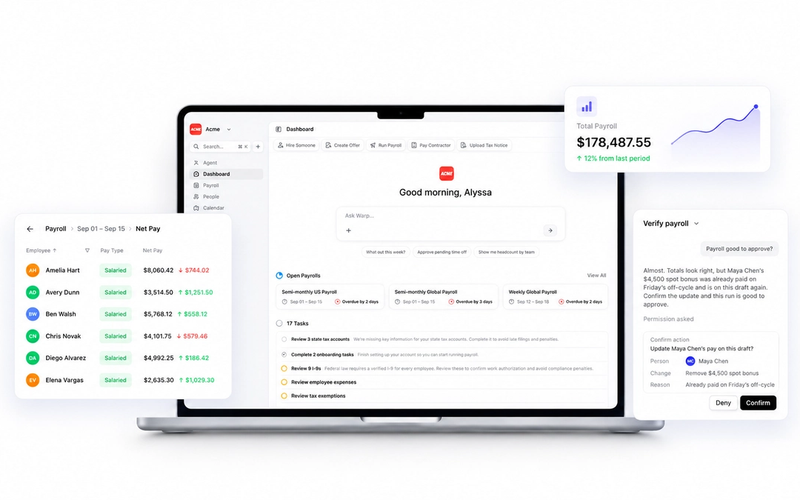
What an agent does: It compares each run against the last one and against what it knows about each employee, and flags variances with an explanation before any money moves.
Human role: An admin approves or corrects the flagged items. Money movement should always have hard limits the agent cannot change.
5. Enrolling new hires in benefits and a 401(k)
The manual version: Send the enrollment link, chase the new hire, check eligibility windows, submit to the carrier and the 401(k) provider, then confirm it went through. Late enrollments create coverage gaps and awkward conversations.
What an agent does: It enrolls each hire based on location, role, and eligibility; follows up until elections are made; and confirms with carriers.
Human role: A benefits advisor helps employees who want guidance choosing a plan.
6. Setting up accounts and devices for new hires
The manual version: IT orders a laptop, creates Google and Slack accounts, and adds the person to the right groups, often the day before they start or the day after.
What an agent does: When the offer is signed, it orders the laptop, creates accounts with the right access, and sends a first-day message. For device setup and security, see how Warp’s device management works.
Human role: The manager picks the welcome lunch spot.
7. Answering employee questions about pay, PTO, and policy
The manual version: “How much PTO do I have?” “Why is my paycheck different this month?” “Do we get Juneteenth off?” Each question is small. Together they fill an HR inbox.
What an agent does: It answers using the employee’s actual pay data, balances, and your written policies, and shares only what that employee is allowed to see. A clear PTO policy makes these answers more consistent.
Human role: Route sensitive questions, like leave related to a medical issue, to a person.
8. Running new hire check-ins
The manual version: Everyone agrees 30-day check-ins matter. Few teams do them consistently once hiring picks up.
What an agent does: It sends every new hire a 30-day check-in on schedule, collects responses, and summarizes them for the manager. With a plain-language workflow, you can set this up once and forget it.
Human role: The manager has the actual conversation. The agent makes sure it happens.
9. Tracking contractor tax forms
The manual version: Collect a W-9 from each US contractor and a W-8BEN or W-8BEN-E from each international one, then remember that W-8 forms expire after three years and need a new one when a contractor’s entity type changes.
What an agent does: It requests the right form at onboarding, tracks expirations, and requests renewals automatically.
Human role: None for routine renewals.
10. Assigning state-required compliance training
The manual version: States like California, New York, and Illinois require harassment prevention training on set schedules. When someone moves states, or you hire in a new one, the requirement changes, and tracking it falls to whoever remembers.
What an agent does: It assigns the right training based on each employee’s location, reminds them until it is done, and keeps completion records next to the employee file.
Human role: None, until an audit, when the records are already there.
What AI agents for HR should not do autonomously
Agents are good at procedural work. They should not be making judgment calls about people. Keep a human in charge of:
- Terminations and disciplinary action
- Compensation and promotion decisions
- Workplace investigations and complaints
- Anything involving medical or protected leave beyond routing the request
- Moving money beyond set limits
The right setup lets you choose, task by task, whether the agent only recommends, acts after a person approves, or acts on its own. Start with approval required, then loosen it for certain tasks as you see the record.
How to evaluate AI agents for HR: 6 questions to ask
Most AI HR tools sit on top of software that was designed for humans to click through. That limits what the agent can do. Before you buy, ask:
- Can it take action, or does it only answer? Ask for a live example of it completing a task end to end.
- Whose permissions does it use? It should only access or change what the person it acts for can.
- Is there a record of every action and why? You need an identity, scope, and written rationale for each step.
- Can you undo what it did? Every action should have a rollback.
- Are there limits it cannot override? Money movement should have hard caps the agent cannot change.
- What happens when it gets stuck? It should bring in a named person, either someone on your team or a specialist from the vendor, not leave a ticket in a queue.
Where Warp Agent fits
Warp is the only AI-native HR and Payroll platform built for ambitious companies. Instead of clicking through clunky dashboards or government websites for taxes, Warp Agent opens every state tax account, files every payroll form, and resolves every tax notice - automatically.
With Routines, Warp Agent handles work from start to finish. When an offer is signed, it can register the employee in a new state, set up payroll, enroll benefits and a 401(k), order a laptop, create Google and Slack accounts, and send a first-day message. You can write your own Routines in plain language and choose if the agent recommends, waits for approval, or acts on its own.
Frequently asked questions
What are AI agents for HR?
AI agents for HR are AI systems that own an HR workflow, such as onboarding a new hire or resolving a tax notice, and carry it through from start to finish. They use context about your business and employees to plan the steps, act inside your HR and payroll systems within set permissions, and record what they did and why. When a task needs judgment or approval, they bring in a person.
How are HR AI agents different from HR chatbots?
A chatbot answers questions and hands the work back to you. An HR AI agent completes the work, handles exceptions, and escalates to a person only when it needs judgment.
Can AI agents run payroll and tax compliance?
Yes, when they are built into the payroll system itself. Agents can open state tax accounts, file federal and state forms, check payroll variances, and resolve tax notices. Money movement should still have hard limits and approval rules.
Are AI agents for HR safe to use with employee data?
They can be, if each action is tied to an identity and scope. Look for agents that only access what the person they act for can see, keep an audit trail, and support rollback.
Will AI agents replace HR teams?
No. AI agents take over procedural, repetitive work so HR teams can focus on culture, talent strategy, and employee relationships. Judgment calls like terminations and compensation should stay with people.