
Every HR and payroll vendor now claims AI agents. Walk through any HR tech conference, open any vendor pricing page, or sit through any demo and you'll hear the same pitch: autonomous agents that handle compliance, file your taxes, onboard your employees, and free your team from manual work.
Most of them are lying. Not in a dramatic fraud sense, but in the way that has a name now: agent washing.
Gartner coined the term, defining it as "the rebranding of existing products, such as AI assistants, robotic process automation (RPA), and chatbots, without substantial agentic capabilities." The firm estimated that out of thousands of vendors claiming to offer agentic AI, only about 130 are genuinely building the real thing. That means if you have five HR and payroll demos this quarter, the statistical odds are strong that at least four of them are showing you a workflow engine wearing a name tag that says "agent."
This matters more in HR and payroll than almost anywhere else. Payroll errors cost real money and real regulatory exposure. A "compliance agent" that sends you an email alert is not the same as one that opens the state tax account, files the form, and resolves the notice automatically. The difference between those two things can be tens of thousands of dollars in penalties and dozens of hours of manual work per year.
Here is what agent washing looks like in HR and payroll specifically, how to spot it, and what to demand instead.
What AI Agent Washing Actually Is
The term intentionally echoes greenwashing: a marketing claims problem, not a technology problem. A vendor does not need to be incompetent to engage in agent washing. They may have a perfectly functional automation product. The problem is that they're selling it as something categorically different from what it is.
Gartner's framework breaks down what actually distinguishes a real agent from its washed alternatives:
- RPA (robotic process automation) follows a pre-programmed script. It clicks the same buttons in the same order, and it breaks the moment anything changes. Giving it a conversational interface does not make it an agent.
- Chatbots respond to prompts. They can chain a few steps together, but every step waits for a human to initiate it. They have no goal of their own.
- AI assistants surface information, generate drafts, and recommend actions. They help you do the work. They do not do the work.
- Real AI agents have a goal, choose their own tools, adapt when they encounter unexpected states, and complete multi-step work with minimal human intervention. They act. They do not just inform.
The dividing line for buyers is simple: does the system do the work, or does it tell you about the work?
The demand data tells you why Agent Washing works. Searches for "agentic AI in HR" grew 234% year-over-year, and SHRM found 87% of CHROs are planning to expand AI adoption this year. Buyers want agents. The problem: Gartner's 2026 CIO survey found only 17% of organizations have actually deployed genuine AI agents, while more than 60% expect to within two years.
Why Payroll Is the Perfect Target for AI Agent Washing
HR and payroll software is unusually vulnerable to agent washing for two reasons.
The category is complex enough to obscure. Payroll involves dozens of moving parts: multi-state tax registrations, quarterly filings, year-end W-2 reconciliation, benefits deductions, equity withholding, notice management across 50 state agencies. Most buyers are not experts in all of it. That complexity creates room for a vendor to gesture at a dashboard full of data and call it "AI-powered compliance."
Automation has always been part of payroll. Legitimate automation has been a core selling point of payroll software for 20 years. Rules-based tax calculation, auto-generated pay stubs, scheduled direct deposits: these are table stakes. The vocabulary of "automation" has primed buyers to accept automation dressed up as agency. When a vendor says "our AI automatically calculates your taxes," they may simply mean the software runs a formula. That was true in 2006. Calling it an agent in 2026 does not change what it does.
The Four Patterns of Payroll AI Agent Washing
1. Dashboard AI Presented as Agents
The most common pattern: an analytics or reporting interface gets renamed as an "AI agent." You get a dashboard that shows your multi-state tax obligations, flags potential issues, and generates PDF reports. The vendor calls it a compliance agent.
It is not an agent. It is a reporting tool. It surfaces information and stops there. You still have to log in to each state portal, register for new accounts, file the forms, and respond to notices yourself.
The test: ask the vendor to walk you through what happens when your company hires its first employee in a new state. Does the system automatically register you for that state's withholding and unemployment tax accounts? Or does it show you a checklist and link you to the relevant .gov pages?
2. Chatbots Relabeled as HR Agents
Several major HRIS platforms have embedded conversational interfaces and called them agents. Employees can ask questions in natural language, get answers about their PTO balance, or request a pay stub. That is genuinely useful, but it is not an agent.
A chatbot responds to what you ask. An agent pursues a goal without waiting to be asked at every step. When an employee's address changes and affects their state withholding, does the "agent" automatically update the tax registration, notify the relevant agencies, and adjust the deduction? Or does it answer follow-up questions from HR?
Watch the verbs in the vendor demo. "Our agent tells you when...", "our agent notifies you about...", "our agent surfaces..." all describe a chatbot. "Our agent opens...", "our agent files...", "our agent resolves..." describe an agent.
3. Scheduled Automation Called Autonomous
This one is subtle. Many payroll platforms have a feature that runs payroll automatically on a set schedule, with rules you configured in advance. This is legitimately useful, but it is also not an agent.
Autonomous means the system can handle novel situations by reasoning about them. A scheduler runs the same playbook every two weeks. When something unexpected happens, a scheduler either fails or sends you an alert. An agent adapts. When your quarterly FUTA filing is due, a real agent knows what to do across the jurisdictions where you operate and handles it. A scheduler does nothing until it is programmed to do something.
4. Alert Systems Marketed as Compliance Agents
This pattern is especially dangerous because it feels like AI work. The platform monitors your payroll data, detects that you received a state tax notice, and sends you a notification: "Action required: respond to California EDD notice by [date]."
That is a monitoring tool with a notification system. A compliance agent would receive the notice, triage it, draft the response, and submit it. You would see it in a log afterward, not in your inbox as a task.
For a startup operating in 8 states, manual notice management means hours of work per month and real penalty exposure when you miss a deadline. A system that alerts you is slightly better than nothing. A system that resolves the notice is a different product category.
What Real Payroll Agents Actually Do
Real payroll agents have tool access to external systems, not just internal databases. They can navigate government portals, submit forms to agency APIs, and take real actions.
The category of real agent-executed payroll work includes: opening state tax accounts when you expand, registering for new employer account numbers, filing quarterly and annual payroll tax returns, responding to and resolving state agency notices, reconciling discrepancies across jurisdictions, and ensuring accurate withholding as local rates change mid-year.
If a vendor cannot point to each of those things and say exactly how their system executes them, you are looking at a monitoring tool with a good brand.
Six Questions to Ask Any Payroll Vendor
These questions come directly from what distinguishes genuine payroll agents from well-marketed automation. Ask them before the contract, not after.
1. When we hire in a new state, what exactly happens?
You want a specific, walkable answer: the agent detects the hire, automatically initiates the state registration, files the required forms, and confirms the account is active. If the answer involves a checklist you complete yourself, that is not an agent.
2. What percentage of payroll runs require human intervention?
This is the Presto Automation question. The SEC charged Presto in January 2025 for claiming its AI eliminated human involvement when most orders still required human intervention. A real agent vendor will give you a specific, measured number. A washed vendor will redirect to the demo.
3. What happens when you receive a state tax notice?
Does the system resolve it or alert you about it? Ask them to show you an actual notice resolution, not a description of the feature.
4. Can I see the audit trail for the last 30 days?
Every action a genuine agent takes should generate a timestamped, evidence-linked record. You should be able to see what it did, why, and what the outcome was. If the audit trail is vague or incomplete, the "agent" is not taking traceable actions.
5. What is your documented first-pass filing accuracy rate?
Vague claims like "highly accurate" are not an answer. Ask for a number and ask how it is measured.
6. Which jurisdictions do your agents handle without manual configuration?
A real agent should handle novel states it has not been pre-programmed for. A rules-based system handles exactly the states someone built rules for, and nothing else.
If a vendor answers these questions confidently with specifics, you are probably talking to one of the genuine minority. If they redirect to the feature list, you are not.
FAQ
What is AI agent washing?
Agent washing is a term for rebranding existing products, including chatbots, automated workflows, and reporting tools, as AI agents without building genuine agentic capabilities.
How do I know if a vendor's AI claims are real?
Ask what the system actually executes versus what it surfaces. Genuine payroll agents open state tax accounts, file forms, and resolve notices autonomously. Systems that alert you, recommend actions, or show you dashboards require human execution of the actual work. The key verbs are opens, files, and resolves, not notifies or surfaces.
Is agent washing illegal?
The FTC brought more than a dozen AI-washing enforcement actions in 2025 under its Operation AI Comply initiative, and the SEC charged Presto Automation in January 2025 for misrepresenting the autonomy of its AI product. While the term "agent washing" is not itself a legal category, misrepresenting product capabilities in a material way creates real regulatory exposure for vendors.
Does Warp charge extra for agent-executed compliance work?
No, Warp does not charge extra. State tax account setup, form filing, and notice resolution are core to what Warp does, not add-on services.
The Real Test
Every vendor will show you a clean demo. The question is what happens when your payroll has a discrepancy the week before a quarterly filing deadline, or when you get a notice from a state agency you expanded into three months ago.
Agent washing collapses at that point. A real agent handles it. A relabeled workflow sends you an alert and waits.
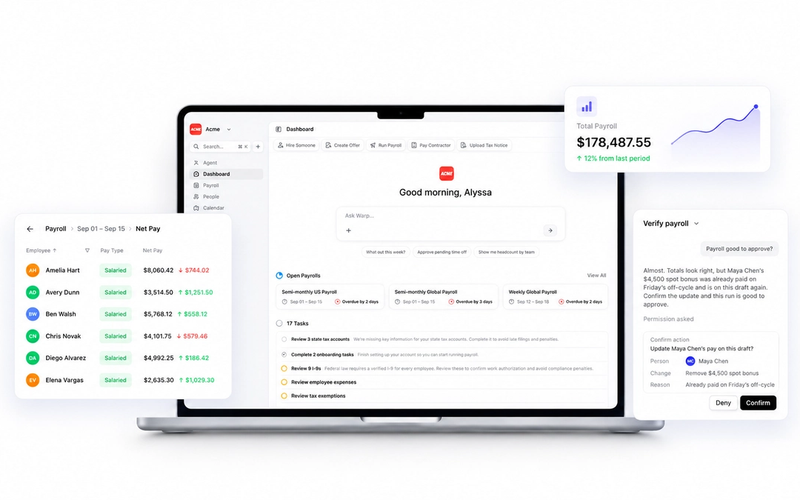
With thousands of companies trusting Warp to stay compliant while they scale, our AI agents have handled state tax accounts, payroll filings, and compliance notices across every US state and jurisdiction. Not alerting, not flagging, not recommending. Opening, filing, resolving.
If you are evaluating payroll vendors and want to see what genuine payroll agents look like in practice, book a demo with Warp and bring the six questions above to the conversation.