
Last updated: June 2026
Warp operates a licensed insurance brokerage with active licenses in all 50 states.
COBRA is a federal law that lets employees and their dependents keep their employer's group health coverage for a limited time after they would otherwise lose it, for example after a layoff or a cut in hours. The person who continues coverage pays the full premium themselves. For employers, COBRA is a set of notice and timing obligations that start the moment someone loses coverage.
Most COBRA explainers are written for the person who just lost their job. This one is written for the employer who has to administer it, including the first question many founders actually have, which is whether COBRA applies to their company at all.
What is COBRA?
COBRA stands for the Consolidated Omnibus Budget Reconciliation Act. It gives employees and their families the right to continue the group health coverage they had through work for a limited period after a qualifying event such as job loss, a reduction in hours, divorce, or the death of the covered employee. The coverage is the same plan they already had, but the former employee now pays the full cost.
COBRA applies to both fully insured and self-insured plans, and an employer has to comply even if it does not contribute to the premium. The full federal rules are maintained by the U.S. Department of Labor in its Continuation of Health Coverage (COBRA) resources.
How does COBRA work, step by step?
From the employer's side, COBRA runs on a fixed sequence with short deadlines:
- A qualifying event happens. An employee is terminated, has their hours reduced below the threshold for coverage, or another qualifying event occurs.
- The employer notifies the plan administrator within 30 days. For events the employer knows about (termination, reduction in hours, death, Medicare entitlement), the employer has 30 days to notify the plan.
- The plan administrator sends an election notice within 14 days. The qualified beneficiary gets a notice explaining their right to continue coverage. If the employer is also the plan administrator, the two windows combine into a single period of up to 44 days.
- The beneficiary has at least 60 days to elect. The election period runs from the later of the date the notice is provided or the date coverage would end. Each qualified beneficiary can elect independently.
- The beneficiary pays the premium. The first payment is due within 45 days of electing, and it can be backdated to the loss of coverage so there is no gap.
- Coverage continues for the applicable period. How long depends on the qualifying event, covered below.
The short windows are where employers get into trouble. A missed 30-day notification or a botched election notice during a layoff is a common and avoidable mistake.
Does COBRA apply to my company?
This is the question to answer first, because the answer is often no.
Federal COBRA applies to group health plans sponsored by employers that had 20 or more employees on more than half of their typical business days in the prior year. Employers with fewer than 20 employees are generally not subject to federal COBRA.
That does not mean a smaller company is off the hook. Most states have their own continuation laws, often called "mini-COBRA," that require smaller employers to offer similar continuation coverage. The rules, the size thresholds, and the length of coverage vary by state, so a 12-person startup in one state may have a continuation obligation that an identical company in another state does not.
For a growing startup, the practical takeaway is that your obligation can change as you cross 20 employees, and that even below 20 you may owe continuation under state law. This is worth confirming for your specific state and headcount rather than assuming.
What are COBRA qualifying events, and how long does coverage last?
The qualifying event determines both who is eligible and how long coverage can last.
| Qualifying event | Who can continue | Maximum coverage |
|---|---|---|
| Termination (except for gross misconduct) | Employee and dependents | 18 months |
| Reduction in hours below the coverage threshold | Employee and dependents | 18 months |
| Employee becomes entitled to Medicare | Spouse and dependents | Up to 36 months |
| Divorce or legal separation | Spouse and dependents | 36 months |
| Death of the covered employee | Spouse and dependents | 36 months |
| Dependent child loses dependent status | That child | 36 months |
There is also a disability extension. If a qualified beneficiary is determined by the Social Security Administration to be disabled during the first 60 days of COBRA coverage, the 18-month period can be extended by 11 months, to a maximum of 29 months. One nuance worth flagging: termination for gross misconduct is not a qualifying event, so it does not trigger COBRA at all.
How much does COBRA cost?
The former employee pays the premium, not the employer. A plan can charge a qualified beneficiary up to 102 percent of the full cost of the coverage. That is the entire premium, both the share the employee used to pay and the share the employer used to pay, plus a 2 percent administrative fee.
During the 11-month disability extension, the plan can charge up to 150 percent of the cost. This is why COBRA is often expensive for the person electing it: they are now paying what the company used to cover.
What are the employer's COBRA responsibilities?
COBRA is primarily an administrative and notice obligation, and the burden sits with the employer and the plan administrator. The core duties are:
- Provide a general COBRA notice to covered employees and spouses when they first enroll in the plan
- Notify the plan administrator within 30 days of a qualifying event the employer is responsible for
- Ensure the election notice goes out within the required window
- Track election periods, premium payments, and coverage end dates for each qualified beneficiary
- Keep records that demonstrate the notices were sent on time
Getting this wrong has real consequences. Noncompliance can trigger excise taxes under the Internal Revenue Code and penalties under ERISA, on top of potential liability for a former employee's medical costs. The Department of Labor publishes An Employer's Guide to Group Health Continuation Coverage Under COBRA that lays out the obligations in full. Because this is genuinely a compliance function, it is worth treating it as one rather than a one-off task during a layoff.
How Warp handles continuation coverage
Continuation coverage is exactly the kind of obligation that slips during a layoff or a fast offboarding, because the clock starts the day coverage would end and the notice windows are short.
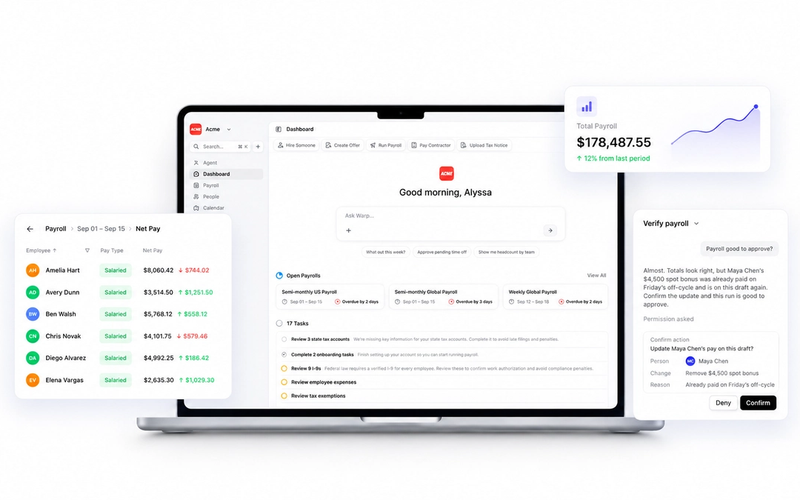
Warp is an AI-native HR and payroll platform built for startups, with benefits administered natively alongside payroll rather than in a separate system. Every company gets a dedicated Account Manager and Benefits Advisor included, and Warp's AI agents track qualifying life events and the coverage changes that follow them, so a termination or a change in hours does not quietly turn into a missed notice. Because Warp operates a licensed insurance brokerage and runs benefits in the same system as payroll, the people who manage your plan are the same ones who help you handle continuation correctly.
Your Benefits Advisor can also answer the threshold question up front: whether your headcount and state put you under federal COBRA, under a state continuation law, or neither. To see how benefits work inside the platform, visit Warp's benefits page, or read our guide to employer-sponsored health insurance for how group coverage fits together.
Frequently Asked Questions
Who pays for COBRA, the employer or the employee? The former employee pays. A plan can charge a qualified beneficiary up to 102 percent of the full cost of coverage, which includes both the employee and former employer shares plus a 2 percent administrative fee. The employer is not required to contribute.
How long does COBRA coverage last? It depends on the qualifying event. Termination or a reduction in hours allows up to 18 months. Events such as divorce, the death of the covered employee, or a dependent aging out allow dependents up to 36 months. A disability determination can extend the 18-month period to 29 months.
Does COBRA apply to companies with fewer than 20 employees? Federal COBRA generally does not apply below 20 employees, but most states have their own continuation laws, often called mini-COBRA, that can require smaller employers to offer similar coverage. The thresholds and rules vary by state.
How long does an employee have to elect COBRA? At least 60 days, measured from the later of the date the election notice is provided or the date coverage would end. After electing, the first premium payment is due within 45 days.
What happens if an employer does not offer COBRA when required? Noncompliance can result in excise taxes under the Internal Revenue Code and penalties under ERISA, plus potential liability for the former employee's medical expenses. This is why the notice deadlines should be treated as a compliance obligation, not an afterthought.