
HR compliance is the process of making sure your company follows every federal, state, and local employment law that applies to how you hire, pay, manage, and part ways with employees. For a startup with five people in one state, that's a manageable list. For a startup with 40 people across 12 states, it's a different challenge entirely, because every new state and every employee threshold triggers new obligations that didn't exist the day before.
Most HR compliance guides are written for HR professionals at established companies. This one is written for startup founders who are handling compliance themselves, often for the first time, without a dedicated HR team. The goal isn't to turn you into a compliance expert. It's to show you where the landmines are at each stage of growth so you can avoid them or automate around them.
What does HR compliance actually cover?
HR compliance spans every stage of the employer-employee relationship. It starts before you make your first hire and continues after your last employee's final paycheck. The major categories are:
Payroll tax compliance. Withholding the correct federal, state, and local taxes from employee paychecks, paying employer-side taxes (Social Security, Medicare, unemployment insurance), and filing returns on time. This is where most startups encounter compliance first because the penalties are immediate and personal. The IRS classifies unpaid payroll taxes as trust fund taxes, meaning officers and directors can be held personally liable even if the business is an LLC or corporation. For a full breakdown of what you owe, see our guide to payroll tax vs. income tax.
Wage and hour compliance. Following the Fair Labor Standards Act (FLSA) at the federal level and state wage laws that often go further. This includes minimum wage (which varies by state and sometimes by city), overtime rules, meal and rest break requirements, pay frequency requirements, and final paycheck timing. California, New York, and Colorado are among the states with the most aggressive wage and hour enforcement.
Hiring and onboarding compliance. Completing Form I-9 within the required timeline, properly classifying workers as W-2 employees or 1099 contractors, collecting state withholding forms, reporting new hires to the state directory, and verifying work eligibility. Each of these has a specific deadline and a specific penalty for missing it.
Benefits compliance. If you offer health insurance, you're subject to ACA reporting requirements once you cross 50 full-time equivalent employees. Before that threshold, you still need to manage benefits enrollment windows, COBRA continuation notices for departing employees, and state-specific requirements like disability insurance contributions. Understanding how health plan funding models work is part of this equation.
Anti-discrimination and workplace safety. Title VII, the ADA, the ADEA, and state equivalents govern how you recruit, hire, promote, and terminate employees. OSHA sets workplace safety standards. Many states have added pay transparency requirements, salary history bans, and expanded protected categories beyond the federal baseline. As of 2026, 13 states plus DC have pay transparency laws in effect.
Employee training and documentation. Several states require specific compliance training for employees, most commonly sexual harassment prevention training. California, New York, Connecticut, Delaware, Illinois, and Maine all have mandatory training requirements with specific deadlines and recordkeeping obligations.
Data privacy and security. If you have employees in states with comprehensive privacy laws (California, Colorado, Connecticut, Virginia, and others), you have obligations around how you collect, store, and use employee data. Companies pursuing SOC 2 compliance also need to demonstrate device security controls and access management across their workforce.
What triggers new compliance obligations as you grow
This is the part most compliance guides skip. They list every law as if they all apply from day one. In reality, compliance obligations layer on as you hit specific triggers. Knowing when they activate matters more than memorizing the full list.
Your first hire
The moment you hire your first W-2 employee, you're an employer. That triggers: federal payroll tax obligations (FICA, FUTA), state payroll tax registration in the employee's work state, state unemployment insurance registration, workers' compensation coverage in most states, I-9 verification, W-4 collection, new hire reporting, and potentially state-specific requirements like sexual harassment training (California requires it once you have five employees, not one, but the clock starts ticking).
If your first hire is also your first employee in a state where you're not registered, that's a state tax nexus event that triggers separate registration requirements.
Your first out-of-state hire
This is where compliance complexity multiplies. Every new state adds state income tax withholding, a new SUI account with a new rate, potentially disability insurance contributions (five states plus Puerto Rico), paid family leave contributions (13 states and growing), local taxes in certain cities, and state-specific labor law posting requirements.
A startup with 15 employees across 6 states might be managing 6 separate SUI accounts, disability insurance in two of those states, paid family leave in three, local payroll taxes in one, and different labor law posting requirements in all six. Each state has its own filing schedule, its own forms, and its own penalties for getting it wrong.
Crossing the 10-employee threshold
OSHA recordkeeping requirements begin for most industries. Some states also use the 10-employee mark for triggering unemployment insurance rate adjustments or disability insurance obligations.
Crossing the 20-employee threshold
COBRA notification requirements take effect. When an employee loses health coverage (through termination, reduction of hours, or other qualifying events), you must provide written notice of their right to continue coverage at their own expense. COBRA applies to employers with 20 or more employees in the prior calendar year.
Crossing the 50-employee threshold
This is the biggest compliance cliff. At 50 full-time equivalent employees, the Affordable Care Act's employer mandate kicks in, requiring you to offer affordable, minimum-value health insurance to full-time employees or face potential penalties. FMLA (Family and Medical Leave Act) also applies at 50 employees, requiring you to provide up to 12 weeks of unpaid, job-protected leave for qualifying reasons.
Both of these create significant administrative and compliance obligations that didn't exist at 49 employees.
What changed in 2026
The One Big Beautiful Bill Act (OBBBA) introduced several changes that affect HR compliance for 2026:
Tips and overtime deductions. Qualified tips and FLSA-mandated overtime are now deductible for federal income tax purposes but remain fully subject to payroll tax. Employers must track these separately and use new W-2 Box 12 codes (TT for overtime, TP for tips) starting with the 2026 tax year.
1099 reporting threshold. The threshold for issuing 1099 forms to contractors increased from $600 to $2,000.
Social Security wage base. Increased to $184,500 for 2026 (up from $176,100 in 2025).
Paid family leave expansion. Delaware and Minnesota launched new paid family leave programs in 2026, joining the 11 states and DC that already had active programs. This expands the number of states where employers have contribution obligations.
Pay transparency. Illinois, Minnesota, New Jersey, Vermont, and Massachusetts all implemented or strengthened pay transparency requirements in 2025-2026. If you have remote employees in these states, you need to comply even if your company is headquartered elsewhere.
What actually goes wrong (and where)
We process payroll and tax compliance across all 50 states at Warp. The compliance failures we see most often aren't exotic edge cases. They're predictable patterns that repeat across startups at similar stages:
Late state registrations. A founder hires a remote employee in a new state and doesn't realize they need to register with that state's tax agencies before running payroll. The first payroll goes through with incorrect or missing state withholding. A notice arrives 3 to 6 months later with penalties attached.
Missed filing deadlines after multi-state expansion. Each state has its own quarterly filing schedule. A startup that goes from 2 states to 8 states in a year suddenly has 8 sets of quarterly deadlines to track. The ones that get missed are usually in the states with the fewest employees, because they're the easiest to forget.
Worker misclassification. Treating someone as a 1099 contractor when they should be a W-2 employee. California (AB5), New York, Massachusetts, and New Jersey have the most aggressive enforcement. Penalties can reach $5,000 to $25,000 per worker in California.
Benefits enrollment window lapses. A new hire joins, the 30-day enrollment window passes without action, and the employee goes without coverage until the next open enrollment. This creates both a compliance issue and an employee relations problem.
Training requirement gaps. A startup with employees in California and New York doesn't realize both states have mandatory sexual harassment prevention training requirements with different deadlines and different formats. The training doesn't get completed on time. Warp's built-in LMS handles this automatically, but most startups without one are tracking deadlines in a spreadsheet, if at all.
Every one of these scenarios is preventable with the right system in place. The pattern is consistent: compliance breaks when something that should be automated is being tracked manually, and the manual process fails when the company grows faster than the process can keep up.
The HR compliance checklist for startups
Here's a concise audit of the core compliance areas. If you can't answer "yes" to each item, that's where to focus first.
Payroll and tax:
- Registered with every state where you have employees
- Federal and state payroll taxes withheld correctly
- Quarterly filings submitted on time in every state
- OBBBA changes reflected in 2026 withholding (tip/overtime tracking, new W-2 codes)
Hiring and onboarding:
- I-9 completed within required timeline for every employee
- W-4 and state withholding forms collected
- New hire reports filed with state directories
- Worker classification documented for every role
- Complete onboarding process in place
Benefits:
- Benefits enrollment offered within 30-day window
- COBRA notices provided (if 20+ employees)
- ACA reporting in place (if 50+ FTE employees)
- Workers' compensation coverage active in every work state
Workplace policies:
- Employee handbook provided and acknowledged
- Anti-discrimination and anti-harassment policies in place
- State-required training completed on schedule
- PTO policy documented and consistent with state law
Data and security:
- Employee data handled per applicable state privacy laws
- Device management policies enforced (if pursuing SOC 2)
- Access provisioned and deprovisioned with employee lifecycle
How Warp handles HR compliance automatically
Most of the compliance work described in this guide exists because traditional HR and payroll platforms were built to digitize paperwork, not eliminate it. They give you dashboards to manage complexity. Warp eliminates it.
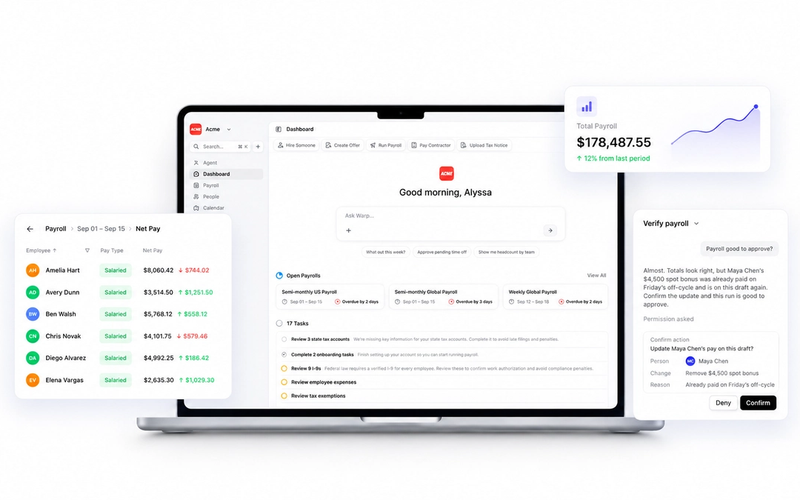
Warp is the only AI-native HR and payroll platform built for ambitious companies. When you hire someone in a new state, Warp's AI agents automatically register your company with that state's tax agencies, configure the correct withholdings, and handle ongoing filings. When a tax notice arrives, Warp resolves it. When state rates change, Warp updates your withholding. When an employee needs to be offboarded, Warp revokes their Google Workspace access, Okta access, and device access in the same action that processes their final paycheck.
Every company gets a dedicated Account Manager and Benefits Advisor included to guide them through payroll setup, multi-state expansion, and benefits selection. You never visit a government website, negotiate with tax agencies, or pay accountants per filing.
See how Warp automates compliance for your team.
Frequently Asked Questions
What is HR compliance?
HR compliance is the process of making sure your company follows every federal, state, and local employment law that governs how you hire, pay, manage, and terminate employees. It covers payroll tax withholding and filing, wage and hour laws, hiring and onboarding requirements, benefits administration, anti-discrimination rules, workplace safety, employee training mandates, and data privacy obligations.
What is an HR compliance audit?
An HR compliance audit is a systematic review of your company's policies, procedures, and records to identify gaps where you're not meeting legal requirements. It typically covers I-9 documentation, payroll tax filings, employee classification, benefits compliance, workplace policies, and training records. Most startups should conduct an informal audit annually or whenever they expand to a new state or cross an employee threshold (10, 20, or 50 employees).
What are the most common HR compliance mistakes for startups?
The most common mistakes are late state tax registrations when hiring in new states, worker misclassification (treating W-2 employees as 1099 contractors), missed quarterly filing deadlines after multi-state expansion, benefits enrollment window lapses, and failure to complete state-required training on time. These tend to cluster around moments of rapid growth when the company expands faster than its manual compliance processes can keep up.
Do I need HR compliance software?
If you have employees in more than one state, the answer is almost certainly yes. Managing separate state tax registrations, filing schedules, withholding rates, and training requirements manually becomes unsustainable quickly. The question is whether you need a standalone compliance tool or a payroll platform that handles compliance natively. Warp takes the second approach, building compliance automation directly into the payroll and HRIS platform so there's no separate system to manage.
What happens if my startup is not HR compliant?
Consequences range from financial penalties to personal liability. Payroll tax violations can result in the Trust Fund Recovery Penalty, which makes individual officers personally liable for unpaid taxes. I-9 violations carry fines of $252 to $2,507 per form for first offenses. Worker misclassification penalties can reach $25,000 per worker in states like California. Beyond penalties, non-compliance can lead to lawsuits, lost talent, and reputational damage that's harder to quantify but equally damaging.
How often do HR compliance requirements change?
Constantly. Over 15,000 new laws pass across all levels of government every year. At the state level, paid family leave programs, pay transparency laws, and minimum wage increases are the most active areas of change in 2026. At the federal level, the OBBBA introduced new payroll tracking and reporting requirements. Any company with employees in multiple states needs a system that monitors regulatory changes automatically, because tracking them manually across 5 or 10 states is not realistic.
Related: