
You found your perfect hire. Now you need to put together an offer letter that seals the deal, stays compliant, and doesn't create legal headaches down the road. For most startup founders, this means copying a template from Google, hoping it covers everything, and crossing your fingers. There's a better way.
In this guide, we'll cover:
- What an offer letter actually is (and how it differs from an employment contract)
- The 9 essential elements every startup offer letter needs
- Common offer letter mistakes that create legal exposure
- How to write offer letters with equity compensation
- How Warp's free offer letter generator works
- What happens after a candidate accepts (the full hiring workflow)
- FAQ: Answers to the most common offer letter questions
→ Try out our free offer letter generator
What Is an Offer Letter?
An offer letter is a formal document that presents a job opportunity to a candidate. It outlines the key terms of employment: job title, compensation, start date, benefits, and any conditions the offer depends on.
Think of it as the bridge between "you're hired" and their first day of work. It gives your candidate everything they need to make an informed decision while documenting the terms you've both agreed to.
Here's what an offer letter is not: a legally binding employment contract. While an offer letter carries weight and both parties typically expect the terms to be honored, it's generally more flexible than a formal employment agreement. That said, poorly worded offer letters can create implied contracts or legal complications, which is why getting the details right matters.
For most startup hires (everyone except C-suite executives), an offer letter is all you need. Save the full employment agreements for situations that require more extensive terms around severance, termination clauses, or specific performance requirements.
Why Your Offer Letter Matters More Than You Think
A well-crafted offer letter closes candidates faster, protects your company legally, and sets clear expectations from day one. Research from AIHR shows that employees who receive highly effective offer letters are 17x more likely to feel emotionally connected to their new organization. That connection starts with the first formal communication they receive from you.
Your offer letter is the first official thing a candidate holds in their hands from your company. It's the first time they're reading something real from you and it should feel like it came from a company they want to join, not like it was pulled from a generic template library.
The 9 Essential Elements of a Startup Offer Letter
Every offer letter your startup sends should include these components:
1. Job Title and Reporting Structure
State the exact position title, the department (if applicable), and who the employee will report to. This sets clear expectations about their role in your organization.
2. Employment Type and Classification
Specify whether the role is full-time, part-time, or temporary. More importantly for startups, clarify whether the position is exempt or non-exempt from overtime requirements.
Getting this wrong is expensive. If you incorrectly classify an employee as exempt when they should be non-exempt, you could owe back overtime pay, penalties, and legal fees. When in doubt, consult an employment attorney before sending the offer.
3. Compensation Details
Include the salary (annual or hourly rate), payment frequency, and payment method. If the role includes bonuses, commissions, or other variable compensation, outline how those are calculated.
Be specific. "$120,000 annually, paid semi-monthly via direct deposit" tells candidates exactly what to expect.
4. Equity Compensation (For Startups)
If you're offering stock options, include the number of shares, the vesting schedule (typically four years with a one-year cliff), and whether they're ISOs or NSOs. Note that the actual grant requires board approval and a separate Stock Option Agreement.
Common vesting language: "Subject to board approval, you will be granted options to purchase [X] shares of the Company's common stock, vesting over four years with a one-year cliff."
5. Start Date
Put the start date in writing to avoid any surprises. If you've discussed this verbally, confirm it. If it's contingent on something (like a background check clearing), say so.
6. Benefits Overview
Summarize the benefits package: health insurance, dental, vision, 401(k), PTO policy, and any other perks your startup offers. You don't need to include every detail here. A statement like "You will be eligible for the Company's standard benefits package, details of which will be provided during onboarding" works fine.
Include when benefits eligibility begins. Many startups offer benefits starting on the first day of employment or the first of the month following the start date.
Need help setting up benefits? See our guides on health insurance for startups and 401(k) plans.
7. At-Will Employment Statement
Every state except Montana is an at-will employment state, meaning either party can terminate the employment relationship at any time, for any reason (or no reason), with or without notice.
Include this statement clearly: "Employment with [Company Name] is at-will. Either you or the Company may terminate your employment at any time, with or without cause or notice."
8. Contingencies
Most offers are contingent on several conditions. Common contingencies include:
- Successful completion of a background check
- Verification of work authorization (I-9 compliance)
- Signing required agreements (PIIA, confidentiality agreement, stock option agreement)
- Reference checks
- Drug screening (if applicable to your industry)
State these clearly so there's no confusion: "This offer is contingent upon successful completion of a background check and your signing of the Company's Proprietary Information and Inventions Agreement (PIIA) on or before your start date."
9. Signature and Acceptance Deadline
Give candidates a deadline to accept or decline. Three to seven days is standard. Include a signature line for them to indicate acceptance and return the signed letter to you.
Common Offer Letter Mistakes That Create Legal Exposure
Making Promises You Can't Keep
Avoid any language that sounds like a commitment to continued employment. "We expect you'll be with us for years" or "This role has a clear path to promotion" can be interpreted as implied contracts.
Forgetting At-Will Language
Even a well-intentioned offer letter can create problems if it doesn't include at-will language. Make it explicit, and make sure nothing else in the letter contradicts it.
Misclassifying Employees
Startup founders often default to classifying roles as exempt (salaried, no overtime) when they should be non-exempt (hourly, overtime eligible). The rules around this are specific and depend on job duties, not just job titles. Get this wrong, and you're on the hook for back pay plus penalties.
Skipping the PIIA Requirement
A Proprietary Information and Inventions Assignment (PIIA) agreement protects your company's intellectual property. Missing PIIAs are one of the most common issues that come up during due diligence. Make your offer contingent on signing one.
Inconsistent Equity Language
If you're offering stock options, use consistent language that matches your actual equity incentive plan. Vague promises about "equity" without specifics can lead to disputes later.
How Warp Handles the Full Hiring Workflow
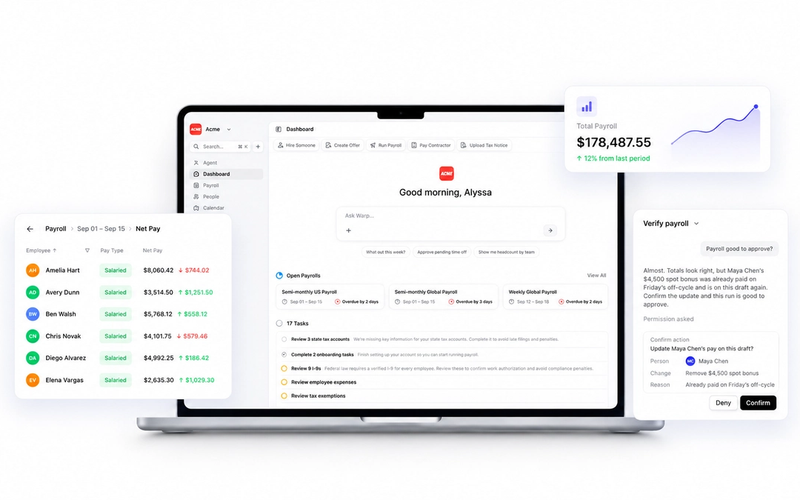
The offer letter is just one piece of bringing on a new hire. Here's what happens when you hire someone through Warp:
Step 1: Generate and Send the Offer Letter
Create a professional offer letter in seconds. Customize it with the candidate's specific compensation, equity (if applicable), start date, and role details. Send it directly from the platform.
Step 2: Candidate Accepts and Completes Onboarding
Once the candidate accepts, they complete everything in one place: personal information, tax forms (W-4, state withholding), direct deposit setup, I-9 verification, and signing required agreements like the PIIA.
Step 3: Automatic State Tax Registration
Here's where Warp is different. When you add an employee in a new state, Warp automatically registers your company with the right state agencies, opens your tax accounts, and handles the compliance requirements. You hire in California today and New York tomorrow. Warp opens the tax accounts for you.
No more spending hours on state department websites trying to figure out which forms to file. No more compliance anxiety wondering if you missed something.
Step 4: Benefits Enrollment
If you offer health insurance, 401(k), or other benefits through Warp, your new hire can enroll during onboarding. Warp syncs deductions automatically with payroll, so there's no manual setup and no missed contributions.
Step 5: Payroll Setup
Your new employee is automatically added to payroll. Warp handles federal, state, and local tax withholdings and filings. When payday comes, it just works.
For a complete walkthrough, see our 9-step payroll setup guide.
How Warp's Free Offer Letter Generator Works
Creating compliant, professional offer letters shouldn't require a lawyer for every hire. Warp's offer letter generator builds complete offer letters in under 30 seconds, covering all the essential elements your startup needs.
What you get with Warp's offer letter generator:
- Pre-built templates reviewed for compliance across all 50 states
- Automatic inclusion of at-will language and necessary legal protections
- Equity compensation sections that match standard vesting structures
- Customizable fields for your specific compensation, benefits, and job details
- Digital signature capabilities so candidates can accept electronically
- Integration with the rest of your hiring workflow (if you use Warp)
Unlike generic templates you find online, Warp's generator is built specifically for startups. It knows what founders actually need and what compliance requirements apply based on where you're hiring.
No more copying and pasting from three different Google Docs, hoping you've covered everything, and manually tracking who has signed what.
→ Try our offer letter generator tool here
What Makes Warp Different
Warp is the only AI-native HR & Payroll platform built for ambitious companies. Instead of clicking through clunky dashboards or .gov websites for taxes, Warp's AI agents open every state tax account, file every payroll form, and resolve every tax notice automatically.
Every company gets a dedicated Account Manager and Benefits Advisor included to guide them through payroll setup, multi-state expansion, and benefits selection. You don't have to spend hours on hold with tax agencies or worry about compliance mistakes.
With Warp, you'll never visit a government website, negotiate with tax agencies, or pay accountants $150 per filing. Just focus on building your business while Warp handles payroll, compliance, and benefits for your team across any state or country.
Thousands of fast-growing companies trust Warp to stay compliant while they scale.
FAQ: Common Offer Letter Questions
Is an offer letter legally binding?
An offer letter is not typically a legally binding employment contract, but it carries significant weight. Once both parties sign, there's an expectation that the terms will be honored. Specific clauses or poorly worded language can create binding commitments in some situations. The key is to include clear at-will language and avoid promises that imply guaranteed employment. If you're unsure about specific language, have an employment attorney review your template.
What's the difference between an offer letter and an employment contract?
An offer letter is a shorter, less formal document that outlines the key terms of a job offer: title, compensation, start date, benefits summary, and conditions. It's used for most hires. An employment contract is a more comprehensive, legally binding agreement typically reserved for executives and senior management. Employment contracts often include detailed provisions around termination, severance, non-compete clauses, and specific performance obligations.
Can a candidate negotiate after receiving an offer letter?
Yes, and most candidates do. Salary, equity, start date, and benefits are all commonly negotiated. Once you reach agreement, issue a revised offer letter reflecting the final terms. Be careful not to make verbal promises that aren't reflected in the written offer.
What should I do if a candidate accepts and then backs out?
It's frustrating, but it happens. If a candidate declines after accepting, you'll typically need to reopen the position or consider other candidates from your pipeline. There's usually no legal recourse unless you had a binding contract with specific terms.
How long should I give a candidate to respond to an offer?
Three to seven business days is standard for most roles. For senior positions or relocation situations, you might extend to two weeks. Set a clear deadline in the offer letter and stick to it.
Ready to streamline your hiring? Warp's offer letter generator creates compliant, professional offers in seconds. Combined with automated state tax registration, benefits administration, and payroll, it's everything you need to hire confidently as you scale. Try Warp and see why thousands of startups trust us to handle their compliance while they focus on building.