
Almost every employee your startup hires will be an at-will employee. That is not a choice you make. It is the default in 49 out of 50 U.S. states.
But "at-will" does not mean "no rules." There are exceptions that vary by state, language traps in your contracts that can accidentally override at-will status, and legal protections that apply to every employee regardless of how they are classified.
This guide explains what at-will employment actually means for startup founders, how it affects the contracts you write, and where the most common mistakes happen.
→ Try our free contract generator
What is at-will employment?
At-will employment means that either the employer or the employee can end the working relationship at any time, for any legal reason, with or without notice.
The employer does not need to prove "just cause" for termination, and the employee does not need to give a reason for quitting.
This is the default employment relationship in every U.S. state except Montana. In Montana, employers can only practice at-will employment during a probationary period (typically six months). After that, employees can only be terminated for "good cause" under the Wrongful Discharge from Employment Act.
For startups, at-will employment provides flexibility. You can restructure teams, eliminate roles, or part ways with underperforming employees without navigating the kind of "just cause" requirements that exist in most other countries. In return, your employees are free to leave at any time without legal consequences.
What is an at-will employment contract?
An at-will employment contract is an agreement that explicitly confirms the at-will nature of the employment relationship. It includes all the standard elements of an employment contract (compensation, duties, benefits, IP assignment, confidentiality) while making clear that either party can terminate at any time.
The at-will clause typically reads something like: "Employment with the Company is at-will. Either party may terminate this Agreement at any time, with or without cause, and with or without notice. Nothing in this Agreement creates a guarantee of continued employment for any specific period."
This language should appear in every employment contract and offer letter your startup sends, unless you are intentionally creating a fixed-term agreement for a specific role.
For a full template and clause-by-clause breakdown, see our guide to creating an employment contract.
What are the exceptions to at-will employment?
At-will employment is the default, but it is not absolute. Every state except Montana has adopted at-will as the baseline, yet most states also recognize one or more exceptions that limit when and why you can terminate an employee. Understanding these exceptions is critical for founders, especially if you are hiring across multiple states.
Public policy exception
This is the most widely recognized exception. It prevents employers from firing employees for reasons that violate the state's public policy. For example, you cannot terminate someone for reporting illegal activity (whistleblowing), refusing to commit an illegal act, filing a workers' compensation claim, serving on jury duty, or exercising a legal right like voting.
Forty-two states plus Washington, D.C. recognize the public policy exception. The states that do not include Florida, Alabama, Louisiana, Georgia, Nebraska, Maine, New York, and Rhode Island.
Implied contract exception
This exception applies when an employer's words or actions create an implied promise of continued employment, even without a formal written contract. The most common trigger is language in employee handbooks, policies, or offer letters that suggests an employee will only be terminated "for cause" or implies long-term job security.
Thirty-six states plus Washington, D.C. recognize implied contract exceptions. The states that do not include Delaware, Florida, Georgia, Indiana, Louisiana, Massachusetts, Missouri, Montana, North Carolina, Pennsylvania, Rhode Island, Texas, and Virginia.
This is the exception that trips up startups most often. Careless language in your contracts, offer letters, or handbook can accidentally create an implied contract and undermine the at-will relationship you intended.
Covenant of good faith and fair dealing
This is the broadest and least common exception. It essentially requires employers to act in good faith when terminating employees. For example, firing someone right before their retirement benefits vest, or terminating an employee to avoid paying a commission they have already earned, could violate this covenant.
Only 11 states recognize this exception: Alabama, Alaska, Arizona, California, Delaware, Idaho, Massachusetts, Montana, Nebraska, Utah, and Wyoming.
How does at-will affect the contracts you write?
At-will status does not eliminate the need for written contracts. It shapes what goes into them.
Your at-will clause must be explicit and consistent
Do not rely on the default. State it clearly in every employment contract, offer letter, and employee handbook. More importantly, make sure nothing else in your documents contradicts it.
Phrases like "permanent position," "guaranteed employment," "stable career opportunity," or "you will only be terminated for cause" can create an implied contract that overrides at-will status. Even verbal assurances during the interview process (like "you will always have a job here") can be used against you in court in states that recognize implied contracts.
Review every document a new hire receives: the job posting, the offer letter, the employment contract, and the employee handbook. The at-will language should be consistent across all of them.
At-will does not replace other contract clauses
Even though either party can end the relationship at any time, your contract should still define what happens when it ends. This includes:
- Return of property. Company laptops, access credentials, documents, and any materials containing confidential information.
- Survival clauses. Which obligations continue after termination? Confidentiality, IP assignment, and non-solicitation clauses typically survive.
- Severance. If you choose to offer severance (which is not required under at-will employment), define the terms in the contract. Most startups make severance contingent on the departing employee signing a release of claims.
- Final pay. State law dictates when final paychecks must be issued. California requires immediate payment upon termination. Other states allow anywhere from the next regular pay period to 30 days. Your payroll platform should handle this automatically based on the employee's state.
At-will does not protect you from wrongful termination claims
You can terminate an at-will employee for almost any reason, but not for an illegal reason. Federal and state laws prohibit termination based on:
- Race, color, national origin, sex, religion, age (40+), disability, or genetic information (Title VII, ADA, ADEA)
- Pregnancy or related conditions (Pregnancy Discrimination Act)
- Retaliation for whistleblowing, filing a complaint, or exercising a protected right
- Retaliation for taking FMLA leave, filing a workers' compensation claim, or participating in union activity
- Military service (USERRA)
Many states add additional protected categories. California, for example, prohibits termination based on sexual orientation, gender identity, marital status, and political activity. New York City adds caregiver status and arrest record to the list.
The practical takeaway: document your reasons for termination, even in an at-will state. If a terminated employee files a claim, having a clear, contemporaneous record of the business reason (performance issues, role elimination, restructuring) is your strongest defense.
Which states have the fewest at-will protections?
If you are hiring across multiple states, it helps to know where the legal landscape is most and least restrictive.
States with the fewest exceptions to at-will (no public policy, no implied contract, no good faith exceptions): Florida, Georgia, Louisiana, and Rhode Island offer employers the broadest at-will protections. These states do not recognize any of the three major common-law exceptions, though federal anti-discrimination and retaliation protections still apply.
States with the most exceptions: California, Alaska, Arizona, and Wyoming recognize all three major exceptions (public policy, implied contract, and covenant of good faith), giving employees the broadest protections against at-will termination.
Montana stands alone as the only state where at-will employment is not the default after the probationary period ends.
No matter which state your employees are in, Warp's compliance engine handles the state-specific requirements automatically. When you hire in a new state, Warp registers your company with the right agencies, sets up tax withholding, and keeps you compliant with local employment laws.
Common at-will mistakes startup founders make
Using handbook language that contradicts at-will status
Your employee handbook says employment is at-will. But three pages later, the disciplinary policy describes a "progressive discipline process" with verbal warnings, written warnings, and a performance improvement plan before termination. A court could interpret that sequence as an implied promise that employees will not be fired without going through each step.
The fix: include a clear disclaimer in your handbook stating that the disciplinary policy is a guideline, not a contractual obligation, and that the company reserves the right to skip steps or terminate immediately.
Making verbal promises during hiring
"We are looking for someone long-term." "This is a stable role." "As long as you perform, you will have a job here." These statements, made casually during an interview, can be used as evidence of an implied contract in states that recognize that exception. Train anyone involved in hiring to avoid language that implies guaranteed employment.
Forgetting at-will language in the offer letter
Your employment contract includes a clear at-will clause, but your offer letter does not mention it. If the offer letter is the only document the employee signed, and it does not reference at-will status, you may have a gap. Include at-will language in every document: the offer letter, the employment contract, and the handbook acknowledgment.
For guidance on structuring offer letters correctly, see our offer letter guide. For the differences between offer letters and contracts, see our comparison guide.
Stop worrying about state-by-state compliance
Writing the right contracts is step one. Staying compliant across every state where you have employees is the ongoing challenge.
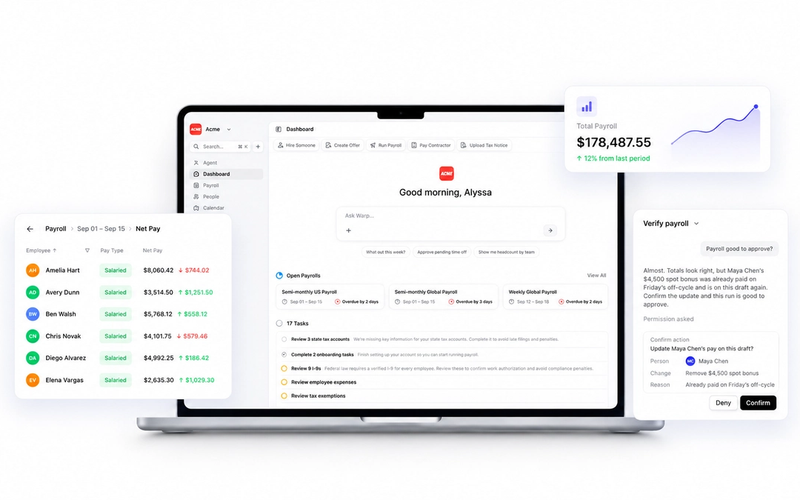
Warp is the only AI-native HR and payroll platform built for startups. Instead of clicking through clunky dashboards or .gov websites for taxes, Warp's AI agents open every state tax account, file every payroll form, and resolve every tax notice, automatically.
Every company gets a dedicated Account Manager and Benefits Advisor included to guide them through payroll setup, multi-state expansion, and benefits selection. You will never visit a government website, negotiate with tax agencies, or pay accountants $150 per filing.
Just focus on building your business while Warp handles payroll, compliance, and benefits for your team across any state or country.
Frequently asked questions
Do I need to put at-will language in writing?
There is no federal law requiring at-will status to be in writing. At-will is the default in 49 states regardless of whether you document it. But putting it in writing protects you from implied contract claims and makes your position clear if a dispute ever reaches court. Include it in every offer letter, employment contract, and handbook.
Can I fire an at-will employee without giving a reason?
Legally, yes. You do not need to provide a reason for terminating an at-will employee. However, the reason cannot be illegal (discriminatory, retaliatory, or in violation of public policy). And from a practical standpoint, documenting the business reason for every termination protects you if the employee files a claim.
Does at-will mean I do not need an employment contract?
No. At-will defines how the relationship can end. An employment contract defines how it operates. You still need contracts to protect your IP, enforce confidentiality, establish non-solicitation terms, and set clear expectations around compensation and benefits. At-will language is just one clause within the broader contract. See our employment contract guide for a full breakdown.
Can an employee sue me even if they are at-will?
Yes. At-will employees can file claims for wrongful termination if they believe they were fired for an illegal reason (discrimination, retaliation, violation of public policy). They can also sue if they believe an implied contract existed based on your handbook, offer letter, or verbal promises. At-will status reduces your legal exposure but does not eliminate it.
What about independent contractors? Are they at-will?
No. Independent contractors operate under a separate legal framework. They are not employees, and the at-will doctrine does not apply to them. The terms of a contractor relationship are governed by the independent contractor agreement, which specifies the scope of work, payment terms, and termination conditions. Misclassifying an employee as a contractor to avoid employment obligations can result in significant penalties. For more on this distinction, see our guide on 1099 reporting requirements.
How do I handle at-will employment when hiring in multiple states?
Each state has its own exceptions to at-will employment. An employee in California has different protections than an employee in Texas. Your contracts should include at-will language that holds up in the employee's state of residence, and your HR processes should account for state-specific termination requirements (like final pay deadlines). Warp handles multi-state compliance automatically, including state tax registration and withholding for every state where you have employees.