
TL;DR: Before your first hire, you need an EIN, state tax registrations, workers' comp, and required new-hire paperwork in place. At 5 to 15 employees, add a written offer letter process, onboarding checklist, and your first real policies (PTO, remote work, expense reimbursement). At 15 to 50, you need documented compliance training, a real benefits program, and someone (even part-time) accountable for HR. Past 50, you likely need a full-time hire.
Most HR checklists for startups read like they were written by someone who has never actually registered a company for state payroll tax. They tell you to "define your culture" and "draft an employee handbook" and skip the part where you'll get a letter from a state tax agency you've never heard of because you hired someone who works from home in a different state.
This checklist covers both. The people side (hiring, onboarding, policies) and the compliance side (the paperwork, registrations, and deadlines that actually create legal exposure if you miss them).
Before Your First Hire: Legal and Compliance Foundations
1. Get your EIN. Every employer needs a federal Employer Identification Number before you can legally pay anyone or file payroll taxes. If you haven't sorted out your tax ID situation yet, here's a straightforward guide to SSNs, ITINs, and EINs for founders.
2. Register for state payroll taxes. You need to register in every state where you have an employee working, not just the state where your company is incorporated. This is the single most common compliance gap for startups that hire remote: one employee in a new state means new withholding accounts, unemployment insurance registration, and sometimes local tax obligations too.
3. Set up workers' compensation insurance. Required in nearly every state, even for a company with one employee. Requirements and minimums vary by state, so check your specific state's threshold rather than assuming.
4. Put up required labor law posters. Federal and state law require you to display specific notices, whether your team works from an office or fully remote (yes, remote teams need a compliant version too). This rundown of exactly which posters you need covers the federal minimum and the state-specific additions.
5. Decide your classification approach. Know the difference between an employee and an independent contractor before you make your first hire, not after a misclassification audit. Misclassifying a worker to avoid payroll tax is one of the most expensive mistakes an early-stage company can make.
Hiring and Onboarding: The Documents That Protect You
6. Build a written offer letter template. Put every offer in writing, with clear terms on compensation, start date, at-will status (where applicable), and any conditions like background checks. Verbal offers create ambiguity that benefits nobody.
7. Collect required new-hire paperwork on day one. At minimum: Form I-9 (identity and work eligibility, within 3 business days of the start date), Form W-4 (federal withholding), and any state-equivalent withholding forms. Missing I-9s are one of the most commonly cited issues in DOL audits.
8. Report new hires to the state. Most states require new-hire reporting within a set window (often 20 days) after the start date, though the exact deadline and reporting method vary by state. This feeds child support enforcement systems and is a legal requirement, not a nice-to-have.
9. Run a real onboarding process, not a scattered one. Equipment, system access, benefits enrollment, and first-week expectations should all be mapped out before day one. Our startup onboarding checklist walks through the full sequence if you're building this from scratch.
10. Set up e-signature and document storage. You'll be collecting a lot of paperwork (offer letters, I-9s, handbooks, policy acknowledgments). Have a system for it before the volume makes "email attachments" unmanageable.
Payroll and Tax: Where Startups Get Caught Off Guard
11. Choose a payroll system before you need one. Waiting until the week before your first pay run to pick a payroll provider is how startups end up with late deposits and incorrect withholding.
12. Understand your multi-state exposure before you hire remote. Hiring someone in a new state creates a new set of tax obligations, sometimes before that employee's first paycheck. If you're about to make a hire outside your home state, walk through this checklist first.
13. Know your filing deadlines. Federal and state payroll tax deposits, quarterly filings, and annual reconciliations all run on fixed schedules, and penalties accrue whether or not you knew the deadline existed.
14. Set up a process for tax notices. Notices from state agencies are common, especially in the first year of registering in a new state, and most of them are resolvable if you respond quickly. Ignoring them is what turns a routine notice into a real problem. Warp resolves roughly 80% of customer tax notices automatically, which is the kind of backstop worth having before the notices start showing up.
Policies and Documentation
15. Draft your core policies before you need them. At minimum: paid time off, remote/hybrid work expectations, expense reimbursement, and anti-harassment. Our guide to building a PTO policy is a good starting point if that's the one you're missing.
16. Put together an employee handbook once you hit meaningful headcount. You don't need one for a 3-person team. By the time you're at 10 to 15 people, informal norms stop scaling, and you need to write them down.
17. Run compliance training where it's legally required. Several states mandate specific training (like sexual harassment prevention) on a schedule, not just once. Here's what's typically required and when.
Benefits
18. Decide your benefits strategy early, even if you're not offering benefits yet. Health insurance, retirement plans, and other benefits become recruiting tools once you're competing for talent, and the setup lead time is longer than founders expect.
19. Understand your options before you commit. Small-group health insurance, ICHRA-style reimbursement arrangements, and PEO-bundled benefits all have different cost structures and trade-offs. Don't default to whatever your first candidate's previous employer offered without checking what fits your headcount and budget.
Tools and Systems
20. Centralize HR data instead of spreading it across spreadsheets, email threads, and whatever system your first hire happened to set up. By the time you have 10 employees, "who has access to what" and "who signed which policy" need to live in one place, not in institutional memory.
21. Automate what you can, especially compliance-heavy tasks. State tax registrations, filings, and new-hire reporting are exactly the kind of repetitive, deadline-driven work that's easy to automate and expensive to get wrong manually.
The Bottom Line
Most of this checklist has nothing to do with culture decks or performance review cycles. It's paperwork, registrations, and deadlines, and getting it right before your first hire is a lot cheaper than fixing it after a tax notice shows up. Start with the compliance foundations, layer in the people processes as you grow, and revisit whether you need a dedicated HR hire once you cross 15 to 20 employees.
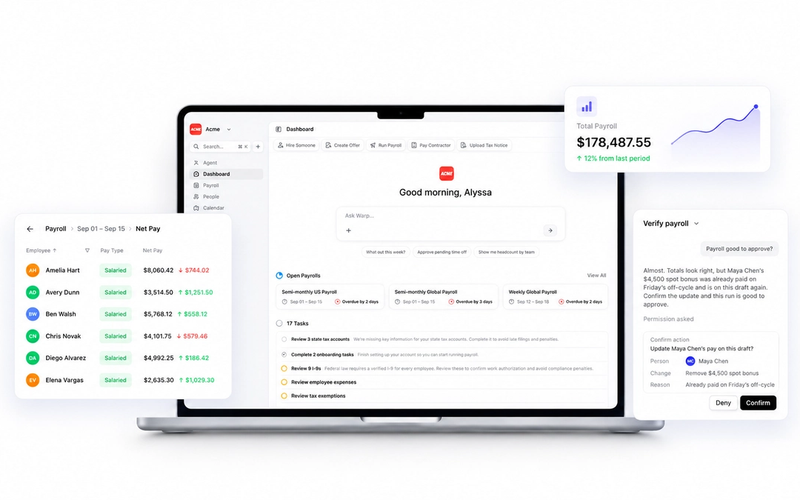
Want support implementing this checklist? Warp is the only AI-native HR & Payroll platform built for ambitious companies. Instead of clicking through clunky dashboards or .gov websites for taxes, Warp's AI agents open every state tax account, file every payroll form, and resolve every tax notice, automatically.
Every company gets a dedicated Account Manager and Benefits Advisor included to guide them through payroll setup, multi-state expansion, and benefits selection, so you don't have to spend hours on hold with tax agencies or worry about compliance mistakes.
With Warp, you'll never visit a government website, negotiate with tax agencies, or pay accountants $150 per filing. Just focus on building your business while Warp handles payroll, compliance, and benefits for your team across any state or country.
Thousands of fast-growing startups trust Warp to stay compliant while they scale.
Disclaimer: requirements below vary by state, and some thresholds and deadlines change year to year. Treat this as a starting checklist, not legal or tax advice, and confirm anything state-specific against a current source or your own counsel.
FAQ
What should be on an HR checklist for a startup?
At minimum: an EIN and state tax registrations, workers' compensation insurance, required labor law postings, a written offer process, I-9 and W-4 collection for every hire, new-hire state reporting, a payroll system, and core written policies like PTO and remote work. Add compliance training and a formal handbook once you're past roughly 10 to 15 employees.
Do startups need a dedicated HR person?
Not right away. Most startups under 15 employees can handle HR with a combination of founder or ops-team attention and an AI-native payroll and compliance platform. The right time to add fractional or full-time HR support depends on headcount and complexity, not a fixed timeline. We break down the decision framework here.
What HR documents are legally required for a new hire?
Form I-9 (work eligibility, due within 3 business days of the start date) and Form W-4 (federal tax withholding) are required for every employee, along with any state-equivalent withholding forms. Most states also require you to report the new hire to a state directory, typically within 20 days, though the exact window varies by state.
When should a startup create an employee handbook?
Once you're consistently above 10 employees, informal norms stop being enough and a written handbook becomes worth the time investment. Below that, a handbook is often premature, but your core policies (PTO, remote work, expenses) should already be written down regardless of headcount.
How do I stay HR compliant across multiple states?
Register for state payroll tax accounts in every state where you have an employee, not just where your company is incorporated, and check each state's specific requirements for labor law postings, new-hire reporting, and any state-mandated training. This is the area where manual tracking breaks down fastest as you add states.
What's the difference between HR compliance and payroll compliance?
Payroll compliance covers tax registrations, withholding, deposits, and filings tied to paying employees. HR compliance is broader: it includes payroll compliance plus required postings, anti-discrimination and harassment training, documentation retention, and classification rules. They overlap heavily, which is why most startups end up managing both together rather than separately.