
At some point, every startup founder realizes they're spending more time on HR than on the thing they actually started the company to do. Payroll runs, state tax registrations, benefits enrollment, compliance training, I-9 forms, offer letters. According to Paychex's 2025 Priorities for Business Leaders survey, 34% of business leaders spend over 10 hours per week on HR administration alone. The work piles up quietly, and one day you're the de facto HR department for a company that doesn't have one.
Fractional HR is a model where an experienced HR professional works with your company on a part-time basis, typically 10 to 40 hours per month, instead of as a full-time hire. It's one of four options startup founders use to handle HR, alongside full-time hires, outsourced HR/PEOs, and AI-native payroll platforms. SHRM data shows fractional executive roles grew 57% between 2020 and 2022, and demand has only accelerated since.
The instinct is to hire someone. But a full-time HR generalist costs $65,000 to $90,000 in salary alone, plus benefits, plus the time it takes to recruit and onboard them. For a 20-person startup still finding product-market fit, that's a significant headcount decision.
The question isn't really "when do I hire HR." It's "what's the right way to handle HR at my current stage." Here are the four approaches founders actually use, what each costs, what each covers, and when each makes sense.
How most startups actually handle HR today
Before any of the four options below, there's the unofficial Option 0: your ops person does it.
At most startups under 30 employees, HR responsibilities land on whoever is closest to operations. That's usually a Head of Ops, a COO, an office manager, or the founder themselves. They run payroll, send offer letters, manage benefits enrollment, track PTO, file state registrations, and handle the occasional employee question about their W-2 or health insurance. It's not their title. It's just their Tuesday.
This works for a while. An organized ops lead with the right tools can manage HR for a small team effectively, especially if the company is in one or two states and headcount is stable. The approach starts to strain when any of the following happen:
- The company expands to 5+ states and each one has different filing schedules, tax rates, and compliance requirements
- Headcount grows faster than the ops person can keep up with onboarding, benefits questions, and payroll changes
- Sensitive employee situations arise (performance issues, terminations, complaints) that require HR expertise the ops person doesn't have
- A SOC 2 audit or investor due diligence requires documented HR policies and device management that don't exist yet.
The question at that point isn't "should we stop having our ops person handle HR." It's "what do we pair them with so they can keep doing it effectively." The four options below are the answer, and the right choice depends on which parts of HR are breaking first: the operational work (payroll, filings, compliance) or the strategic work (policies, people decisions, culture).
Option 1: Full-time HR hire
What is a full time HR hire?: A dedicated HR generalist or HR manager on your payroll, handling everything from compliance and payroll administration to recruiting, employee relations, and culture.
What it costs: $65,000 to $120,000 in base salary depending on experience and market, plus 20-30% on top for benefits, payroll taxes, and overhead. Fully loaded, expect $80,000 to $155,000 per year.
What it covers: Everything. A good HR generalist handles payroll coordination, benefits administration, compliance, recruiting, onboarding, employee relations, performance management, policy creation, training, and offboarding. The trade-off is that one person can only go so deep in each area.
When it makes sense: Generally at 50 to 75 employees, when the volume and complexity of people operations justifies a dedicated role. Some companies hire earlier if they're in a heavily regulated industry or experiencing rapid headcount growth. Companies pursuing a SOC 2 audit or managing complex multi-state compliance sometimes hire sooner.
The catch: A single HR generalist can be stretched thin quickly. They end up spending most of their time on administrative work (payroll, filings, enrollment) rather than strategic work (recruiting, retention, culture). The more of the administrative layer that can be automated, the more value a future HR hire actually delivers when you're ready.
Option 2: Fractional HR
What is fractional HR?: Fractional HR means hiring an experienced HR professional (typically someone who has held a Director or VP-level role) on a part-time basis. They work with your company for a set number of hours per month, usually 10 to 40 hours, and are embedded in your team rather than operating at arm's length.
Think of it as renting a senior HR leader instead of hiring one. They attend your leadership meetings, know your team by name, and own the HR function as if it were their full-time job. The difference is they do this for multiple clients simultaneously, which is what makes the cost work for you.
What it costs: $2,000 to $7,000 per month depending on the scope and seniority of the consultant. A fractional CHRO with 15 years of experience costs more than a fractional HR manager with 5. Most startup engagements fall in the $3,000 to $5,000 range.
What it covers: Strategic HR work: building your people processes, creating an employee handbook, setting up performance reviews, advising on compensation strategy, handling sensitive employee situations, and ensuring your policies comply with state-specific requirements. Some fractional HR providers also handle operational tasks like onboarding and benefits enrollment, but many focus on the strategic layer and expect you to have a system handling the transactional work.
When it makes sense: Between 15 and 50 employees, when you have real people-management questions (how to structure compensation, how to handle a performance issue, how to build a promotion framework) but not enough work to justify a full-time hire. Also useful as a bridge: a fractional HR leader can set up the systems and processes that a future full-time hire will run.
The catch: Fractional HR solves the expertise gap but doesn't solve the operational gap. Your fractional HR leader can tell you that you need to be registered in New Jersey for disability insurance, but they're probably not going to log into the NJ Division of Taxation and do the registration for you. You still need a system handling payroll, tax filings, state registrations, and compliance operations.
Option 3: Outsourced HR (including PEOs)
What it is: Handing some or all of your HR functions to an external provider. This ranges from narrow outsourcing (just payroll processing) to full outsourcing through a PEO (Professional Employer Organization) that becomes the co-employer of your workforce and handles payroll, benefits, compliance, and HR administration under their own tax IDs.
What it costs: PEOs typically charge 3% to 15% of total payroll, or a flat fee of $150 to $250 per employee per month. For a 20-person startup with $2M in annual payroll, that's $60,000 to $300,000 per year. Non-PEO HR outsourcing firms charge $500 to $2,000 per month for basic administrative outsourcing, scaling up for more comprehensive services.
What it covers: PEOs cover the most ground: payroll processing, tax filings, benefits administration (often at better rates through pooled purchasing), workers' compensation, and some compliance support. Non-PEO outsourcing covers whatever functions you hand off, typically payroll and benefits administration.
When it makes sense: PEOs make sense when benefits access is the primary driver. PEOs can offer large-group health insurance rates to small companies that wouldn't qualify on their own. If your main goal is getting Fortune 500 benefits for a 15-person team, a PEO is one path to that. For a deeper comparison of models, see our guide on whether startups really need a PEO or EOR.
The catch: PEOs require a co-employment arrangement, meaning the PEO becomes the employer of record for tax purposes. You give up some control over benefits decisions, and your employees show up under the PEO's EIN on their tax forms. Leaving a PEO is a significant operational project. Costs can increase unpredictably: some founders report benefits premiums doubling after the first year. And most PEOs are still built around manual processes. You're outsourcing the work, not eliminating it.
Option 4: An AI-native platform that eliminates the work
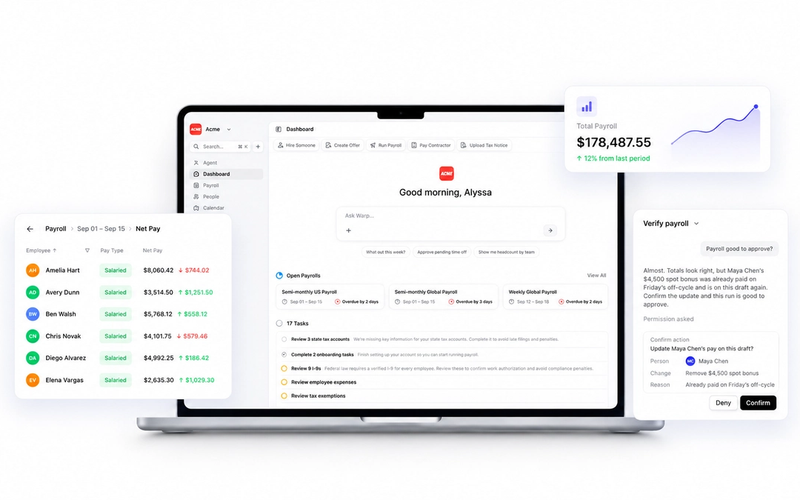
What it is: A payroll and HR platform that automates the operational layer of HR (payroll, tax filings, state registrations, benefits administration, compliance monitoring, IT provisioning, onboarding) so you don't need a person or a service to do it.
This is a fundamentally different approach from the first three options. Fractional HR, outsourced HR, and full-time HR hires all assume that HR work needs to be done by a person. The question is just which person and how much you pay them. An AI-native platform starts from a different assumption: most of the operational work can be automated entirely, and the strategic work that actually requires a human becomes something you hire for later, at the right time, after the administrative layer is handled.
What it costs: Warp costs $89/month platform fee plus $35 per employee per month. For a 20-person startup, that's roughly $8,500 per year. All features included: multi-state payroll, compliance automation, benefits administration, compliance training (LMS), time tracking, and IT management through Warp Fabric (including device management, Google Workspace provisioning, and Okta provisioning). No setup fees, no per-state charges, no module upsells.
What it covers: Everything that used to require an HR administrator or outsourced service: payroll runs across all 50 states, tax registrations in every state where you have employees, quarterly and annual tax filings, tax notice resolution, benefits enrollment and administration, offer letters and employment contracts, employee onboarding, device enrollment and security policies, app provisioning and deprovisioning, and compliance training tracking. Every customer also gets a dedicated Account Manager and Benefits Advisor included, so you have a human to call when you need guidance on benefits selection, multi-state expansion, or anything the platform handles.
When it makes sense: From your first hire onward. The earlier you start, the less compliance debt you accumulate. Most Warp customers run payroll, compliance, benefits, and IT management without a dedicated HR person well past 50 employees. When they eventually hire someone for HR, that person focuses on recruiting, culture, and employee development rather than payroll administration and tax filings.
How to decide
The decision tree is simpler than it looks.
If you have fewer than 15 employees and you're in 1 to 3 states: A platform like Warp handles everything. You don't need a specific person.
If you have 15 to 50 employees and you're hitting people-management questions (compensation strategy, performance issues, employee handbook, promotion frameworks): pair an AI-native platform for the operational layer with a fractional HR consultant for the strategic layer. The platform handles payroll, compliance, and benefits. The consultant handles the human questions. Total cost: roughly $15,000 to $70,000 per year depending on scope, compared to $80,000 to $155,000 for a full-time hire who would be doing both.
If you're past 50 employees and need a dedicated people leader: Hire a full-time Head of People or VP of HR, and make sure the operational layer is already automated so that person spends their time on strategy and culture rather than running payroll and filing taxes. The worst outcome is hiring a $120,000 HR leader and having them spend 60% of their time on administrative work a platform could handle.
If your primary goal is benefits access at large-group rates: Evaluate a PEO, but understand the co-employment trade-offs and compare the total cost against a platform with a built-in benefits brokerage. Level-funded health plans can offer comparable savings without the co-employment structure.
The real cost comparison
For a 20-person startup:
| Approach | Annual Cost | What's Included |
|---|---|---|
| Full-time HR generalist | $80,000 to $155,000 | One person covering everything (stretched thin) |
| Fractional HR consultant | $36,000 to $84,000 | Strategic guidance 10-40 hrs/month (no operational work) |
| PEO | $36,000 to $60,000+ | Payroll, benefits, basic compliance (co-employment required) |
| Warp | ~$8,500 | Payroll, compliance, benefits, IT, training, dedicated support |
The math shifts as you grow, but the pattern holds: automating the operational layer is always cheaper than paying people to do it manually. The question is whether the platform you choose actually covers enough to replace the manual work.
Frequently Asked Questions
What is fractional HR?
Fractional HR is an arrangement where an experienced HR professional works with your company on a part-time, embedded basis, typically 10 to 40 hours per month. Unlike a consultant who advises from the outside, a fractional HR leader integrates into your team, attends leadership meetings, and owns the HR function. The model works because they serve multiple clients simultaneously, so you get senior-level expertise at 15 to 25 percent of the cost of a full-time hire.
What is HR outsourcing?
HR outsourcing is the practice of contracting an external provider to handle some or all of your HR functions. This can range from outsourcing just payroll processing to fully outsourcing HR through a PEO (Professional Employer Organization) that becomes the co-employer of your workforce. The scope and cost vary widely depending on which functions you hand off.
What's the difference between fractional HR and outsourced HR?
Fractional HR is a part-time, embedded HR leader who integrates into your team and focuses on strategic work: building people processes, advising on compensation, handling sensitive employee situations, and ensuring compliance. Outsourced HR is an external service that handles operational tasks like payroll processing, benefits administration, and tax filings. Think of fractional HR as renting a senior HR leader. Think of outsourced HR as delegating administrative work. Many startups use both: an AI-native platform like Warp handles the operational layer, and a fractional HR consultant handles the strategic layer.
How much does HR outsourcing cost?
PEOs charge 3% to 15% of total payroll or $150 to $250 per employee per month. Non-PEO HR outsourcing firms charge $500 to $2,000+ per month depending on scope. Fractional HR consultants charge $2,000 to $7,000 per month. An AI-native platform like Warp costs $89/month plus $35 per employee per month with all features included.
What are the advantages of outsourcing HR functions?
The main advantages are cost savings compared to a full-time hire, access to expertise you don't have in-house, reduced compliance risk, and the ability to focus your team's time on core business work. The specific advantages depend on which outsourcing model you choose. A PEO gives you benefits access. A fractional HR leader gives you strategic guidance. An AI-native platform gives you full operational automation.
When should a startup hire its first HR person?
Most startups don't need a dedicated HR hire until 50 to 75 employees, as long as the operational layer (payroll, compliance, benefits, onboarding) is handled by a platform. If you're hiring an HR person primarily to run payroll and manage compliance, you're overpaying for work a system should handle. Hire for HR when you need someone focused on recruiting strategy, employee development, culture building, and organizational design.
Can I use fractional HR and software together?
Yes, and this is often the best combination for startups between 15 and 50 employees. The platform handles the operational work (payroll, tax filings, compliance, benefits administration, IT provisioning). The fractional HR consultant handles the strategic work (compensation frameworks, performance management, employee relations, handbook creation). Each does what it's best at.
Warp is the only AI-native HR and payroll platform built for ambitious companies. Payroll, compliance, benefits, IT management, and training in one platform. No HR hire required.
Related:
- What Is HR Compliance? A Founder's Guide
- Do Startups Really Need a PEO or EOR for Payroll?
- The Complete Onboarding Checklist
- 10 Payroll Mistakes That Cost Startups Thousands
- How to Switch Payroll Providers