
HSAs are employee-owned, roll over forever, and require a High Deductible Health Plan. FSAs are employer-owned, use-it-or-lose-it, and work with any plan type. Most early-stage startups do well pairing an HDHP with an HSA. It lowers premiums, saves on payroll taxes, and gives employees a portable long-term savings tool. If you have employees in California or New Jersey, there are extra state tax rules you need to know.
What this article covers:
- What an HSA and FSA are, and how they differ
- 2025 and 2026 HSA and FSA contribution limits
- What benefits packages startups actually offer by stage
- State-specific compliance rules for CA and NJ
- FSA compliance requirements every employer should know
- What changed in 2026 under the One Big Beautiful Bill Act
- How Warp handles benefits setup for you
What Is an HSA?
An HSA (Health Savings Account) is a tax-advantaged savings account owned by the employee, available only to people enrolled in a qualifying High Deductible Health Plan (HDHP).
The appeal is the triple tax advantage: contributions go in pre-tax, the account grows tax-free, and withdrawals for qualified medical expenses are tax-free. No other account type offers this combination. Because the employee owns the account, it travels with them when they leave. There is no use-it-or-lose-it rule. Unused funds roll over indefinitely, and after age 65 the account functions like a traditional IRA for non-medical expenses.
Employers can also contribute to employee HSAs. Those contributions are exempt from FICA payroll taxes for both the employer and the employee, saving roughly 7.65% on every dollar contributed.
To qualify for HSA contributions, an employee must be enrolled in a qualifying HDHP, carry no other non-HDHP coverage (with limited exceptions for dental, vision, and limited-purpose FSAs), not be enrolled in Medicare, and not be claimed as a dependent on someone else's tax return.
What Is an FSA?
An FSA (Flexible Spending Account) is an employer-owned, employer-administered account funded through pre-tax payroll deductions under a Section 125 cafeteria plan.
Unlike an HSA, employees can access their entire annual election on day one of the plan year, before the money has been deducted from their paychecks. This is called the uniform coverage rule. It is a genuine employee benefit, but it also means employers carry financial risk if an employee draws down their full election and then leaves.
FSAs do not require a specific health plan type. They pair with PPOs, HMOs, and HDHPs alike. The tradeoff is the use-it-or-lose-it rule: funds not used by year-end are forfeited unless the employer offers a carryover or grace period. FSAs are non-portable, require more administrative overhead than HSAs, and cannot be used by self-employed individuals.
What Is the Difference Between an HSA and an FSA?
The core difference is ownership. An HSA belongs to the employee: it is portable, investable, and rolls over forever. An FSA belongs to the employer: it is use-it-or-lose-it, non-portable, and requires more compliance work to maintain. HSAs require an HDHP; FSAs work with any plan type.
| Feature | HSA | FSA |
|---|---|---|
| Account ownership | Employee | Employer |
| Portability | Fully portable | Forfeited on departure |
| Health plan required | HDHP only | Any employer plan |
| 2025 limit (self-only / family) | $4,300 / $8,550 | $3,300 |
| 2026 limit (self-only / family) | $4,400 / $8,750 | $3,400 |
| Rollover | 100%, indefinitely | Use it or lose it (max $680 carryover in 2026) |
| Investment options | Yes | No |
| Funds available | As contributed | Full election on day one |
| Self-employed eligible | Yes | No |
| Employer admin burden | Lower | Higher |
What Are the HSA and FSA Contribution Limits for 2025 and 2026?
The IRS adjusts HSA and FSA limits annually for inflation. Here are the current numbers:
HSA limits (IRS Rev. Proc. 2025-19):
- 2025: $4,300 (self-only) / $8,550 (family)
- 2026: $4,400 (self-only) / $8,750 (family)
- Catch-up contribution for employees age 55 and older: $1,000 per year (unchanged)
- Note: combined employer and employee contributions cannot exceed the annual limit
Health FSA limits (IRS Rev. Proc. 2024-25):
- 2025: $3,300 per employee
- 2026: $3,400 per employee
- 2026 maximum carryover: $680
Dependent Care FSA (DCFSA):
- 2025: $5,000 per household (married filing jointly or single)
- 2026: $7,500, the first increase since 1986, enacted by the One Big Beautiful Bill Act (National Law Review)
HDHP minimum thresholds to qualify for HSA eligibility:
| 2025 | 2026 | |
|---|---|---|
| Minimum deductible (self-only / family) | $1,650 / $3,300 | $1,700 / $3,400 |
| Maximum out-of-pocket (self-only / family) | $8,300 / $16,600 | $8,500 / $17,000 |
What Other Benefits Accounts Should Employers Know About?
Beyond HSAs and FSAs, a few other account types are worth understanding as your benefits package grows:
Limited-Purpose FSA (LPFSA): Covers dental and vision expenses only. Fully compatible with an HSA, making it a useful add-on for HDHP plans where employees want tax-advantaged dental and vision spending without losing HSA eligibility.
Dependent Care FSA (DCFSA): Covers eligible childcare and dependent care. The 2026 limit increases to $7,500 for most households. Subject to annual non-discrimination testing, which can be tricky for startups with income-skewed teams.
Health Reimbursement Arrangement (HRA): Employer-funded only. Employees cannot contribute. Comes in several forms: QSEHRA (for companies with fewer than 50 employees who do not offer group coverage), ICHRA (no size limit, employees buy individual coverage), and Excepted Benefit HRA (up to $2,150 in 2025 to supplement group coverage).
For a deeper look at how these accounts fit into a complete health insurance strategy for your startup, see our full guide.
What Benefits Do Startups Typically Offer?
Early-stage companies (Seed to Series A)
Most early-stage startups keep benefits simple: one or two health plan options, often through a PEO that pools employees for better group rates. The administrative overhead of an FSA is a real deterrent at this stage. Only 16.5% of small organizations offer FSAs compared to 87.5% of large organizations, largely because of non-discrimination testing, plan document requirements, and ERISA compliance.
An HDHP paired with an HSA is often the right starting point for small businesses. It lowers monthly premiums, the employer can contribute to HSAs without a complex plan structure, and the account is owned by the employee, with no forfeiture, no complicated year-end rules.
Growth-stage companies (Series B+)
As teams grow and talent competition intensifies, companies typically add a PPO option alongside the HDHP, introduce DCFSA, and may layer in a limited-purpose FSA to complement the HSA. According to Sequoia's 2024 Startup Benefits Report, startups on average cover 89% of employee-only premiums and 75% of dependent premiums. The most competitive packages match HSA contributions and offer tiered plan choice.
Why HDHP and HSA adoption is accelerating
Per the KFF 2025 Employer Health Benefits Survey, 33% of covered workers are now enrolled in HDHP or savings-option plans, up sharply from 27% in 2024. The Bureau of Labor Statistics reports HDHP availability at private-sector employers rose from 38% in 2015 to 50% in 2024.
The cost math drives a lot of this. Per KFF 2025 data, HDHP premiums average $8,620 per year for single coverage versus $9,818 for PPO plans, roughly $1,200 in annual savings per employee. For a 20-person startup, that difference alone can free up $24,000 or more per year before HSA contributions are factored in. Getting your payroll and benefits set up correctly from the start makes a meaningful difference in what you pay and what you keep.
How Much Do Employers Typically Contribute to HSAs?
Employer HSA contributions are optional but one of the most underused tools in startup benefits. They reduce FICA payroll taxes for both employer and employee (7.65% on every dollar), increase participation significantly, and are genuinely valued as a long-term savings benefit.
According to KFF 2025 data, the average employer HSA contribution is $842 for single coverage and $1,539 for family coverage. Research from WEX identifies $750–$1,000 for single and $1,500–$1,750 for family as the sweet spot where employee participation peaks. Even a $50 employer contribution meaningfully moves participation rates.
Employer contributions count toward the annual IRS limit. Combined employee and employer contributions cannot exceed $4,400 (self-only) or $8,750 (family) in 2026. Communicate your contribution amount during open enrollment so employees can plan their own payroll deductions accordingly.
Do States Have Different HSA and FSA Rules?
Which states do not follow federal HSA tax rules?
California and New Jersey are the only two states that do not conform to federal HSA tax treatment. In these states, HSA contributions are taxable at the state level. Employers must include them in state taxable wages, and employees do not get a state income tax deduction.
What do California employers need to know about HSAs?
California Revenue and Taxation Code §17131.4 explicitly decouples from IRC §223. The practical impact:
- Employee and employer HSA contributions must be included in California state taxable wages. W-2 Box 16 (state wages) will be higher than Box 1 (federal wages)
- HSA investment earnings, including interest, dividends, and capital gains, are treated as taxable California income each year
- Employees must reconcile this on California Schedule CA (540) annually
- California does not conform to OBBBA provisions as of October 2025
California also has a separate FSA notification requirement under AB 1554. Employers must notify California employees about FSA claim submission deadlines through two different communication channels, only one of which may be electronic.
Pending legislation (AB 781 in the 2025-2026 session) would allow California to conform to federal HSA treatment for tax years 2026 through 2030. Passage is uncertain given the state's budget situation.
What do New Jersey employers need to know about HSAs?
New Jersey Gross Income Tax law does not adopt IRC §223 or IRC §125 for HSAs. Like California, employer and employee HSA contributions must be included in NJ state taxable wages. NJ does allow a partial offset through a medical expense deduction for amounts exceeding 2% of NJ adjusted gross income. Pending legislation (NJ A1311) would align the state with federal HSA rules. It has also not yet passed.
What should multi-state employers actually do?
Configure payroll to add HSA contributions back into state taxable wages for employees in CA and NJ. Most modern payroll platforms built for multi-state compliance handle this automatically. Employees in these states should be told at enrollment that their HSA contributions will appear as state taxable income on their W-2.
A few other local nuances: Philadelphia includes HSA contributions in local wage tax income (up to 3.9%), while New York City excludes them. See how Warp handles compliance across every state automatically as you scale.
What FSA Compliance Requirements Do Employers Need to Meet?
The short answer: more than most startups expect. FSAs require a written plan document, annual non-discrimination testing, and in some cases ERISA filings and COBRA administration.
Section 125 plan document: FSAs must be offered through a written Section 125 cafeteria plan. Elections are generally irrevocable for the plan year unless a qualifying life event occurs, such as marriage, divorce, birth, or a job change. Two percent S-corporation shareholders cannot participate on a pre-tax basis.
Non-discrimination testing (NDT): Required annually to ensure the plan does not disproportionately benefit highly compensated employees or key employees. The DCFSA carries an additional 55% Average Benefits Test, the test most commonly failed by startups with income-skewed workforces. If the plan fails, HCEs lose pre-tax treatment for the year. The 2026 DCFSA increase to $7,500 raises the stakes on this test considerably.
ERISA obligations: Health FSAs are ERISA-covered plans requiring a Summary Plan Description and a written plan document. Plans covering 100 or more participants must file Form 5500 annually. Penalties for non-filing: up to $2,400 per day from the DOL and $250 per day from the IRS.
COBRA: Health FSAs may be subject to COBRA continuation. Non-compliance penalties run $110 per day per qualified beneficiary.
What Changed for HSAs and FSAs in 2026?
The One Big Beautiful Bill Act (signed July 4, 2025) introduced several changes that affect startup benefits decisions for 2026:
DCFSA limit raised to $7,500. The household limit increases from $5,000 to $7,500, the first increase since 1986. Married filing separately is capped at $3,750. This is a legislative change, not indexed to inflation, and it raises non-discrimination testing risk for DCFSA plans.
Bronze and Catastrophic ACA plans now qualify as HDHPs. Employees enrolled in Bronze or Catastrophic marketplace plans can now open and contribute to HSAs, expanding access for employees who buy their own coverage.
Direct primary care no longer disqualifies HSA eligibility. Employees can hold a direct primary care membership (capped at $150/month individual, $300/month family) without losing the ability to contribute to an HSA.
Telehealth safe harbor made permanent. Pre-deductible telehealth coverage no longer disqualifies HSA eligibility. This is retroactive to January 1, 2025.
How Does Warp Help With HSA and FSA Administration?
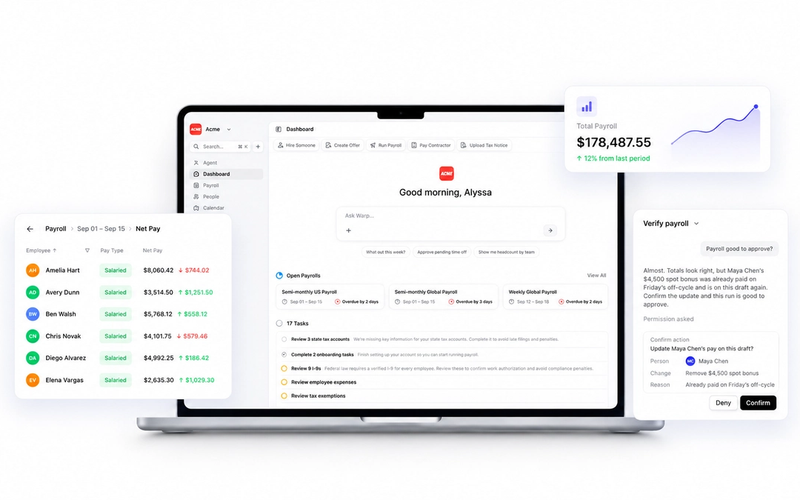
Warp is the only AI-native HR and payroll platform built for startups. Instead of clicking through clunky dashboards or .gov websites for taxes, Warp's AI agents open every state tax account, file every payroll form, and resolve every tax notice, automatically. Every company gets a dedicated Account Manager and Benefits Advisor included to guide them through payroll setup, multi-state expansion, and benefits selection, so you don't have to spend hours on hold with tax agencies or worry about compliance mistakes.
With Warp, you'll never visit a government website, negotiate with tax agencies, or pay accountants $150 per filing. Just focus on building your business while Warp handles payroll, compliance, and benefits for your team across any state or country. Thousands of fast-growing startups trust Warp to stay compliant while they scale.
Here is what that looks like for HSA and FSA specifically:
Benefits setup without the back-and-forth. Your dedicated Benefits Advisor walks you through plan design, HSA vs FSA considerations, and carrier selection, with context on on what companies at your stage are typically offering.
HSA contributions handled automatically. Once your HDHP and HSA are set up, Warp handles payroll deductions, employer contributions, and CA/NJ state wage adjustments automatically. No manual overrides, no spreadsheets.
Multi-state compliance built in. If you have employees in California or New Jersey, Warp automatically includes HSA contributions in state taxable wages with no configuration required. As you add employees in new states, Warp opens the required tax accounts and keeps payroll compliant. See how Warp handles compliance across every state.
FSA administration and non-discrimination testing. For companies offering FSAs, Warp manages plan compliance requirements so you are not tracking annual testing deadlines on your own.
Explore Warp's benefits platform or compare payroll software options for your stage to see where Warp fits.
FAQ
Can an employee have both an HSA and an FSA at the same time?
Not a standard general-purpose FSA, but yes with a Limited-Purpose FSA. A general-purpose health FSA disqualifies HSA eligibility. A Limited-Purpose FSA (covering dental and vision only) is fully compatible with an HSA, as is a Dependent Care FSA, which covers a separate category of expenses. Many employers pair an HDHP with both an HSA and an LPFSA to give employees tax-advantaged spending across medical, dental, and vision without any eligibility conflict.
What happens to FSA funds when an employee leaves?
Remaining FSA funds are forfeited. FSA accounts are employer-owned and do not travel with the employee. Employees can typically submit claims for expenses incurred before their termination date, but any remaining balance generally returns to the employer. One exception: if an employee used more funds than they contributed (possible because the full annual election is available on day one), the employer generally cannot recover the overage. COBRA continuation is available for health FSAs but is rarely cost-effective for departing employees.
Do employers have to contribute to employee HSAs?
No. Employer HSA contributions are optional. But they are worth considering. They reduce FICA payroll taxes for both parties, and WEX research shows contributions in the $750–$1,000 range for single coverage are the sweet spot where employee participation peaks. Any employer contributions count toward the employee's annual IRS limit ($4,400 self-only or $8,750 family in 2026), so communicate your contribution amount clearly during open enrollment.
We have employees in California. Does offering an HSA create extra compliance work?
Yes. California does not conform to federal HSA tax treatment, so HSA contributions must be included in California state taxable wages. Your payroll system needs to add those amounts back into W-2 Box 16 even though they are excluded from Box 1. Employees will see a higher state taxable income than federal taxable income and will need to account for this on their California return. California also requires employers to notify employees about FSA claim deadlines through two different communication channels. Warp handles both automatically for companies with CA employees.
What is the difference between an FSA carryover and a grace period?
A carryover lets employees roll up to $680 (2026) of unused FSA funds into the next plan year with no deadline. A grace period gives employees an extra 2.5 months after the plan year ends to spend remaining funds, but those funds still expire after the window closes. Employers can offer one or the other, not both. They are not required to offer either. If you offer neither, all unused funds are forfeited at year-end. Whichever option you choose must be documented in your Section 125 plan document and communicated clearly at open enrollment.
This post is for general informational purposes only and does not constitute legal, tax, or benefits advice. HSA and FSA rules are subject to change. Consult a qualified benefits advisor or tax professional for guidance specific to your company's situation.