OASDI stands for Old-Age, Survivors, and Disability Insurance. It is the official name for the Social Security tax withheld from paychecks. In 2026, the OASDI tax rate is 6.2% for employees and 6.2% for employers, applied to the first $184,500 in wages. Self-employed individuals pay the full 12.4% through the Self-Employment Contributions Act (SECA).
If you have ever looked at a paystub and wondered what "Fed OASDI/EE" means, this is it: your Social Security contribution. This guide covers what OASDI tax is, how it is calculated, who pays it, what the 2026 limits are, and how it connects to the broader types of payroll taxes employers are responsible for.
OASDI tax at a glance: 2026 rates and limits
| Detail | 2026 Figure |
|---|---|
| Tax rate (employee) | 6.2% |
| Tax rate (employer) | 6.2% |
| Combined rate | 12.4% |
| Wage Base | $184,500 |
| Maximum employee contribution | $11,439 |
| Maximum employer contribution | $11,439 |
| Self-employed rate | 12.4% (deduct half) |
| Reported on | IRS form 941 (filed quarterly) |
| Paystub labels | Fed OASDI/EE, FICA-SS, OASDI/EE |
What does OASDI mean?
OASDI breaks down into three programs, all administered by the Social Security Administration (SSA):
Old-Age Insurance provides monthly retirement benefits to workers who have earned at least 40 work credits (roughly 10 years of covered employment). In 2026, you earn one credit for every $1,810 in covered earnings, up to a maximum of four credits per year.
Survivors Insurance provides monthly benefits to the families of deceased workers who had sufficient work credits. This can include surviving spouses, dependent children, and in some cases dependent parents.
Disability Insurance provides monthly benefits to workers who become unable to work due to a qualifying medical condition, provided they have enough recent work credits. The eligibility requirements depend on the worker's age at the time of disability.
Together, these three programs make up Social Security. The OASDI tax funds two trust funds that pay out these benefits: the Old-Age and Survivors Insurance (OASI) Trust Fund and the Disability Insurance (DI) Trust Fund.
How is OASDI different from FICA?
FICA (the Federal Insurance Contributions Act) is the law that mandates payroll tax contributions for both Social Security and Medicare. OASDI is the Social Security portion of FICA. Medicare (officially called Hospital Insurance, or HI) is the other portion. Think of FICA as the container and OASDI as one of the two things inside it. The combined FICA rate is 15.3% (12.4% OASDI + 2.9% Medicare), split between employer and employee. For a complete breakdown of how all payroll taxes fit together, see our guide to the types of payroll taxes.
What is OASDI on my paycheck?
When you see "Fed OASDI/EE" on a paystub, the "/EE" means "employee." This line shows the 6.2% Social Security tax withheld from the employee's gross wages. The employer pays an additional 6.2% that does not appear on the employee's pay statement.
Depending on the payroll software or provider, OASDI may appear under different labels. Common variations include:
Fed OASDI/EE: Federal OASDI, employee share. FICA-SS: FICA Social Security portion. OASDI/EE: OASDI, employee share. SS Tax or Social Security Tax: The plain-language version. FICA-OASDI: Another common abbreviation combining both terms.
All of these refer to the same tax going to the same program. If an employee cannot find an OASDI withholding line on their pay statement, they should check with HR. They may be classified as a 1099 independent contractor rather than a W-2 employee, which means OASDI is not withheld at the source. Instead, they would owe self-employment tax when they file their annual return.
What is the OASDI wage base limit for 2026?
The OASDI wage base for 2026 is $184,500. This means only the first $184,500 of an employee's annual wages are subject to the 6.2% Social Security tax. Once cumulative year-to-date wages exceed that cap, OASDI withholding stops for the remainder of the year.
For employees, this shows up as a noticeable increase in take-home pay once the cap is reached. Medicare tax, by contrast, continues on all wages with no limit.
OASDI wage base: recent history
| Year | Wage base | Max employee OASDI |
|---|---|---|
| 2026 | $184,500 | $11,439 |
| 2025 | $176,100 | $10,918 |
| 2024 | $168,600 | $10,453 |
| 2023 | $160,200 | $9,932 |
| 2022 | $147,000 | $9,114 |
The SSA adjusts the wage base annually based on changes in the national average wage index. The $184,500 figure for 2026 was announced in October 2025 and applies to all wages paid from January 1, 2026 forward.
How is OASDI tax calculated?
The calculation is straightforward. For each pay period, multiply the employee's gross taxable wages by 6.2%. Do the same for the employer match. Stop withholding once cumulative wages for the year reach $184,500.
Example: salaried employee earning $150,000
Annual OASDI: $150,000 x 6.2% = $9,300 per year from the employee, $9,300 from the employer. Paid biweekly, the employee sees $357.69 withheld per pay period. Since $150,000 is below the wage base, OASDI is withheld on every paycheck all year.
Example: employee earning $220,000
OASDI applies only to the first $184,500. Employee OASDI: $184,500 x 6.2% = $11,439 total for the year. Once cumulative wages hit $184,500 (roughly mid-October on a biweekly schedule), withholding stops. The remaining paychecks for the year have no OASDI deduction, resulting in higher net pay. The employer's OASDI obligation also stops at $11,439.
Example: self-employed individual earning $120,000
Self-employed workers pay the full 12.4% OASDI rate on net self-employment income. $120,000 x 12.4% = $14,880 in OASDI tax. However, self-employed individuals can deduct the employer-equivalent half ($7,440) from their adjusted gross income on their annual tax return, reducing their overall income tax liability.
Who is exempt from OASDI tax?
OASDI is mandatory for the vast majority of U.S. workers, but a few narrow exemptions exist:
Members of certain religious groups who have a conscientious objection to Social Security benefits can apply for an exemption using IRS Form 4029. This is uncommon and requires meeting strict criteria.
Some non-resident aliens on specific visa types are exempt, including F-1 and J-1 students and scholars, A-visa holders (foreign government employees), and G-visa holders (employees of international organizations).
Students employed by the school they attend may be exempt from OASDI under the student FICA exemption, provided the student's primary relationship with the school is educational.
Self-employed individuals who earn less than $400 in net self-employment income for the year are not required to pay OASDI.
If you work multiple jobs and your combined wages exceed the $184,500 wage base, each employer withholds independently. You may overpay OASDI during the year. If that happens, you can claim the excess as a credit on your individual tax return using Schedule 3 of Form 1040.
What is the difference between OASDI and SSI?
OASDI and SSI (Supplemental Security Income) are both administered by the Social Security Administration, but they are separate programs with different funding sources and eligibility rules.
OASDI is funded by payroll taxes (the 12.4% rate discussed in this guide) and provides benefits based on your work history and earnings record. You must have earned sufficient work credits to qualify.
SSI is funded by general tax revenue (not payroll taxes) and provides cash assistance to aged, blind, or disabled individuals with limited income and resources. Work history is not a factor for SSI eligibility.
A person can potentially receive benefits from both programs simultaneously if they meet the eligibility requirements for each.
What are employer OASDI obligations?
As an employer, you are responsible for withholding 6.2% from each employee's wages, matching that amount from your own funds, and depositing the combined amount with the IRS on the applicable schedule. Most employers report OASDI (along with Medicare and federal income tax withholding) on Form 941, filed quarterly. For specific due dates, see our 2026 payroll tax deadline calendar.
The deposit schedule depends on the size of your payroll. Smaller employers deposit monthly (by the 15th of the following month). Larger employers deposit semi-weekly. The IRS notifies you of your deposit schedule each November based on your lookback period.
Getting these deposits wrong can be expensive. The IRS failure-to-deposit penalty ranges from 2% to 15% depending on how late you are. For startups setting up payroll for the first time, getting the deposit schedule right from day one is critical.
Let Warp handle OASDI and every other payroll tax
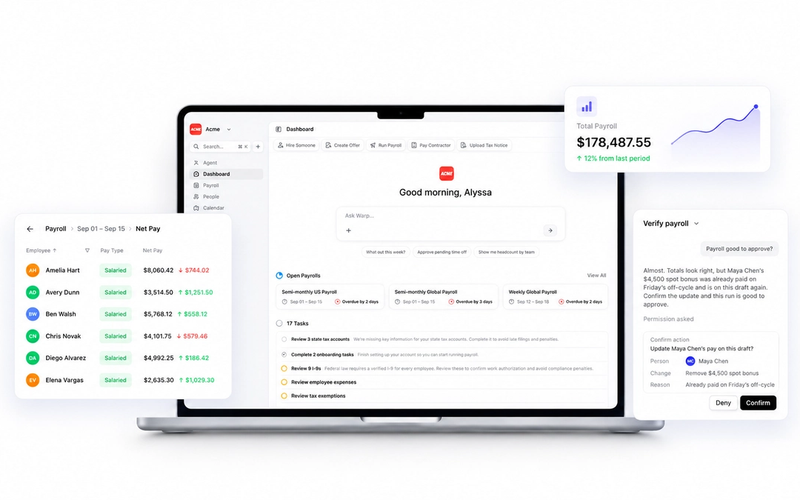
Warp is the only AI-native HR & Payroll platform built for ambitious companies. Instead of clicking through clunky dashboards or .gov websites for taxes, Warp's AI agents open every state tax account, file every payroll form, and resolve every tax notice automatically.
Every company gets a dedicated Account Manager and Benefits Advisor included to guide them through payroll setup, multi-state expansion, and benefits selection. You do not have to spend hours on hold with tax agencies or worry about compliance mistakes.
With Warp, you will never visit a government website, negotiate with tax agencies, or pay accountants $150 per filing. Just focus on building your business while Warp handles payroll, compliance, and benefits for your team across any state or country.
Thousands of fast-growing companies trust Warp to stay compliant while they scale.
Frequently asked questions about OASDI
Is OASDI the same as Social Security?
Yes. OASDI is the official name for Social Security. Your paycheck may label it "OASDI," "Social Security," or "Fed OASDI/EE." All three refer to the same tax funding the same program.
What does Fed OASDI/EE mean on my paycheck?
Fed OASDI/EE means Federal Old-Age, Survivors, and Disability Insurance, Employee share. It is the 6.2% Social Security tax withheld from your wages. The "/EE" indicates this is the employee's portion. Your employer pays an additional 6.2% that does not appear on your pay statement.
What is the OASDI tax rate for 2026?
The 2026 OASDI rate is 6.2% for employees and 6.2% for employers, for a combined 12.4%. Self-employed individuals pay the full 12.4%. The tax applies to the first $184,500 in wages.
What is the OASDI limit for 2026?
The 2026 OASDI wage base limit is $184,500, up from $176,100 in 2025. Wages above this amount are not subject to Social Security tax. The maximum employee OASDI contribution for 2026 is $11,439.
Why did OASDI stop coming out of my paycheck?
OASDI withholding stops once your year-to-date wages reach the annual wage base ($184,500 in 2026). This is normal. You will notice higher take-home pay for the remaining pay periods of the year. Medicare tax continues on all wages with no cap.
Can I get a refund if I overpaid OASDI?
Yes. This typically happens if you work for two or more employers and your combined wages exceed the wage base. Each employer withholds independently, so you may overpay. Claim the excess on Schedule 3 of Form 1040 when you file your annual tax return.
How is OASDI different from Medicare tax?
OASDI (Social Security) funds retirement, survivor, and disability benefits. Medicare funds health insurance for those 65 and older. OASDI has a wage base cap ($184,500 in 2026) while Medicare applies to all wages with no limit. Both are components of FICA.