Mosey Got Acquired by Gusto. Now What?
Ayush Sharma, CEO
Today, Gusto announced the acquisition of Mosey, a compliance services company that helps businesses manage state registrations, filings, and ongoing compliance requirements. If you're a Mosey customer, this post is for you.
Mosey built a useful compliance services business. Their team helped companies navigate multi-state registrations, track filing deadlines, and manage compliance across jurisdictions. It was primarily a services-driven model — people handling compliance tasks on your behalf, with a software dashboard to give you visibility into the process. Many businesses relied on that service.
But today's announcement changes the picture for every Mosey customer who isn't on Gusto payroll. And unlike most acquisitions, this one comes with a hard deadline.
What we know. Confirmed from Mosey's own communication.
This isn't speculation. Mosey CEO Alex Kehayias sent an email to all non-Gusto customers today. Here's what it confirms:
- June 30, 2026 is a hard cutoff. After this date, Mosey's compliance services will only be available to Gusto payroll customers. If you use Rippling, ADP, Paychex, Warp, or any other payroll provider, your Mosey access ends.
- Gusto is offering 6 months of free payroll to incentivize Mosey customers to switch their entire payroll stack to Gusto before the deadline.
- Mosey will provide a transition packet with your account data, compliance status, and filing history for customers who don't switch to Gusto.
- Customer Success teams are reaching out over the coming weeks to guide the offboarding process.
This gives every non-Gusto customer approximately 82 days to find a replacement compliance platform, migrate their data, and ensure no gaps in state registrations or filings.
What "acquired" actually means here.
Gusto announced that Mosey's technology and team will expand Gusto's platform to include state and local business registrations, entity management, ongoing filings, and real-time compliance monitoring. Tomer London, Gusto's Co-Founder and CPO, described it as a way to take complexity off the plate of small business owners.
For Gusto's 400,000+ customers, this is good news. They'll get compliance services built into the payroll platform they already use. That's a real improvement.
For everyone else, it's a different story. Mosey's compliance capabilities are being absorbed into Gusto's ecosystem. If you don't use Gusto for payroll, you're not the customer this acquisition was designed to serve.
This is worth understanding clearly: Mosey is not continuing as a standalone product for non-Gusto customers. The team, the technology, and the platform are becoming part of Gusto. Alex Kehayias, Mosey's founder, said it directly — they're joining Gusto to bring their vision to the millions of small businesses that need it most. Those businesses are Gusto's existing customer base, not yours.
It's also worth noting what this means for Mosey's services model specifically. Mosey's value was largely in the people who knew how to navigate state agencies, file the right forms, and manage compliance workflows on your behalf. In an acquisition, software transfers cleanly. Services teams and institutional knowledge often don't — they get redeployed across the acquirer's priorities. The hands-on compliance support that Mosey customers relied on may look very different inside an organization serving 400,000+ businesses.
Questions to ask right now. This week, not this quarter.
Can you actually switch your entire payroll to Gusto by June 30?
Mosey is offering 6 months of free Gusto payroll to make this tempting. But switching payroll providers isn't a weekend project. It means migrating every employee's direct deposit, tax withholding, benefits enrollment, and W-2 history. It means re-establishing tax accounts in every state. It means telling your team their paychecks are coming from somewhere different. For a 50-person company across 10 states, that's a significant operational undertaking — and you're doing it under a deadline, not on your own timeline. (Need help evaluating? Read our honest comparison of Gusto alternatives for scaling startups.)
What happens to your compliance data after June 30?
Mosey says they'll provide a transition packet. But what does that include, exactly? Your state registration numbers? Your filing history? Your compliance calendar with upcoming deadlines? The notices that have been resolved on your behalf? Request your packet now, while Mosey's Customer Success team is still staffed and focused on offboarding. Don't wait until June.
Who monitors your compliance during the transition?
This is the gap nobody talks about. If you leave Mosey on May 15 and your new platform isn't fully set up until June 1, who's watching your state compliance during those two weeks? Quarterly filings don't pause because you're switching vendors. Tax notices don't wait. State agencies don't care that your compliance platform got acquired. Plan for overlap, not a clean handoff.
Are you comfortable being locked into Gusto's ecosystem long-term?
The 6 months of free payroll is attractive today. But what happens in month 7? You're now on Gusto's pricing, in Gusto's ecosystem, with your compliance data inside their platform. If Gusto's product, pricing, or support doesn't meet your needs, you'll face another migration — except this time you'll be migrating payroll and compliance simultaneously. That's the definition of vendor lock-in.
What about the compliance requirements Mosey hasn't finished?
If you have state registrations in progress, filings that are pending, or notices that are being resolved, what happens to those? Are they completed before your access ends? Or do they get dropped? Get clarity on every open item now.
Why compliance keeps getting absorbed. A pattern that won't stop.
Mosey's story fits a pattern we've written about before.
A team identifies that compliance is broken for multi-state businesses. They're right — businesses with fewer than 50 employees face roughly $14,700 per employee per year in compliance costs, and 15,000 new laws pass across all levels of government every year. The problem is massive and real.
So the team builds a services business around it. It works. It gains traction. But services businesses are expensive to scale — every new customer requires more people, more manual work, more operational overhead. Eventually, a larger platform sees an opportunity to absorb that capability and offer it exclusively to their own customers. The standalone business disappears, and the customers who relied on it are told to either join the larger ecosystem or leave.
We saw this with Central, the AI payroll startup that was acqui-hired by Mercury. We saw it with Teal, the accounting startup Mercury acquired before that. Teal as a product essentially ceased to exist — it became a feature inside Mercury's banking platform. Central's customers faced the same uncertainty.
Now it's happening with Mosey, except with a critical difference: there's a confirmed hard deadline. Mosey's acquisition comes with a clear June 30 cutoff and a binary choice — switch to Gusto, or find an alternative.
The underlying problem is structural. When compliance becomes a feature inside someone else's platform, the incentives shift. The parent company invests in what drives their core business — payroll for Gusto — and the deep, unglamorous compliance work that Mosey's standalone customers actually relied on gets folded into a broader product roadmap where it has to compete for priority.
Not sure Gusto is the right move? See our comparison of Gusto alternatives
What Warp does differently. Product-driven compliance, not services.
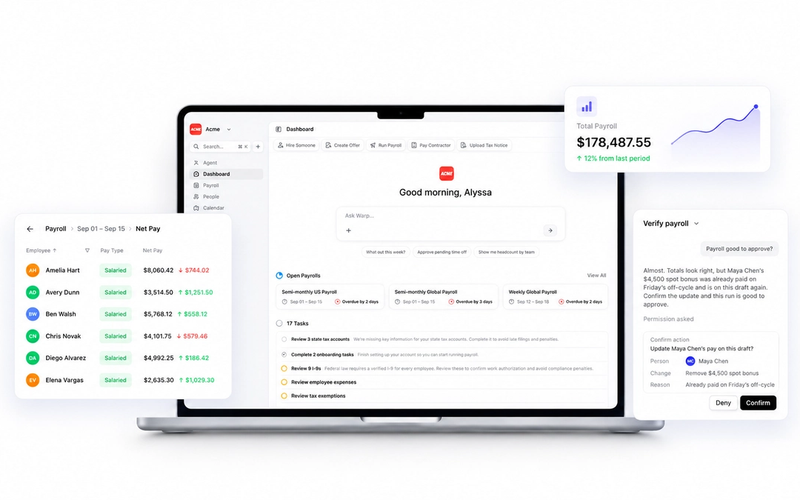
Warp is an AI-native payroll, compliance, and benefits platform. That's the whole company. Not a services business with a dashboard on top. Not a feature inside someone else's platform. Not one of twenty products.
The difference between Warp and how Mosey operated is architectural. Mosey's model was services-driven — their team handled compliance tasks on your behalf, which worked but required people at every step. Warp is product-driven. Our AI agents programmatically open state tax accounts, file forms with agencies, resolve notices, and monitor for new requirements. When you hire an employee in a new state, the same system that processes their payroll automatically handles the state tax registration — no humans in the loop for routine compliance tasks, no waiting days for a services team to process your filing.
That's why the acquisition dynamics are different for Warp. A services business is fragile when the team gets absorbed into a larger company. A product-driven platform keeps running regardless of headcount changes, because the automation is in the software, not in the people.
We automate tax compliance across 800+ US tax agencies. We handle state registrations, quarterly filings, notice resolution, unemployment insurance, and ongoing compliance monitoring across all 50 states. We've processed hundreds of millions in payroll transactions and are scaling toward $1B in annual transaction volume.
Our engineering team builds AI-native infrastructure specifically for compliance automation. When a state agency changes a form, updates a deadline, or modifies a filing requirement, our systems adapt automatically. That's the advantage of building compliance as a product rather than running it as a service.
And critically: if Warp makes a compliance mistake, we pay the penalty. Not you. The IRS reports that 40% of small businesses face payroll tax penalties each year. Having a provider that takes financial responsibility for errors matters — especially when you're migrating under a deadline and can't afford gaps.
Over the past 24 hours since the announcement, we've already heard from Mosey customers who are evaluating alternatives. The migration has begun.
If you're on Mosey. Dedicated migration and priority onboarding.
We're offering Mosey customers a dedicated migration with priority onboarding. Our team will handle:
- Compliance data migration — we'll work with your Mosey transition packet to ensure every state registration, filing status, and open item transfers cleanly.
- State tax account verification — we'll confirm active registrations in every state where you have employees and flag any gaps.
- Employee onboarding — if you're also moving payroll to Warp, we handle the full setup. Most startups complete the migration in under 10 minutes.
- Compliance continuity — no gap in monitoring. We pick up where Mosey leaves off so nothing falls through the cracks.
Sign up here. We'll get back to you within 24 hours. Or email founders@joinwarp.com directly.
You don't need to wait until June to figure this out. The earlier you migrate, the more runway you have to verify everything transferred correctly — and the less risk you carry.
Frequently Asked Questions
Will Mosey remain available as a standalone product?
No. Mosey CEO Alex Kehayias confirmed that compliance services will only be available to Gusto payroll customers after June 30, 2026. If you're not on Gusto, your access ends.
Is the 6 months of free Gusto payroll worth it?
It depends on your situation, but for most companies the switching costs outweigh the savings. Migrating payroll means moving every employee's direct deposit, tax withholding, benefits enrollment, and W-2 history — under a deadline. And after the 6 free months, you're locked into Gusto's pricing. If your current payroll provider works well, there are compliance alternatives that don't require a payroll switch.
What data will Mosey provide in the transition packet?
Mosey has confirmed they'll provide account data, compliance status, and filing history. Request your packet now — don't wait for their Customer Success team to reach out. The more lead time you have, the smoother the migration.
Who handles my compliance between leaving Mosey and joining a new platform?
This is the critical gap to plan for. Quarterly filings and tax notices don't pause during vendor transitions. Choose your replacement early and plan for overlap — ideally, have your new platform monitoring compliance before you leave Mosey, not after.
Can I use Warp just for compliance without switching payroll?
Yes. While Warp offers full payroll, benefits, and HR, the compliance automation works independently. You can keep your current payroll provider and use Warp for state registrations, tax filings, and multi-state compliance monitoring.
How quickly can I migrate from Mosey to Warp?
Most startups complete the migration in under 10 minutes. We handle the data transfer, verify your state registrations, and ensure no compliance gaps. Sign up here or email founders@joinwarp.com for a response within 24 hours.
Compliance should be built into your payroll platform from day one — not bolted on as someone else's feature.
Switch to Warp today. Dedicated Mosey migration. 24-hour response.