The average small business pays $845 per year in IRS penalties for payroll errors, according to Paychex research. But for startups scaling across multiple states, a single compliance mistake can cost far more. Misclassifying one worker in California can trigger fines of $5,000 to $25,000. A missed quarterly filing can snowball into 25% of your unpaid tax bill within five months.
In this guide, you'll learn:
- The 10 most expensive payroll mistakes startups make, ranked by financial impact
- Exact IRS penalty amounts for late deposits, late filings, and misclassification
- Why multi-state withholding errors are the most common mistake for remote-first startups
- How payroll errors compound
- Specific steps to prevent each mistake, including which ones automation eliminates entirely
- The real cost of payroll errors at scale, including hidden costs like employee turnover and audit exposure
The frustrating part: most of these mistakes are entirely preventable. They happen because startup founders are managing payroll alongside building products, closing customers, and raising funding, and the compliance details fall through the cracks.
Here are the 10 payroll mistakes we see most often, what they actually cost, and how to make sure your startup avoids each one.
1. Misclassifying employees as independent contractors
What it costs: Back taxes on all wages paid, plus interest. Federal penalties include the employer's full share of FICA (7.65%) on all wages, plus income tax withholding that should have been collected. In California, willful misclassification carries civil penalties of $5,000 to $25,000 per violation under Labor Code Section 226.8. In 2026, federal agencies are using AI to detect misclassification patterns faster than ever.
Why startups do it: Contractors are cheaper upfront. No payroll taxes (7.65% employer FICA), no benefits, no unemployment insurance, no workers' comp. For a cash-strapped early-stage startup, the savings are tempting.
How to avoid it: Use the IRS behavioral control, financial control, and relationship type test to evaluate each role. If you control when, where, and how the person works, they're likely an employee. If you're unsure, file Form SS-8 with the IRS for a determination. For a detailed comparison, see our guide on 1099 vs W-2 workers.
2. Missing state tax registration when hiring remotely
What it costs: Penalties for operating without required registrations vary by state but typically include back taxes, interest, and failure-to-file penalties. Some states impose additional penalties for willful non-compliance.
Why startups do it: You hire a remote engineer in Colorado. They start working. You don't realize that one employee in a new state triggers a payroll tax nexus, which means you need to register with Colorado's Department of Revenue for withholding tax and the Department of Labor for unemployment insurance.
How to avoid it: Treat every new-state hire as a compliance event. Before the employee's first paycheck, register with all required state agencies. Or use a payroll platform like Warp that handles state registration automatically when you add an employee's work location.
3. Late payroll tax deposits
What it costs: The IRS penalty for late payroll tax deposits escalates rapidly:
| Days Late | Penalty Rate |
|---|---|
| 1-5 Days | 2% of unpaid tax |
| 6-15 days | 5% of unpaid tax |
| 16+ days | 10% of unpaid tax |
| 10+ days after IRS notice | 15% of unpaid tax |
For a startup with $50,000 in quarterly payroll taxes, a deposit that's 16 days late costs $5,000 in penalties alone, before interest.
Why startups do it: The deposit schedule is confusing. Depending on the size of your payroll tax liability, you might be on a monthly or semi-weekly deposit schedule. Miss the schedule once and the penalties start compounding immediately.
How to avoid it: Know your deposit schedule (monthly if your lookback period liability is $50,000 or less; semi-weekly if it exceeds $50,000). Better yet, use a payroll platform that deposits taxes automatically. Warp files and deposits federal, state, and local taxes automatically every pay cycle.
4. Withholding for the wrong state
What it costs: You owe the correct state the taxes you should have been withholding (plus interest and penalties for late payment). You may also need to correct employees' W-2s and deal with employees who filed in the wrong state.
Why startups do it: This is the single most common multi-state error. A company headquartered in New York hires a remote employee in North Carolina and withholds New York tax instead of North Carolina tax. The employee ends up with the wrong state on their W-2.
How to avoid it: Withhold based on the employee's work location, not your company's headquarters. Understand which state gets the tax, especially when reciprocity agreements or convenience-of-employer rules apply. And build a process that requires employees to notify you before changing their work state.
5. Failing to track employee relocations
What it costs: Incorrect withholdings for every paycheck processed after the unreported move. Penalties from the correct state for failure to withhold. Corrected W-2s. Employee frustration.
Why startups do it: Remote employees move. They don't always think to tell payroll. If someone relocates from Colorado to Oregon without notifying you, you could be withholding for the wrong state for months. Each paycheck compounds the error.
How to avoid it: Require employees to notify you before changing their work state. Include this requirement in your employee handbook and onboarding process. Run quarterly address audits. Some payroll platforms can detect address changes automatically and flag them for review.
6. Missing the W-2 and 1099 filing deadline
What it costs: Late W-2 penalties range from $60 to $310 per form depending on how late, with a $3.5 million annual cap for small businesses. For a 50-person startup, one missed W-2 deadline could mean $15,000+ in penalties.
| Filing Delay | Penalty Per Form |
|---|---|
| 1-30 days late | $60 |
| 31 days - August 1 | $130 |
| After August 1 or not filed | $310 |
| Intentional Disregard | $630 (no cap) |
Note: For 2026, the 1099-NEC reporting threshold increased to $2,000 (from $600), so you'll file fewer contractor forms. But the W-2 threshold hasn't changed.
Why startups do it: Year-end is chaotic. W-2s and 1099-NECs are due by January 31 (extended to February 2 in 2026 because January 31 falls on a Saturday). Startups that are still manually managing payroll data or using multiple systems for employees and contractors often miss the deadline.
How to avoid it: Use a payroll platform that generates and files W-2s and 1099s automatically. Warp's compliance calendar tracks every federal and state filing deadline and handles filings automatically.
7. Forgetting about local taxes
What it costs: Back taxes, penalties, and interest from the local jurisdiction. Some cities impose their own failure-to-file penalties on top of the tax owed.
Why startups do it: State taxes get all the attention. But cities like New York City, Philadelphia, San Francisco, Newark, and dozens of others impose their own income taxes, business privilege taxes, or payroll taxes. Philadelphia's wage tax alone is 3.75% for residents. If you have an employee there and aren't withholding it, the liability accumulates fast.
How to avoid it: When hiring in any metro area, check for local tax obligations. A payroll platform that covers all 10,000+ tax jurisdictions will handle this automatically. Manual payroll almost never catches local taxes.
8. Not updating SUI rates
What it costs: Overpaying (costing your startup unnecessary cash) or underpaying (creating a liability with the state unemployment agency).
Why startups do it: Every state assigns employers a State Unemployment Insurance (SUI) rate based on their experience rating. New employers start at a default rate. As your experience develops, the rate changes. States mail rate notices, often in December or January. If you miss the notice, your payroll system keeps using the old rate.
How to avoid it: Watch for annual SUI rate notices and update your payroll system immediately. Warp's AI agents detect rate adjustments and update them automatically. For example, the homepage demo shows a real case: "Identified unemployment insurance rate adjustment for Q2 2026. Updated SUI rate from 3.4% to 1.5% across 3 pay groups."
9. Running payroll late
What it costs: Beyond employee dissatisfaction (72% of US workers would face financial difficulties if their paycheck was delayed by one week, according to the American Payroll Association), late payroll can trigger state-level penalties. Many states have strict payday requirements and impose fines for late payment. California allows employees to collect waiting time penalties of up to 30 days of daily wages for willful late payment.
Why startups do it: With limited resources and no dedicated payroll person, payroll gets deprioritized. This is especially common at early-stage startups where the founder is also the payroll administrator, and a crisis in product or fundraising pushes payroll to the back burner.
How to avoid it: Set a recurring calendar reminder at least four business days before payday. Better yet, use automated payroll that runs on schedule without manual intervention. Warp processes payroll in 3 clicks, and upcoming deadlines are surfaced automatically.
10. Not keeping payroll records long enough
What it costs: If you're audited and can't produce records, you lose the ability to defend your position. The IRS can assess additional taxes based on their own calculations, which are rarely in your favor.
Why startups do it: Record retention requirements vary by agency and type of record. The IRS requires four years. The Department of Labor requires three years for payroll records and two years for time cards and work schedules. Some states require longer. Startups that change payroll providers, switch accounting systems, or simply don't have organized recordkeeping may lose access to historical records.
How to avoid it: Keep all payroll records for at least four years from the later of the tax filing date or the tax due date. Keep employment records (I-9s, offer letters, termination documentation) for at least three years after the employment relationship ends. Cloud-based payroll platforms typically retain records indefinitely.
Migrating your payroll provider can seem like a big undertaking, but it doesn’t have to be. Learn how Warp can help you switch.
The real cost of payroll errors at scale
These mistakes compound. According to a 2024 Ernst & Young report, correcting payroll errors at a 1,000-employee company can cost up to $922,131 annually. Payroll errors account for 2% to 5% of total annual payroll costs across industries.
For startups, the damage isn't just financial.
As Warp CEO Ayush Sharma has observed, the last generation of payroll platforms were "built on the premise of digitizing manual workflows." Digital forms are still forms. Digital mistakes are still mistakes. The shift to AI-native payroll is about removing the opportunity for human error from processes that have clear right answers: tax rates, filing deadlines, form requirements.
If you're on Gusto and hitting these issues, here are three alternatives built for multi-state teams
The real cost of payroll errors: by the numbers
| Metric | Amount |
|---|---|
| Average annual IRS penalties per small business | $845 |
| Percentage of small businesses that incur penalties | 40% |
| Annual cost of correcting errors (1,000-employee company) | $922,131 |
| Workweeks spent fixing payroll errors per year (1,000 employees) | 29 workweeks |
| Payroll errors as percentage of total payroll costs | 2% to 5% |
| Cost of failing to enter a new hire into payroll | $635 per employee |
| Workers who'd face financial difficulty from one delayed paycheck | 72% |
| Penalties saved for Warp customers to date | $100M+ |
How Warp prevents all 10 of these mistakes
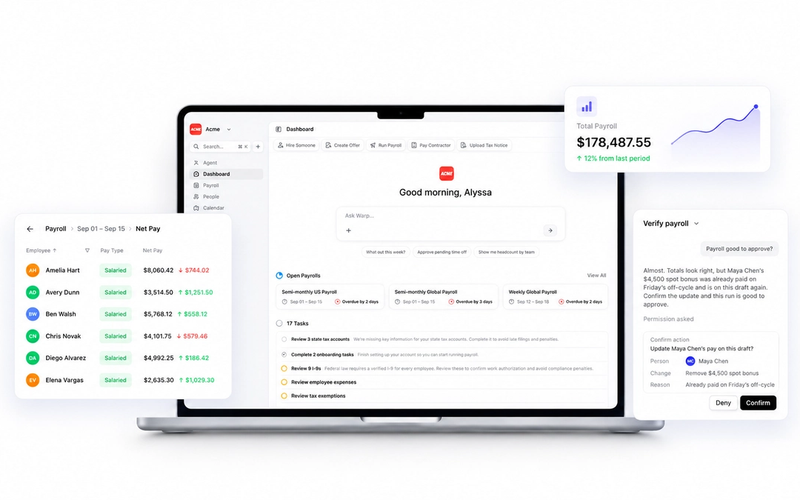
Warp is the only AI-native HR and payroll platform built for ambitious companies. Instead of clicking through clunky dashboards or .gov websites for taxes, Warp's AI agents open every state tax account, file every payroll form, and resolve every tax notice automatically.
Every company gets a dedicated Account Manager and Benefits Advisor included to guide them through payroll setup, multi-state expansion, and benefits selection, so you don't have to spend hours on hold with tax agencies or worry about compliance mistakes.
With Warp, you'll never visit a government website, negotiate with tax agencies, or pay accountants $150 per filing. Just focus on building your business while Warp handles payroll, compliance, and benefits for your team across any state or country.
Thousands of fast-growing companies trust Warp to stay compliant while they scale.
Frequently Asked Questions
What is the most common payroll mistake for startups?
Misclassifying employees as independent contractors is the most consequential, but withholding for the wrong state is the most frequent for remote-first startups. Both errors compound over time and become more expensive to fix the longer they go undetected.
What are the IRS penalties for payroll mistakes?
Penalties vary by mistake type. Late deposits: 2% to 15% of unpaid tax. Late W-2 filings: $60 to $310 per form. Late Form 941: 5% of unpaid tax per month, up to 25%. Misclassification: employer's share of FICA plus income tax withholding on all wages paid. Interest accrues on all unpaid amounts.
How much do payroll errors cost small businesses?
According to Paychex research, roughly 40% of small businesses incur an average of $845 per year in IRS penalties. Ernst & Young estimated that correcting payroll errors at a 1,000-employee company costs up to $922,131 annually. The true cost includes administrative time, employee turnover, and reputational damage.
How can startups avoid payroll mistakes?
The most effective approach is using a payroll platform that automates compliance end-to-end: automatic tax calculations, automatic state registrations, automatic filings, and automatic notice resolution. Manual processes and spreadsheet-based payroll are the primary sources of errors.
What should I do if I discover a payroll error?
Correct it immediately. For underpayments to employees, issue a supplemental payment as quickly as possible. For tax errors, file corrected returns (Form 941-X for federal quarterly returns). For state registration issues, contact the state agency or use a payroll provider that can facilitate voluntary disclosure. The longer you wait, the more penalties and interest accrue.
Can payroll software prevent all payroll mistakes?
Software eliminates calculation and timing errors but cannot prevent upstream data problems like incorrect addresses or unreported employee relocations. AI-native payroll platforms go further by flagging anomalies, auto-updating tax rates, and resolving notices proactively. No system is perfect, which is why Warp also pairs every customer with a dedicated Account Manager for human oversight.
Last updated: April 2026