You're hiring your fifth engineer. She's in Austin. Your last hire was in Denver. The one before that, Brooklyn. And the group health insurance plan you set up when your entire company was in San Francisco? Its network doesn't reach any of them.
This is the moment most startup founders discover ICHRA health insurance.
An Individual Coverage Health Reimbursement Arrangement (ICHRA) is a federal benefits program that lets employers give employees a fixed, tax-free monthly allowance to buy their own individual health insurance plan. Instead of choosing one group plan for everyone, you set a budget and each employee picks coverage that actually works where they live.
More than 20,000 US businesses now offer ICHRA or QSEHRA, according to the HRA Council's August 2026 report. ICHRA alone covered more than 500,000 lives at the start of 2026, and more than two-thirds of small businesses offering it previously offered no health coverage. Lawmakers have proposed codifying ICHRA as the CHOICE Arrangement, but the proposal has not become law, and ICHRA continues to operate under existing federal rules.
For remote-first startups hiring across state lines, ICHRA solves a problem that group plans and PEOs handle poorly: giving every employee access to quality health coverage, regardless of where they live.
Here's how it works, who it's built for, and how to decide whether it's the right move for your company.
How Does ICHRA Work?
The mechanics are straightforward.
Step 1: You set a monthly allowance. As the employer, you decide how much to reimburse each employee per month. There's no minimum or maximum. You can also set different allowance amounts for different employee classes (full-time vs. part-time, salaried vs. hourly, or by geographic location).
Step 2: Employees buy their own health insurance. Each employee shops for an individual health plan on the ACA marketplace or directly from a carrier. They pick the plan that fits their needs, their doctors, and their location.
Step 3: Employees submit proof of coverage. To participate, employees must be enrolled in an individual health insurance plan. This is a federal requirement.
Step 4: You reimburse them tax-free. The employee's premium costs (and other qualifying medical expenses, depending on how you design the plan) get reimbursed up to the monthly allowance. These reimbursements are tax-free for the employee and tax-deductible for the employer.
That's it. No carrier negotiations. No network restrictions. No annual renewal panic when your one group plan jacks up premiums by 15%.
Who Is ICHRA Built For?
ICHRA works for any employer with at least one W-2 employee. There's no company size minimum or maximum. But certain types of companies get outsized value from it.
Remote-first startups with employees in multiple states. This is the core use case. A traditional small group plan is based on your company's headquarters address. If you're incorporated in Delaware but your team is spread across California, Texas, New York, and Colorado, a single group plan will have network gaps. ICHRA eliminates this problem entirely because each employee picks a plan in their own state with local providers.
Companies under 50 employees. Businesses with fewer than 50 full-time employees aren't required by the ACA to offer health insurance. But offering benefits is critical for recruiting. ICHRA lets you offer real health benefits on a budget you control, without the overhead of administering a group plan.
Startups that want predictable costs. With a group plan, your premiums can spike at renewal based on claims experience. With ICHRA, you set the budget. Period. If you allocate $500 per employee per month, that's your cost. It doesn't change because one employee had a high-claims year.
Companies exiting a PEO. If you joined a PEO primarily for access to health benefits, ICHRA gives you an alternative that doesn't require co-employment. You keep full control of your HR and payroll while still offering competitive benefits to your team.
How Does ICHRA Compare to a Small Group Health Plan?
Small group health plans and ICHRA both accomplish the same goal (health coverage for your employees), but they work very differently.
Cost control. With a small group plan, your premiums are set by the carrier based on your team's demographics and location. You can choose richer or leaner plan designs, but you don't control the base rate. With ICHRA, you set a fixed monthly allowance. Your cost is 100% predictable.
Employee choice. A small group plan offers one, maybe two or three plan options. Every employee gets the same menu. With ICHRA, each employee can choose from every ACA-compliant plan available in their area. An employee in Brooklyn who wants a PPO with access to NYU Langone can pick that. An employee in Austin who wants a low-cost HMO can pick that. Nobody is stuck on a plan optimized for a headquarters they've never visited.
Geographic flexibility. Small group plans are tied to a specific state and often a specific region. If your team is distributed, some employees will end up with out-of-network providers or limited coverage options. ICHRA is location-agnostic. Each employee shops in their local market.
Administration. Small group plans require carrier negotiations, annual renewals, enrollment coordination, and premium reconciliation. ICHRA requires setting allowance amounts, verifying employee coverage, and processing reimbursements. Both have admin burden, but the nature of that burden is different. With the right payroll platform, ICHRA administration can be fully automated inside your existing payroll workflow.
When a small group plan still wins: If your entire team is in one metro area and you want to offer rich benefits with employer-selected plan designs, a small group plan can be simpler. It also allows you to negotiate specific carrier relationships and offer plans that may not be available on the individual market. For companies exploring the tradeoffs between different plan funding models, the comparison between level-funded, fully insured, and self-insured plans is worth reviewing alongside the ICHRA decision.
Is ICHRA Better Than a PEO for Startup Benefits?
Many startups join a Professional Employer Organization (PEO) specifically for health benefits access. The pitch is compelling: the PEO pools your employees with thousands of others to get large-group rates.
But that access comes with significant tradeoffs.
Co-employment. PEOs require a co-employment arrangement where the PEO becomes the employer of record for tax purposes. This means your employees show up on the PEO's payroll tax filings, not yours. For some startups, especially those preparing for due diligence during a fundraise, co-employment adds complexity that investors and legal teams flag.
Cost transparency. PEO administrative fees typically range from 5% to 15% of total gross payroll, on top of actual insurance premiums. These costs are often bundled into a single invoice that makes it hard to see what you're actually paying for health insurance vs. administrative overhead. With ICHRA, your cost is the allowance you set. There's no bundled markup.
Plan flexibility. PEOs offer a limited menu of health plans. You don't get to choose carriers or plan designs. If the PEO's network doesn't include a major hospital system in one of your employees' cities, there's no workaround. With ICHRA, each employee accesses the full individual market in their state.
Lock-in. Leaving a PEO means migrating payroll, benefits, compliance, and HR simultaneously. It's a major operational project. With ICHRA administered through your own payroll platform, you can change your ICHRA approach, adjust allowances, or switch administrators without disrupting your entire HR stack.
When a PEO still makes sense: If you have zero HR capacity and need someone to handle everything (payroll, compliance, benefits, workers' comp) in one bundle, a PEO can be a reasonable short-term solution. But as your company grows past 20 to 30 employees, most startups find the cost and inflexibility of PEOs outweigh the convenience. If you're considering a PEO exit, understanding your health insurance options as a startup is an important first step.
What Are the Tax Benefits of ICHRA?
ICHRA creates a tax advantage on both sides of the equation.
For employers: ICHRA reimbursements are not subject to payroll taxes (FICA, FUTA). They're also fully deductible as a business expense. This means every dollar you put into ICHRA allowances costs you less than the equivalent in salary. If you're unfamiliar with how payroll taxes work, the short version is: ICHRA reimbursements avoid the 7.65% employer-side FICA tax that applies to regular wages.
For employees: Reimbursements are excluded from taxable income. Employees don't pay federal income tax, state income tax, or FICA taxes on the amounts they receive through ICHRA. This is a meaningful benefit compared to a taxable health stipend, where the employee would owe income and payroll taxes on the full amount.
One important note on premium tax credits: Employees who are offered an "affordable" ICHRA (as defined by IRS safe harbors) are not eligible for ACA marketplace premium tax credits. The affordability threshold for 2026 is 9.96% of household income, and for 2027 it is 10.22%. This means if your ICHRA allowance is generous enough, your employees may lose access to marketplace subsidies. For most startup employees earning market-rate salaries, this is a non-issue. But it's worth understanding, especially for lower-wage workers.
What are the ICHRA Requirements for Employers?
ICHRA is a federal program with clear rules. Employer compliance requirements are real but manageable for startups.
90-day advance notice. You must provide eligible employees with a written notice at least 90 days before the ICHRA plan year begins (or upon hire for new employees). The notice explains how the ICHRA works and how it may affect premium tax credit eligibility.
Employee classes. You can offer different ICHRA allowances to different employee classes, but the classes must follow IRS-approved categories (full-time, part-time, salaried, hourly, geographic, seasonal, temporary, and others). You cannot create classes based on health status. Within each class, everyone must get the same allowance.
Coverage verification. Employees must be enrolled in individual health insurance to participate. You need a process to verify this. Most ICHRA administrators handle this automatically.
ACA affordability (for companies with 50+ employees). Applicable Large Employers (ALEs) must ensure their ICHRA offers meet ACA affordability standards. The IRS provides safe harbors to simplify this calculation.
Annual filing. ICHRA is considered a group health plan under ERISA, which means plan documents and summary plan descriptions are required. If you use an ICHRA administrator or a payroll platform with built-in benefits administration, these documents are typically generated for you.
The compliance overhead is real, but it's dramatically simpler than running a self-insured health plan or managing the co-employment obligations of a PEO.
How to Set Up ICHRA for Your Startup
Setting up ICHRA involves four decisions and one operational step.
Decision 1: Set your budget. Determine how much you'll reimburse per employee per month. Common ranges for startups are $300 to $600 per employee, but there's no cap. Consider what comparable companies in your space offer and what your employees would need to purchase reasonable coverage in their local markets.
Decision 2: Define employee classes. Decide whether you'll offer the same allowance to everyone or vary it by class. Many startups start with a single class (all full-time employees) and add geographic differentials later as they scale into higher-cost states.
Decision 3: Choose your plan year. ICHRA plan years can start on any month, not just January. Aligning with your fiscal year or a mid-year start date is fine.
Decision 4: Select your ICHRA administrator. This is where the experience varies dramatically. Standalone ICHRA vendors (Take Command, Remodel Health, PeopleKeep) handle ICHRA administration but don't touch your payroll. This means reimbursements, deductions, and tax reporting happen in separate systems that you have to reconcile manually.
The alternative is a payroll platform with ICHRA baked in. When your ICHRA administration lives inside the same system as payroll, benefits enrollment syncs to carriers automatically, reimbursements calculate each pay run, COBRA notices go out on termination, and qualifying life events trigger enrollment windows without manual intervention. You don't manage a separate vendor, a separate login, or a separate reconciliation process.
Operational step: Notify employees and support enrollment. Send the required 90-day notice, provide resources to help employees shop for individual plans, and set up reimbursement processing. If your platform includes concierge support or a dedicated Benefits Advisor, this step gets significantly easier for both you and your employees.
Warp Handles ICHRA So You Don't Have To
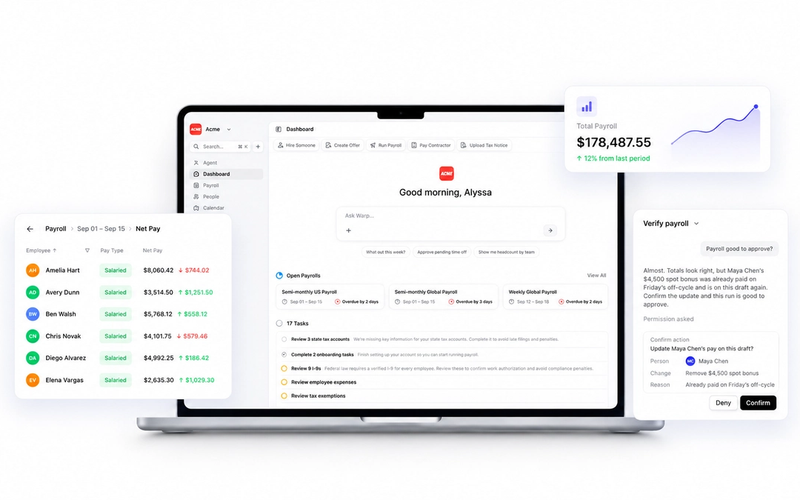
Warp is the only AI-native HR and payroll platform built for startups. Instead of clicking through clunky dashboards or .gov websites for taxes, Warp's AI agents open every state tax account, file every payroll form, and resolve every tax notice automatically.
Warp is also a licensed insurance brokerage with direct carrier relationships across 30+ carriers. Whether you choose ICHRA, a small group plan, or a level-funded option, enrollment, deductions, carrier sync, and premium reconciliation all happen automatically inside the same platform where you run payroll.
Every Warp customer gets a Benefits Advisor, who can help evaluate whether ICHRA is the right model for your team, shop carrier options across the full market, and guide your employees through enrollment. No separate broker. No third-party portal. No manual reconciliation.
With Warp, you never visit a government website, negotiate with tax agencies, or pay accountants per filing. Just focus on building your business while Warp handles payroll, compliance, and benefits for your team across any state.
FAQ
What is ICHRA health insurance?
ICHRA (Individual Coverage Health Reimbursement Arrangement) is a federal program that lets employers reimburse employees tax-free for individual health insurance premiums and qualifying medical expenses. Instead of offering a one-size-fits-all group plan, the employer sets a monthly allowance and each employee picks their own plan.
Is ICHRA cheaper than group health insurance?
It depends on your team's size, age, and location. For startups with young, healthy, distributed teams, ICHRA is often cheaper because employees can access competitive individual market rates in their local area. The key cost advantage is predictability: you set a fixed monthly allowance and it doesn't spike at renewal.
Can startups of any size offer ICHRA?
Yes. Any employer with at least one W-2 employee can offer ICHRA. There is no minimum or maximum company size. This makes it especially attractive for early-stage startups that want to offer health benefits without the overhead of a group plan.
Does ICHRA affect employees' eligibility for ACA marketplace subsidies?
It can. If your ICHRA offer is considered "affordable" under IRS safe harbors (the employee's remaining cost for a silver plan is less than 9.96% of household income in 2026), the employee cannot receive premium tax credits on the marketplace. They can decline the ICHRA and keep their subsidies, but they can't have both.
Can I offer ICHRA and a group plan at the same time?
You cannot offer both to the same class of employees. However, you can offer a group plan to one employee class (for example, headquarters-based employees) and ICHRA to another class (remote employees in other states). The IRS allows this as long as the classes follow approved categories.
How is ICHRA different from a health stipend?
A health stipend is a taxable cash payment. Both the employer and employee pay payroll and income taxes on it. ICHRA reimbursements are tax-free for the employee and tax-deductible for the employer, making ICHRA significantly more tax-efficient.