
Most founders think contractor payroll is simple: pay the invoice, collect a W-9, send a 1099 at year-end. That works fine when you have one designer on a monthly retainer. It stops working when you have a fractional CFO in Texas, a freelance marketer in New York, an engineer on contract in Colorado, and a growth consultant you paid $1,800 for a project last quarter.
Contractor payroll best practices aren't complicated in theory. They're complicated at scale, under time pressure, and when the rules keep changing. (The 1099-NEC filing threshold just jumped from $600 to $2,000 for 2026, for instance, and most companies haven't updated their processes.) This guide covers what actually matters, in the order you'll encounter it as a startup that's growing.
TL;DR:
- Classify workers before you pay them. The IRS doesn't care what your contract says.
- Collect a W-9 before any payment, even if you think you'll stay under the filing threshold.
- The 2026 1099-NEC threshold is $2,000. You still need to track all payments.
- File 1099-NEC by January 31. Late filing starts at $60 per form.
- Multi-state contractors create state tax obligations you may not know about.
- At 10+ contractors, manual processes break down. Automation pays for itself.
Why Contractor Payroll Is Different from Employee Payroll
When you pay a W-2 employee, you withhold federal and state income taxes, Social Security, and Medicare. You match their FICA contributions. You file quarterly 941s, annual W-2s, and stay on top of state-specific requirements.
Contractors are different. You pay the gross invoice amount, withhold nothing, and your tax reporting obligation is limited to filing a 1099-NEC if you pay them $2,000 or more in a calendar year (for 2026 and beyond). They handle their own self-employment taxes, estimated quarterly payments, and deductions.
That simplicity is real. But it creates two risks that catch founders off guard: misclassification and missed deadlines. Both are expensive.
1. Classify Before You Pay
The single most important thing you can do in contractor payroll is get classification right before any work begins. The IRS uses a three-factor test to determine whether a worker is truly a contractor or a misclassified employee:
Behavioral control: Does your company control how the worker does the job, not just the outcome? If you're setting their hours, requiring them to use your tools, or directing their daily tasks, that looks like employment.
Financial control: Does the worker have the opportunity for profit or loss? Do they work for other clients? Do they set their own rates? Contractors who work exclusively for one company, on an indefinite basis, at a company-set rate look more like employees.
Type of relationship: Is the relationship permanent? Is the worker doing work that's core to your business? Do they receive any benefits? Long-term, core-function relationships push toward employee classification.
The IRS doesn't weight these factors equally, and context matters. But the cleaner your contractor relationships look across all three dimensions, the safer you are.
Misclassification penalties in 2026 include 1.5% of wages for failure to withhold income tax, 40% of unpaid FICA taxes (the employee's share), plus 100% of the employer's FICA contribution. For intentional misclassification, criminal penalties can reach $1,000 per worker. If you have 10 misclassified workers in Massachusetts, state-level penalties alone can run $100,000 to $250,000.
If you're unsure whether your contractor relationships pass the test, the IRS Voluntary Classification Settlement Program (VCSP) lets you proactively reclassify workers and cap your exposure at 10% of the most recent year's tax liability. That's far cheaper than getting audited.
For a detailed comparison of when to hire contractors versus employees and how to make the classification call, see 1099 vs W-2: Which Worker Type Is Best for Your Startup in 2026?
2. Collect a W-9 Before the First Payment
This is the step most companies skip until they're scrambling in December.
Form W-9 captures a contractor's legal name, business name, TIN (tax ID number), and classification. You need it to file a 1099-NEC accurately. The problem: tracking down a W-9 from someone you paid eight months ago, who has since moved on, is genuinely painful. Some contractors ghost you entirely. Others send it with the wrong TIN.
The fix is simple: make W-9 collection a condition of your first payment. No W-9, no wire transfer.
Some founders think they can skip this step if a contractor will earn less than the $2,000 filing threshold for 2026. That logic fails for two reasons. First, you can't always predict how much you'll pay someone over the course of a year. A one-time $1,500 project can turn into ongoing work. Second, if you don't have a W-9 on file and payments later exceed the threshold, you're required to apply 24% backup withholding. That creates friction with your contractor and additional IRS filings.
For the full breakdown of what changed in 2026 and what it means for your 1099 process, see 1099 Changes for 2026: What Startups Need to Know Now.
3. Use a Written Contract for Every Engagement
A contractor agreement does more than document the relationship. It establishes the contractor's independent status in a way that holds up if you're ever audited.
At a minimum, your contractor agreements should cover: scope of work and deliverables, payment terms and schedule, intellectual property ownership, non-disclosure provisions, the contractor's status as an independent business (not an employee), and how either party can terminate the engagement.
The IP clause matters more than founders often realize. Work product created by a contractor doesn't automatically belong to your company the way it does with employees. You need a written assignment, or you may not own what you paid for.
Warp offers a free Contractor Agreement Generator that covers the standard provisions and can be tailored to your state.
4. Build a Consistent Payment Process
Inconsistent payment practices create two problems: cash flow complaints from contractors and record-keeping gaps that haunt you at tax time.
Most contractors are paid on a milestone, monthly, or net-30 basis. Whatever terms you set, make sure they're in the contract and honored consistently. Late payment erodes contractor relationships and often violates the terms you agreed to.
Payment method matters for record-keeping. ACH transfers and checks create a clear paper trail. Cash and personal Venmo payments do not. If you're ever audited, "I sent it to their personal PayPal" is not documentation.
For contractors you pay via third-party platforms (PayPal, Stripe, Gusto contractor payments), the 1099-K rules are separate from 1099-NEC. As of 2026, 1099-K applies to payment platform transactions exceeding $20,000 AND 200 transactions, restored from the prior planned reduction to $600. Make sure you're not double-counting by issuing a 1099-NEC for payments that will also appear on a contractor's 1099-K.
5. Track Every Payment in Real Time
The 1099-NEC threshold is $2,000 for 2026, but you should be tracking every contractor payment regardless of amount. Here's why:
Totals add up faster than you expect, especially with ongoing contractors. The threshold only tells you when you're required to file a 1099. It doesn't change your obligation to keep accurate payment records for at least four years (the IRS can audit three years back, or six if there's significant underreporting).
Your payment records should include the contractor's name, TIN, payment date, payment amount, and the form of payment. For project-based work, keep the invoice as well. This protects you during audits and simplifies 1099 preparation at year-end.
The 2026 Payroll Tax Deadlines guide has the full calendar of filing deadlines for contractors and employees.
6. File 1099-NEC Forms by January 31
1099-NEC forms are due to both the contractor and the IRS by January 31 of the year following payment. For payments made in 2026, that means January 31, 2027.
Late filing penalties start at $60 per form for filings within 30 days of the deadline, and increase to $310 per form for intentional failure to file. If you have 20 contractors, that's up to $6,200 in penalties before any other consequences.
You'll file 1099s electronically through the IRS FIRE system or through a payroll platform that handles the submission on your behalf. Electronic filing is required if you're submitting 10 or more forms.
State 1099 requirements vary. Some states require separate filings; others participate in the IRS Combined Federal/State Filing program, which means your federal filing also covers the state. Check your states before assuming federal filing is enough.
What Changes When Contractors Work Across Multiple States
Remote contractors create a state compliance wrinkle most guides don't address. When a contractor performs work in a state where your company has nexus, you may have state tax registration and reporting obligations beyond the federal 1099.
California, for example, requires businesses to report contractor payments to the state EDD in addition to the IRS. New York, Massachusetts, and several other states have their own rules. And if you're expanding into new states for the first time, adding a contractor in that state can be the trigger that creates payroll tax nexus.
This is less about the contractor's taxes (they handle their own) and more about your company's compliance obligations as the payor. The Multi-State Payroll Compliance Guide for Startups covers nexus triggers and what to do when a contractor puts you in a new state.
International Contractors: A Separate Compliance Track
Paying contractors outside the US involves a different set of rules entirely. You don't file 1099s for international contractors, but you do need to verify their status to avoid US withholding requirements.
For foreign contractors, the equivalent of a W-9 is Form W-8BEN (for individuals) or W-8BEN-E (for entities). These certify that the contractor is not a US person and allow you to pay without withholding. Without a valid W-8, you're required to withhold 30% and remit it to the IRS.
Additionally, some countries have tax treaty provisions that reduce or eliminate withholding. Managing this correctly requires knowing the contractor's country, reviewing the applicable treaty, and keeping the W-8 on file.
Warp's Global Payroll and Contractor platform handles international contractor onboarding and payments. Scaling fast? Warp’s HRIS platform can automate both contractor & employee management.
What Breaks at Scale
Early on, a spreadsheet and a folder of W-9s works fine. At 10+ contractors, that system starts generating real risk:
- W-9s get lost or expire (contractors can submit new ones if their information changes)
- Payment totals across multiple tools are hard to reconcile at year-end
- January 31 arrives and you're hunting down TINs for five people you haven't talked to in six months
- A contractor in a new state creates a compliance obligation you don't realize until you file
- You miss a threshold change and file 1099s based on the old $600 number
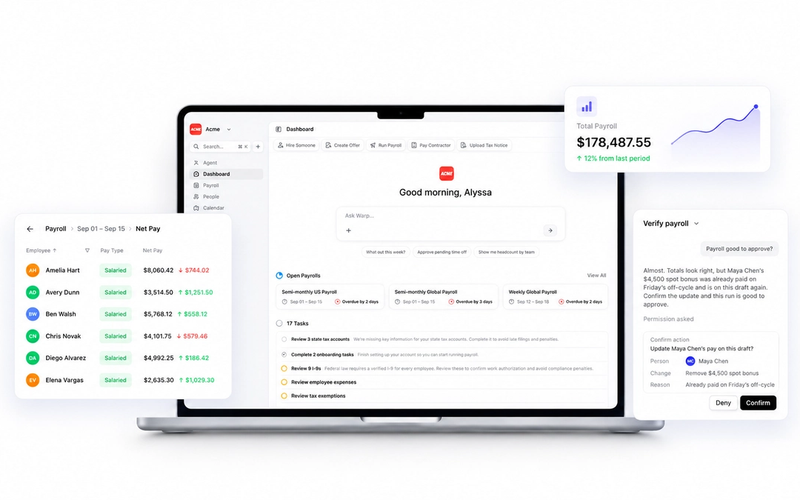
The operational answer is a payroll platform that handles contractor payments end-to-end. When you pay a contractor through Warp, the W-9 is collected automatically before the first payment, payment totals are tracked in real time, 1099-NEC forms are generated and filed automatically by January 31 (including the new 2026 thresholds), and multi-state requirements are flagged without you having to monitor them.
Warp is the only AI-native HR and Payroll platform built for ambitious companies. Instead of clicking through government websites or managing spreadsheets of contractor data, Warp's AI agents handle the compliance work automatically so your team can focus on building.
If you're setting up contractor payroll from scratch alongside your first employee hires, the Complete Guide to Setting Up Payroll for Your Startup walks through both tracks together.
Frequently Asked Questions
What is the 1099-NEC filing threshold for 2026?
For payments made after December 31, 2025, the 1099-NEC filing threshold increases from $600 to $2,000 under the One Big Beautiful Bill Act. You only need to issue a 1099-NEC to contractors you pay $2,000 or more in the calendar year. However, you should still track all contractor payments regardless of amount.
Do I need to withhold taxes from contractor payments?
No. Independent contractors are responsible for their own taxes, including self-employment tax (15.3% on net earnings). You pay the gross invoice amount and do not withhold federal income tax or FICA. If a contractor hasn't provided a valid W-9, you are required to apply 24% backup withholding.
What happens if I pay a contractor through PayPal or Stripe?
Third-party payment platforms file 1099-K forms for transactions above $20,000 AND 200 transactions (as of 2026). If a contractor's payments through a platform meet that threshold, the platform files the 1099-K. You generally should not also issue a 1099-NEC for the same payments to avoid double-reporting. If you pay contractors directly via ACH or check, the 1099-NEC rules apply normally.
Can a contractor work exclusively for my company?
Yes, but exclusivity increases misclassification risk. A contractor who works only for your company, on an indefinite basis, doing core business functions, looks more like an employee under the IRS behavioral and financial control tests. If you want a contractor to be exclusive, consult an employment attorney first and consider whether a full-time or part-time employee relationship makes more sense.
When is the 1099-NEC due?
January 31 of the year following payment. For 2026 payments, that's January 31, 2027. Forms must be delivered to both the contractor and the IRS by that date. Electronic filing is required for 10 or more forms.
What records do I need to keep for contractor payments?
The IRS requires you to retain payroll and contractor payment records for at least four years. Keep W-9s, invoices, payment confirmations, contracts, and any communication establishing the scope of work. In an audit, a complete paper trail is your best protection.
Last updated: July 2026. This article provides general information about contractor payroll compliance. For state-specific requirements or complex classification questions, consult a qualified employment attorney or tax professional.