
Rippling is a powerful platform. But it was built for enterprises with dedicated HR and IT teams. If you're a 15-person startup, you don't need a modular system with 30+ products to configure, a sales process that takes weeks, and a pricing structure that requires a phone call to understand.
Most startup founders and small business owners just want payroll that works, compliance that's handled, and support that actually responds. Here are three alternatives that deliver exactly that, without the enterprise overhead.
What we cover:
- Why startups & SMB’s leave Rippling (and when it makes sense)
- Side-by-side comparison of pricing, support, and compliance coverage
- Which platforms automate state tax registration vs. make you do it yourself
- PEO vs. standalone payroll: when co-employment makes sense
- How to evaluate total cost of ownership across providers
- Contract flexibility and switching costs
Why Startups & Small Businesses Look for Rippling Alternatives
Rippling was built to scale to thousands of employees. Early-stage teams inherit complexity designed for companies ten times their size.
Common reasons startups switch away from Rippling:
Setup takes weeks, not minutes. Implementation can run 3-8 weeks for full deployment.
Support requires 150+ employees. Phone support is only available for larger clients. Smaller companies get chat only.
Annual contracts lock you in. Unlike month-to-month alternatives, Rippling often requires annual commitments.
Compliance is still your job. You get tools, but opening state tax accounts and responding to notices? That's on you.
If your team is under 200 employees and you don't have a full-time HR person, there's a good chance you're paying for features you'll never use.
The 3 Best Rippling Alternatives for Startups & SMBs
Warp: Best Payroll for Multi-State Compliance Automation
Best for: Startups with remote teams across multiple states who want compliance taken off their plate.
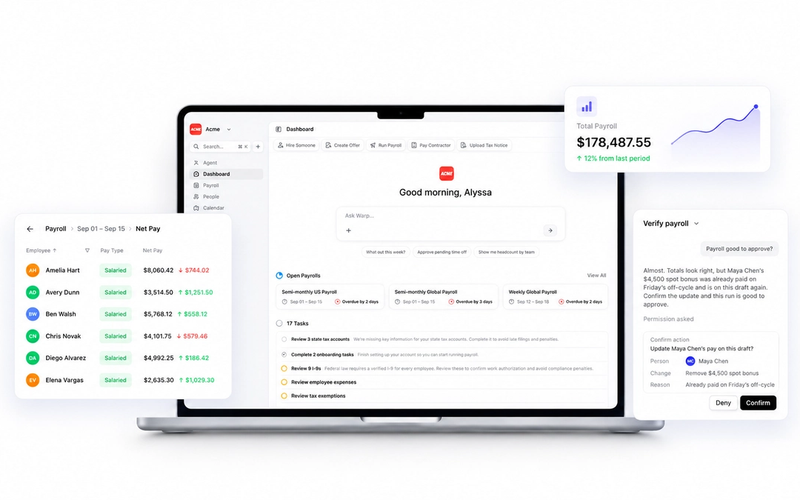
Warp is the only AI-native HR & Payroll platform built for startups. Instead of clicking through clunky dashboards or .gov websites for taxes, Warp's AI agents open every state tax account, file every payroll form, and resolve every tax notice automatically.
Every company gets a dedicated Account Manager and Benefits Advisor included to guide them through payroll setup, multi-state expansion, and benefits selection. You don't have to spend hours on hold with tax agencies or worry about compliance mistakes. Plus, we help make the migration process easy.
With Warp, you'll never visit a government website, negotiate with tax agencies, or pay accountants $150 per filing. Just focus on building your business while Warp handles payroll, compliance, and benefits for your team across any state or country.
Designed for 1 to 1000+ employees. Companies 10x on Warp.
What makes Warp different:
Compliance is done for you. Warp automatically opens tax accounts when you hire in new states, files quarterly returns, and resolves tax notices before they reach your inbox. No more .gov tabs.
Built for distributed teams. 50% of new startups have employees across multiple states from day one. Warp handles all 50.
Fast human support. 5-minute median response time from a NYC-based team. No chatbots, no offshore queues.
Setup in minutes. Most migrations complete in under 10 minutes. Warp handles the data transfer.
IT management built in.Warp Fabric includes native device management (MDM), Google Workspace provisioning, and Okta provisioning. When you hire someone, their email, apps, and device security policies are set up automatically. When someone leaves, everything is revoked in one action. No separate IT tools to buy and maintain.
| Plan | Platform Fee | Per Employee |
|---|---|---|
| Pro | $89/month | $35 |
| Premium | $129/month | $50 |
Example: A 10-person team on the Pro plan pays $439/month ($89 + 10 × $35)
"We switched from Rippling to Warp and scaled from 10 to 100 employees. The difference has been striking. Warp delivered on rapid growth without breaking down every week." — Sobhan Nejad, CEO, Bland AI
Where Warp excels over Rippling: If your biggest pain is multi-state compliance chaos (registration headaches, tax notices you don't understand, and hours spent on hold with state agencies) Warp eliminates all of it. You get compliance as a service, not compliance as a DIY project. And with Warp Fabric, you now get the IT management capabilities that used to be Rippling's biggest differentiator, like device management, app provisioning, and automated onboarding/offboarding across every system, built natively into the same platform that runs your payroll. No separate modules. No additional sales calls.
Gusto: For Budget-Conscious Single-State Teams
Best for: Small businesses under 25 employees in one or two states.
Gusto is the most popular payroll provider among small businesses, serving over 400,000 SMBs. It's straightforward, affordable, and does the basics well.
What Gusto does well:
Simple interface. Clean, intuitive design that non-HR people can navigate.
Affordable entry point. Starting at $49/month + $6/employee makes it accessible for early-stage companies.
Strong ecosystem. Integrates with most accounting tools.
What to watch out for:
Multi-state costs more. Single-state payroll is on the Simple plan ($49 + $6), but multi-state requires Plus ($80 + $12).
Compliance is still catching up. Gusto acquired Mosey in April 2026 to bring state compliance in-house, but the integration is brand new. Mosey's value was built on a services team that knew how to navigate state agencies for a focused customer base. Inside Gusto's 400,000+ customer ecosystem, that same team and technology now has to serve a much larger audience, and compliance has to compete for roadmap priority against payroll, benefits, and everything else Gusto ships. It's too early to know how well this works in practice. And critically, Gusto's standard terms still don't include financial liability for compliance errors. If a filing gets missed or a registration lapses, the penalty lands on you, not on Gusto. That's where expensive compliance mistakes happen.
Support wait times. 285 G2 reviewers mention long waits for customer support.
Scaling ceiling. Most companies outgrow Gusto around 50-75 employees.
| Plan | Pricing | Per Employee | Multi State? |
|---|---|---|---|
| Simple | $49/month | $6 | No |
| Plus | $80/month | $12 | Yes |
| Premium | ~$180/month | ~$22 | Yes |
Example: A 10-person team on the Plus plan pays $200/month ($80 + 10 × $12)
Gusto vs. Warp: Gusto is cheaper upfront, but if you're hiring across multiple states, Warp's compliance automation saves significant time and prevents costly mistakes. Gusto gives you tools. Warp does the work.
Justworks: For Outsourcing HR Entirely
Best for: Teams that want a PEO to handle everything, including benefits administration
Justworks operates as a Professional Employer Organization (PEO), which means they become a co-employer and handle HR administration on your behalf. This is a different model than standard payroll software.
What Justworks does well:
Enterprise benefits for small teams. Even a 5-person startup can access health insurance rates typically reserved for large companies.
Transparent PEO pricing. Unlike most PEOs, Justworks publishes their pricing openly.
Full HR outsourcing. Workers' comp, compliance, and benefits administration are all included.
What to consider:
Higher per-employee costs. PEO Basic runs $79/employee, PEO Plus is $109/employee.
Co-employment model. Your employees are technically employed by Justworks, which some founders find uncomfortable.
Less control. The standardized approach may not fit specialized needs.
Price volatility. Some users report benefits costs doubling after the first year.
Benefits: Some users report benefits costs doubling after the first year. Understanding how health plan funding models work can help you anticipate these increases before they hit.
| Plan | Price | What's Included |
|---|---|---|
| Payroll Only | $50/month + $8/employee | Standalone payroll, no PEO |
| PEO Basic | $79/employee/month | Full PEO without health admin |
| PEO Plus | $109/employee/month | Full PEO + health, HSA/FSA, COBRA |
Example: A 10-person team on PEO Basic pays $790/month (10 × $79)
Justworks vs. Warp: Justworks makes sense if you want to fully outsource HR and don't mind the co-employment structure. Warp is better if you want to maintain control while still getting compliance handled automatically, without the PEO overhead or unpredictable benefits pricing.
Quick Comparison: Rippling vs. Warp vs. Gusto vs. Justworks
| Factor | Rippling | Warp | Gusto | Justworks |
|---|---|---|---|---|
| 10 - Person Monthly Cost | ~$245-$325 | $439 (Pro) | $200 (Plus) | $790 (PEO Basic) |
| Multi-State Compliance | Tools provided | Fully automated | Plus plan required | Handled via PEO |
| State Tax Registration | Self-service | Automatic | Third party | Automatic |
| Support Model | Chat (phone at 150+ EE) | Chat/email - always human | Chat/email | 24/7 phone |
| Contract Terms | Annual | Annual | Month to month | Month to month |
| Best for | 200+ EE with HR team | Multi state startups | Single state SMBs | Full HR outsourcing |
How to Choose the Right Rippling Alternative
Choose Warp if:
- You're a startup or SMB hiring across multiple states
- Multi-state compliance is eating up your time
- You want compliance done for you, not tools to do it yourself
- You value fast, human support over chatbots
- You're growing quickly and need a platform that scales without drama
- You want IT management (device security, app provisioning, automated onboarding/offboarding) without buying separate tools
Choose Gusto if:
- You're a small team (under 25) mostly in one state
- Budget is your primary concern
- You have straightforward payroll needs
- You already have a benefits broker relationship
Choose Justworks if:
- You want to fully outsource HR administration
- Access to enterprise-quality benefits is critical for recruiting
- You don't have dedicated HR staff and don't want to build that function
- You're comfortable with the co-employment model
Before you decide, if you need help understanding what healthcare plans you need for your growing startup, check out our guide on how health plan funding models work.
Frequently Asked Questions
Is Warp cheaper than Rippling?
For most startups and SMBs under 50 employees, Warp's total cost is comparable to or lower than Rippling once you factor in the modules needed for equivalent functionality. More importantly, Warp handles compliance work that would otherwise require your time or additional staff.
Can I switch from Rippling to Warp mid-year?
Yes. Warp offers contract buyouts up to $1,000 for startups & SMBs stuck in Rippling contracts, and handles the full migration for you.
Does Gusto handle multi-state payroll?
Yes, but only on the Plus plan ($80 + $12/employee). The Simple plan is single-state only. And even on Plus, you'll still receive tax notices that require your attention. Gusto doesn't respond to agencies on your behalf.
What's the difference between a PEO and regular payroll?
With regular payroll (Warp, Gusto, Rippling), your company remains the employer of record. With a PEO like Justworks, employees are technically co-employed by Justworks, which handles HR administration but also means less direct control.
Why do startups leave Rippling?
The most common reasons are: complexity that requires dedicated HR staff to manage, annual contracts that reduce flexibility, self-service compliance that still creates work, and support that's hard to reach for smaller teams. Rippling's IT and device management features used to be a reason to stay despite these issues. With Warp Fabric now offering native MDM, Google Workspace provisioning, and Okta provisioning, that tradeoff no longer applies.
Bottom Line
Rippling built an impressive platform for enterprises. But if you're a startup or SMB without a full HR team, you're paying for complexity you don't need.
For multi-state startups & SMBs that want compliance handled automatically, Warp is purpose-built for your situation. For budget-conscious teams in one state, Gusto works. For those who want to fully outsource HR, Justworks is an option, though you'll pay premium prices and give up some control. If you want to learn more about migrating to a different payroll provider, see our full migration guide here.
Join the thousands of fast-growing companies who trust Warp to stay compliant while they scale.
Ready to see how Warp handles payroll and compliance differently? See a demo and try the platform today.